
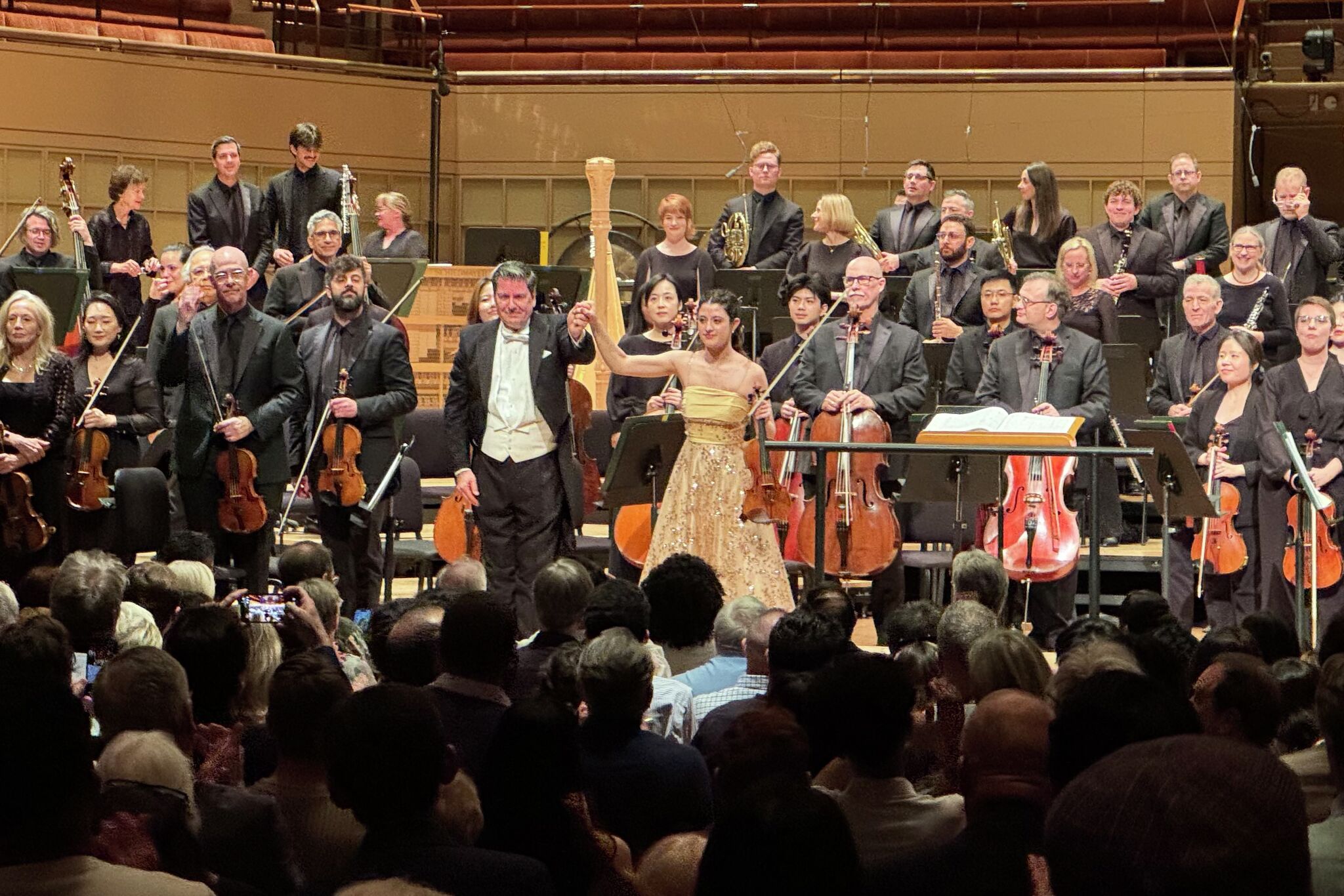

Violinist María Dueñas and guest conductor Sebastian Weigle acknowledge applause after a performance with the Dallas Symphony Orchestra at the Meyerson Symphony Center on May 29, 2026.
From the early 19th century to the later 1930s and World War II, Prague, Vienna and Budapest represented a fertile crescent of scientists, intellectuals, artists and musicians. Along with Jews and Roma, though, progressives were persecuted by Hitler — and in Russia by Stalin. Many who could escape landed in the United States, with dramatic impact on American science, scholarship and the arts.
Vienna and Prague — and Hollywood — were represented in Friday night’s Dallas Symphony Orchestra concert at the Meyerson Symphony Center.
Led by German guest conductor Sebastian Weigle, the final program of the DSO’s classical season began with two works by Erich Wolfgang Korngold. A musical prodigy who lived from 1897 to 1957, Korngold created early sensations in his adopted hometown of Vienna and elsewhere in Europe.
Article continues below this ad
His lush, arguably passé musical language also proved well suited to swashbuckling, romantic movies, and in the 1930s he began arranging and composing Hollywood scores. With Hitler’s annexation of Austria, the Jewish composer settled in Hollywood, subsequently becoming an American citizen.
So prolifically did he turn out film music that his “serious” music credentials — and compositions — were largely forgotten. But he returned to concert music after the war, in 1945 completing the Violin Concerto he’d begun as early as 1937, and, in 1952, a full-fledged symphony.
Opening the concert was Korngold’s late Straussiana, an agreeable bit of fluff subtly tarting up tunes from the Viennese “Waltz King” Johann Strauss, Jr. Weigle and the orchestra gave a performance oozing charm and joie de vivre.
The Violin Concerto has become one of the best-loved in the repertory. Never mind that it borrows from Korngold’s earlier film scores; Bach and Handel extensively recycled their own earlier music. Korngold’s tunes are great, lushly harmonized and orchestrated, and the finale is a virtuoso showpiece.
Article continues below this ad
The young Spanish violinist María Dueñas supplied dazzling technique, especially at quite a brisk tempo in the finale, but also sweetly soaring pianissimos. But bulges in phrases lacked the subtlety and suave legato I remember from Hilary Hahn’s performances on the DSO’s 2013 European tour. Weigle was a careful collaborator, sensitively balancing the plush, colorful orchestration with the solo violin.
For an encore, Dueñas performed her own luscious arrangement of “Granada,” a song by Mexican composer Agustín Lara, with DSO principal harpist Emily Levin.
Prague was represented by that quintessentially Czech composer Antonín Dvořák. Of Dvořák’s’s nine symphonies, the Seventh, from 1885, has been called the most Brahmsian in its substantive seriousness. Indeed, it was inspired by Brahms’ recent Third Symphony, but also, as Dvořák wrote in a manuscript note, “from the sad years” — the recent death of his beloved mother and the mental disintegration of his Czech musical forebear Bedřich Smetana.
Less immediately tuneful than Dvořák’s beloved Ninth Symphony (From the New World), the Seventh is still replete with melodic and developmental imagination, including shifting accents in the dancing scherzo.
Weigle led a boldly characterized performance, with urgency balanced by moldings and yieldings at just the right moments.
Article continues below this ad
Details
Repeats at 7:30 p.m. Saturday at the Meyerson Symphony Center, 2301 Flora St., Dallas. $33 to $255. 214-849-4376, dallassymphony.org.
Credit: Source link