
In Bob Rafelson’s 1987 thriller Black Widow, Debra Winger’s Alex, a government agent obsessed with the possibility that several recent deaths are connected, tricks her slimy boss (Terry O’Quinn) by explaining that her own history of abuse allows her to understand the mindset of a suspected serial killer (Theresa Russell). When she senses he’s convinced by her theory, she points and laughs.
“Don’t you know? No one knows why anyone does anything,” she says.
Furious
The Bottom Line
Comes together gratifyingly in its second half.
Airdate: Monday, July 27 (Hulu)
Cast: Emmy Rossum, Lola Petticrew, Scoot McNairy, Quincy Tyler Bernstine
Creator: Elizabeth Meriwether
It’s safe to assume this line played at least some role in Elizabeth Meriwether’s approach to making Black Widow — the 45th highest grosser of 1987 — into one of the odder pieces of IP mined in the streaming era. If Black Widow meant to shock viewers with the notion that sometimes a woman might be capable of committing murder simply for money, Hulu‘s Furious is all about a more nuanced sense of motivation for female rage.
If anything, the actions in Furious seem over-motivated — at worst to the point of coincidence and contrivance, but at best making the persuasive case that if society and its most trusted institutions are incentivized to ignore the exploitation of girls and young women, then taking extreme steps is defensible, or at least uncomfortably comprehensible.
This makes Furious one of the rare film-to-television transplants with enough plot and more than enough thematic concern to justify going from 100 minutes to eight hours.
The series unsteadily walks the line of gawking sensationalism in its first half but, especially in its home stretch, becomes a complex, well-acted and even funny thriller about the ongoing toll of trauma, the psychic cost of revenge and the danger of a life driven by anger.
Despite the “Inspired by…” credit and the presence of screenwriter Ronald Bass as executive producer, Meriwether’s (The Dropout, Dying for Sex) adaptation leaves Black Widow behind almost immediately.
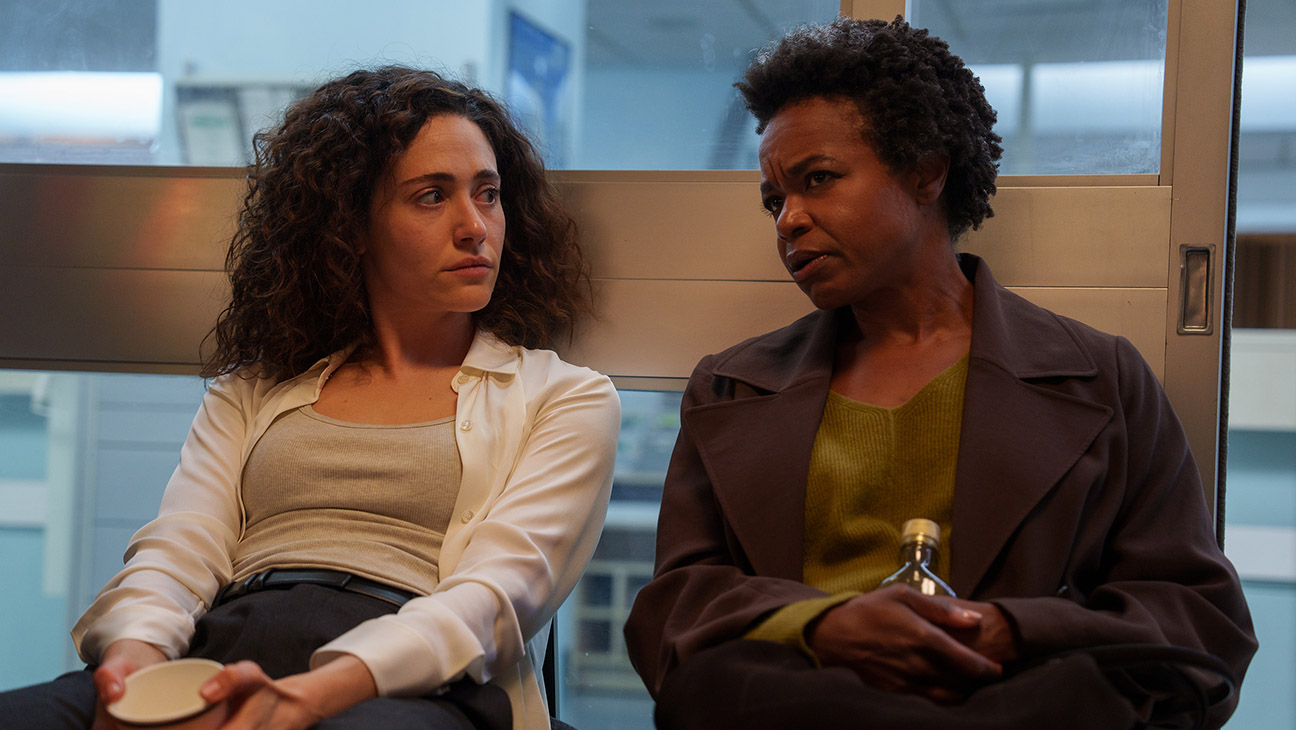
Emmy Rossum plays Alice, a probational agent transitioning to the FBI after years as an NYPD homicide detective, a job she left in part to escape an abusive cop boyfriend (Jake Lacy’s Marshall).
Alice wants to work in the FBI’s sex crimes department, but until she gets a formal assignment she’s stuck answering calls from crackpots. Then her former NYPD partner (Scoot McNairy) calls her in to consult on a case that appears to involve the overdose death of the son of one of New York City’s richest men. Alice quickly becomes certain that it’s one of several recent deaths that are linked, and she’s able to get FBI jurisdiction under the oversight of Nora (Quincy Tyler Bernstine), an alcoholic hardened by years of exposure to crimes against children.
Now operating out of a gloomy basement office of outcasts — shades of Dept. Q or several seasons of The Wire — Alice quickly realizes that her suspicions are correct. We’re immediately introduced to Lola Petticrew as a woman first seen in a cat mask and later explained to be named Catherine. She’s calculating and vicious, preying on men who prey on girls. Alice isn’t wrong to want to bring Catherine down, but Alice’s own past and a lot of paralleled editing suggest that the two women and their agendas aren’t actually that different.
What follows is an extended game of cat and mouse in which both adversaries might be mice, but the mice have fangs.
If shows like MTV’s Sweet/Vicious and films like Promising Young Woman caught the zeitgeist of the #MeToo movement — the thirst for a justice long overdue — Furious joins Hulu stablemate The Testaments in catching the zeitgeist of the Epstein Files era: fury at the way justice is willfully denied by the very people entrusted with our protection.
I’m not sure if Brian Kirk was exactly the right or exactly the wrong person to direct the first couple of Furious episodes. The opening installments look and feel like a very familiar serial killer show, a genre in which Kirk (Dexter, Luther) is well-versed. From its treatment of violence to the nudity that Catherine deploys as a weapon as potent as a fentanyl-filled syringe, those early episodes are often distractingly lurid and voyeuristic.
One could argue that this is a bit of a bait and switch — an intentionally off-putting application of the male gaze (so characteristic of a genre in which the antagonists and protagonists are usually men and the victims frequently women) to a story in which most of the principal characters are women, with the men reduced to simplistically villainous and sympathetic secondary roles. Still, “I see what you’re doing” isn’t necessarily the same as “I appreciate what you’re doing.”
The fourth episode, directed by Karena Evans, marks the point at which I started to appreciate the friction that Furious is creating between the way audiences expect this story to be told and the way Meriwether and company want to tell it.
This is a messy and emotionally ragged story focused on people who have earned that melodrama, but it helps when Furious is able to approach the story from the fringes.
It isn’t that stars Rossum and Petticrew are bad. Both are excellent as women emerging from a pupa of damage and tentatively fluttering their wings. Petticrew, who is 30 but played a teen convincingly as recently as 2024’s Say Nothing, portrays Catherine as the sociopathic consequence of a culture prone to sexualizing the young. Catherine enjoys doing what she’s doing because she was never taught to enjoy normal things. Rossum, by contrast, conjures a woman unable to enjoy anything; her dead-eyed smiles, meant (unsuccessfully) to put others at ease, are haunting.
But these are characters we’ve seen before, simply rendered through a different prism.
For me, Furious is most interesting when it finds figures who would normally slip through the small-screen cracks, starting with Nora, whom Power and Broadway veteran Bernstine turns into a master class in eccentricity. The character is introduced leaving the heavily secure FBI repository of child pornography — the gloomy inner sanctum of the gloomy basement. She’s seen too much, and she’s seen it too often, and she no longer cares if anybody thinks she’s “normal.” Bernstine’s every line reading is off-kilter and off-putting, making her worrisome one moment, badass the next, and frequently hilarious.
The more Bernstine the show gives us, the better it is. The same is true with Ramy veteran Steve Way, as a character with muscular dystrophy whose interactions with Catherine are very different from her interactions with other men. Funny and sad, it’s one of the most nuanced depictions of disability since, well, Way’s work in Ramy. It would be reasonable for both performances to be in awards conversations next year at this time.
Hulu is calling Furious a “drama series,” but I found the eighth episode to be satisfying and fully conclusive. There’s no narrative need for more adventures of Alice and Catherine, and the difficult things the show does well — most notably unfurling a mystery in which the whodunit and even the whydunit are rarely meant to be surprising — aren’t really reproducible. It’s a tough watch, but a gratifying corrective to the Criminal Minds and Law & Orders of the world.
Credit: Source link