
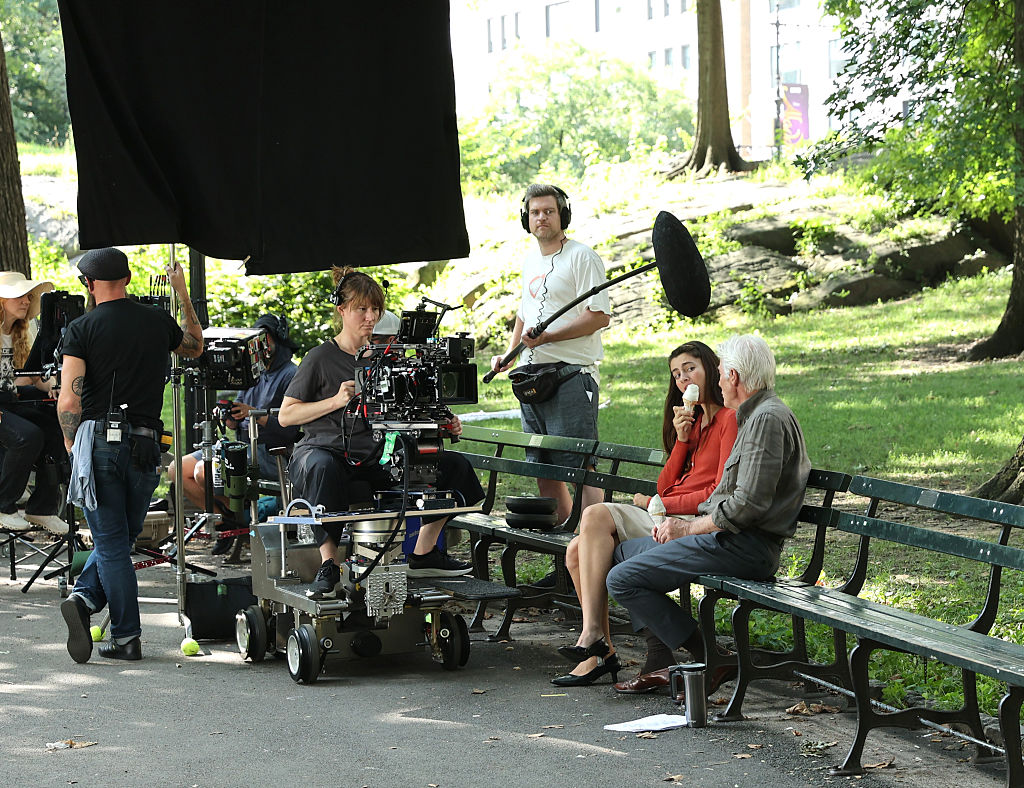
The flight of film and television production out of the United States is usually framed in terms of jobs and dollars. And no wonder: entire careers are evaporating at a nauseating rate, with US film and television production down 40 percent in 2024 from its 2022 peak. What gets less attention is a quieter loss: the erosion of an intergenerational workforce.
In 2021, I directed an episode of The CW’s Nancy Drew. Like many productions of its scale, it shot in Vancouver. It was an ambitious show — narratively dense with five lead characters, technically demanding with supernatural elements, all within the constraints of a modest broadcast budget. It was also a blast to make. As with most episodic directing jobs, I parachuted in as a short-term transplant, folding into the well-established ecosystem of a multiseason show.
While on Nancy Drew, I met Hannah, a script supervisor who stood all of four feet eleven with a voice to match. We spent long days side by side at the monitors, as directors and script supervisors do. Close in age and aligned on which jokes were absolutely hilarious, we became fast friends.
“You’re Jim’s girl, aren’t you?” someone asked her one day, referring to her father, a longtime camera operator and cinematographer. This led to stories of being brought to set as a child and coming of age under the watchful guard of a workforce who “knew her when.”
I’ve since learned this kind of intergenerational collaboration is not uncommon in Canada, and working in Toronto and Vancouver, I’ve been repeatedly struck by it — along with a pang of envy and grief for our ailing Hollywood. What emerges is an on-set experience buoyed by a network of shared history and continuity passed from older workers to younger ones, not uncommonly in the same family.
Before you write this off as garden-variety nepotism, I’d argue it’s actually trade succession, similar to what you see in the building trades. These are not the film industry’s rarefied or glamorous above-the-line roles. They are the physically demanding, highly specialized trades that form the backbone of film and TV production, and in that context the term “nepotism” loses its stink.
The benefits of working with multiple generations of craftspeople are impossible to quantify. The combined knowledge, dedication, and identification with craft and community are greater than the sum of their parts.
Trades have long functioned this way, at least since the guild era of the Middle Ages. If you grew up around a craft, you absorbed it by default — awakening in a cloud of sawdust or to the sound of a hammer on an anvil, you were a de facto apprentice. But beyond the nuts and bolts of the trade, the younger generation gets to observe the ineffable soft skills of the work and the countenance required for it.
It’s for precisely this reason that the Writers Guild of America fought in 2023 to get writers back on set as producers of their own episodes. The new contract restored a version of that expectation — central to how the next generation of writers learns to be showrunners — but only for some shows, after it had fallen away almost entirely during COVID-19.
When Nancy Drew wrapped, Hannah and I stayed loosely in touch. Over the next few years, I worked on a handful of shows in different cities — Santa Fe, Atlanta, even Los Angeles — most of which didn’t make it past their first season as the industry contracted. But when I returned to Vancouver for work, I ran into something I hadn’t experienced in a long time: a lot of the same crew members.
Among them was Hannah, now with her married name, directing her own shorts between script supervising gigs. I was reunited with an A-camera dolly grip who’d had a baby, and a producer whose son had started in the locations department. It was frankly utopian. “Now this is an industry town,” I thought.
But if Vancouver is a true industry town, what does that make Los Angeles? Increasingly, film is becoming an industry in which the decision-makers are headquartered at a distance from production itself — and in that gap, to paraphrase Antonio Gramsci, morbid symptoms appear.
When I recently wrote Hannah to get her blessing to tell her story, she replied, “Literally standing next to another second-gen camera op right now. Didn’t know that wasn’t a thing in LA.” Indeed, it is increasingly uncommon in this age of footloose capital, which uproots industries from the communities that built them and sets them down wherever labor comes cheapest, often thanks to tax breaks and government subsidies.
A stable industry that treats its workers well does more than reliably turn out art the public loves. It can be a scaffold on which entire generations grow and flourish. It allows workers not merely to make a living but to actually live — to hit life’s milestones with the work as a steady backdrop, marrying and buying homes and raising the next generation with the confidence that the work will still be there for them. It allows older workers to stick around and pass knowledge down as an uncle might on a Saturday afternoon in his garage wood shop.
This is the future I dream of for our industry.
Credit: Source link