Jack Reacher, protagonist of books by Lee Child and an ongoing Amazon drama, has several characteristics integral to his Jack Reacher-ness.
Of primary importance to Child’s readers, Jack Reacher is gigantic. If Jack Reacher isn’t 6’5″ and 250 pounds, he might as well be Tom Cruise in a muscle car, because he sure isn’t Jack Reacher.
Lanterns
The Bottom Line
Even in its uneven moments, the stars shine.
Airdate: 9 p.m. Sunday, August 16 (HBO)
Cast: Kyle Chandler, Aaron Pierre, Kelly Macdonald
Creators: Chris Mundy, Damon Lindelof and Tom King
Of subtler importance, albeit more complicated to discuss, is Jack Reacher’s whiteness. Reacher is a behemoth who strolls into towns in the South and the American heartland. He’s a vagrant who picks fights in public places, undermines law enforcement, beds random women and refuses to leave before unraveling mid-level conspiracies. Many, if not all, of Jack Reacher’s adventures would play out wildly differently if he were a 6’5″, 250-pound man of color.
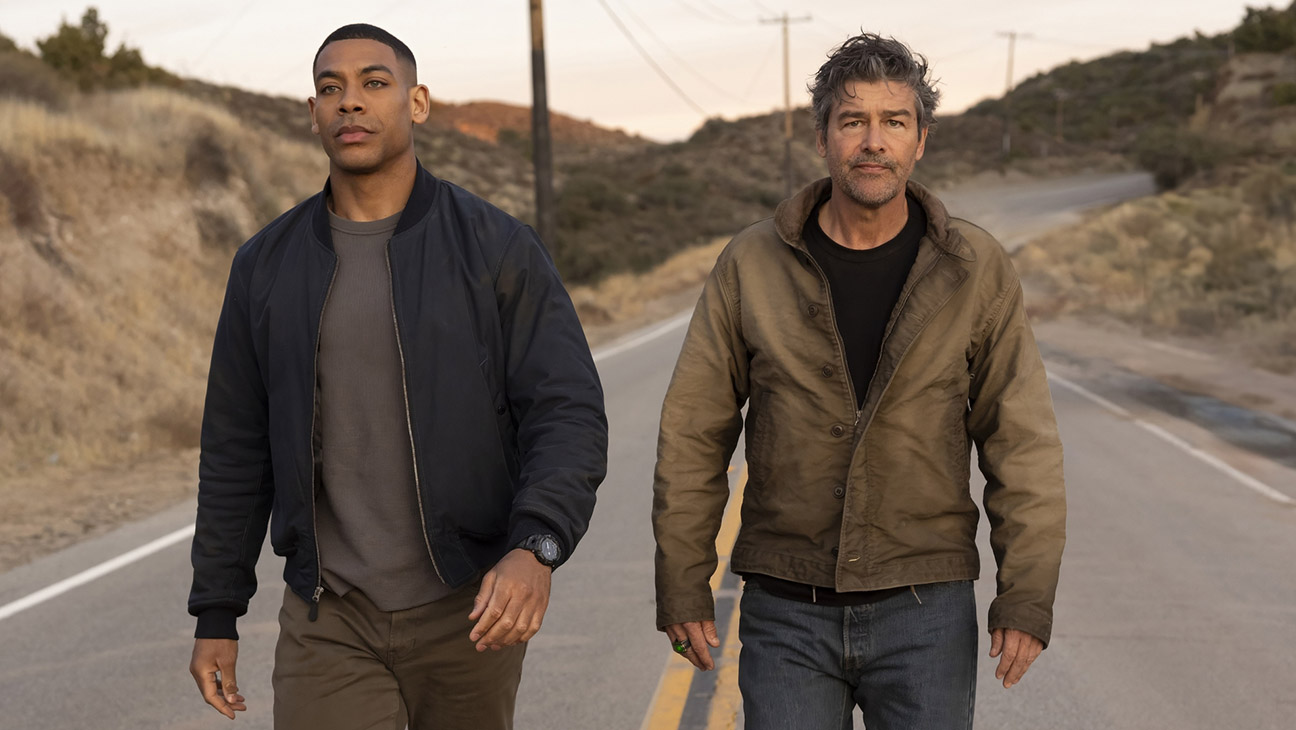
HBO’s Lanterns has DC Comics roots and some moments of effects-driven superhero bombast. But, as adapted by Chris Mundy, Damon Lindelof and Tom King, what it feels like is a Jack Reacher story with Aaron Pierre as the swaggering, oversized outsider who strolls into a small Nebraska town, undermines law enforcement, beds random women and refuses to leave before unraveling a mid-level conspiracy. Yes, he’s accompanied by a partner and, yes, there’s a bulky ring that can be used to manifest an assortment of wondrous and less-than-wondrous things. But as depicted here, Pierre’s John Stewart offers a small glimpse of what would happen if Jack Reacher were a towering Black man. And if there were aliens.
Since Lanterns just so happens to be premiering opposite the new season of Reacher, it’s easy to acknowledge that Lanterns is smarter, better-acted and just plain better than any season of Reacher to date. At the same time, Lanterns comes with a set of expectations that will never burden Reacher, an extended B-movie of a TV series adapted from a potboiler run of airplane novels.
With Lindelof as a key piece of its pedigree, Lanterns invariably has to be compared to Watchmen, a spectacular superhero non-adaptation that combined conventional genre thrills with a rich socially conscious undercurrent that launched a million “Was the Tulsa Massacre Real?” Google searches.
The text and subtext of Lanterns aren’t woven together as consistently as in Watchmen, and viewers tuning in with a particular interest in it being a comic book blockbuster are likely to be at least a little underwhelmed.
Still, based on the seven episodes sent to critics (out of eight total), Lanterns has a lot to recommend it — particularly the prickly chemistry between Pierre and Kyle Chandler, a top-notch supporting ensemble led by Kelly Macdonald, Poorna Jagannathan and Garret Dillahunt, and enough engaging ideas to make up for the spectacle that’s occasionally lacking.
The series starts in 1996 with a 60 Minutes episode introducing the world to Hal Jordan (Chandler), the formerly masked hero protecting the Earth as part of the organization of intergalactic cops known as the Green Lantern Corps. Jordan is a former test pilot and the first human to wield the Green Lantern ring, a responsibility he received largely by virtue of giving the correct answer to the query, “Are you afraid?” (“No” is the correct answer.)
The interview is being watched by young John Stewart, whose father (J. Alphonse Nicholson) and mother (Jasmine Cephas Jones) have Green Lantern Corps aspirations for him.
20 years later, John (Pierre) is serving as an apprentice to an older, grouchier Hal. It is not a particularly warm relationship, in part because Hal knows that the only way for John to become Green Lantern is through Hal’s retirement or death, and Hal has no intention of retiring. As a result, despite having been paired together for years, very little mentoring has occurred.
Through a very peculiar source, John and Hal learn that they’re needed in a small Nebraska town. Hal takes flight to the destination using the power of the ring, leaving John to fly coach.
In Rushville, Hal and John learn about the death of what appear to be victims of a mass shooting, but the civilians are actually aliens and one of the bystanders is of extraterrestrial origin as well, with a nefarious agenda.
Although John and Hal (or at least Hal) have expertise in these matters, the town sheriff (Macdonald’s Kerry) isn’t eager to give up her jurisdiction. She claims it’s because she doesn’t want to freak out the populace, but there’s a reason that the aliens are in Rushville and there are places Kerry doesn’t want these interlopers poking around.
One of those places is the vast ranch owned by her father-in-law (Dillahunt’s Will Macon), so it’s a bit peculiar when Macon invites Hal and John to a BBQ on the ranch. Macon, it turns out, is an Earth First nativist, with militia tendencies, which would seem to put him on the same side as our planetary protectors. But perhaps there’s more afoot.
I’m not sure if there’s any single Jack Reacher book in which Reacher arrives in a Midwestern town and finds a nativist cult with militia tendencies or if it’s two books that I’m combining in my head, but almost beat-by-beat, the things Hal and John encounter in Rushville match that vibe — from the tense scenes in the local cafe, to potential brawls at dingy watering holes, to threatening mobs in pickup trucks, to John’s fast-moving flirtations with the mysterious Zoe (Jagannathan), drawn to the very large man either because he’s big enough to have his own gravitational pull or for other reasons. (Yes, this is also the basic plot of a dozen John Wayne, Clint Eastwood and Japanese ronin movies that influenced Reacher, but season four of Reacher is premiering this week, so that’s what’s on my mind.)
It’s genre standard, but the Lanterns writers supply clever atmospherics that alternate between fantastical and all-too-real. Having a protagonist capable of thwarting violence by creating a shimmering green dome with his mind and a poorly charged ring — it’s forever at 5 percent, which gives Hal and the show an excuse to resort to CG wizardly sparingly — or blasting off into deep space for a consultation with Sinestro (Ulrich Thomsen, under-utilized), a disgraced Green Lantern and one of Hal’s former mentors, is a wild wrinkle. A small town in which under-trained and over-armed civilians rant about illegal immigration and talk insurrection is…less wild.
John Stewart, a character created by Dennis O’Neil and Neal Adams in the early 1970s as a pointed acknowledgement of the culture’s shifting racial landscape, is all too aware of what it means to be a Black man in law enforcement, and all too wary of the attentions of rich white men professing allyship. When you have Dillahunt in friendly-menace/menacing-friendly mode, who can blame him?
“White men have the privilege of being eccentric. White men with money? They can do whatever the fuck they want,” says Zoe, who also understands the pressures of being an outsider in this corn belt town, bristling with an annoyance and anxiety that Jagannathan nails.
I loved the first episode of Lanterns — written by the creators and directed by James Hawes — which plays the subtext aggressively and well, washed down with the dysfunctional buddy space-cop banter between Hal and John. Chandler, rarely better, grounds Hal’s irritation in a variety of insecurities, making him an interesting mixture of angry and sad, heroic and cowardly. Pierre, glowering, growling and smoldering, plays Stewart as an extension of his similar Rebel Ridge character (another Jack Reacher/classic Western archetype through a Black lens), a man who would be perfectly happy to do the right thing and be on his way, except that idiots keep obstructing and underestimating him.
John describes himself as a back-up quarterback and if you put “back-up quarterback” and “Kyle Chandler” in the same sentence, that makes John Stewart into a superhero version of Matt Saracen, creating a warped coach/pupil relationship sure to amuse Friday Night Lights fans. Pierre and Chandler are just great together.
It’s possible, though, that Macdonald is my favorite part of the show. She’s always been superb at finding humanity and vulnerability in authority figures — see Giri/Haji, Line of Duty and Dept. Q — creating a juxtaposition between her job and her diminutive stature and chirpy voice. Whether we’re supposed to trust Kerry is irrelevant, because she’s instantly likable and tough in a way that doesn’t require superpowers. A shift in the character dynamics in the second half of the season allows Macdonald to do great work, at times wordlessly.
The season starts off so well, but from there it’s a little up-and-down — albeit more “up.” The third episode, written by Breannah Gibson and directed by Geeta Vasant Patel, does great backstory work for John and his family. The second and fourth episodes are duller, not exactly bad but thematically thin — some viewers will be relieved that Lanterns takes its foot off the sociopolitical gas, but I was not — and, frankly, not nearly fun or funny enough. The fifth episode is the only one of the seven that goes full-on, high-octane action and, despite feeling like it monopolized 75 percent of the entire series budget, the execution is perfunctory instead of exhilarating.
It’s a gritty and ground-level show that occasionally has to pander to viewers with a sci-fi set piece or a friendly carnivorous plant, and no matter how “big” anything is intended to be, you never forget that’s not where the series’ heart or technical capabilities reside. My emotional investment, which grew in the sixth and seventh episodes, became entirely in the characters and not the galactic stakes, which don’t really materialize.
I’m not interested in the other Green Lanterns — Nathan Fillion reprises his Superman role as Guy Gardner very briefly and I just didn’t care — or even the entity represented by a mellow, effective Laura Linney in a recurring role. I would, however, happily watch Pierre and Chandler wander into different towns and cities with a power-depleted magical ring, quarreling and raising a ruckus for eight new episodes every year.
Credit: Source link