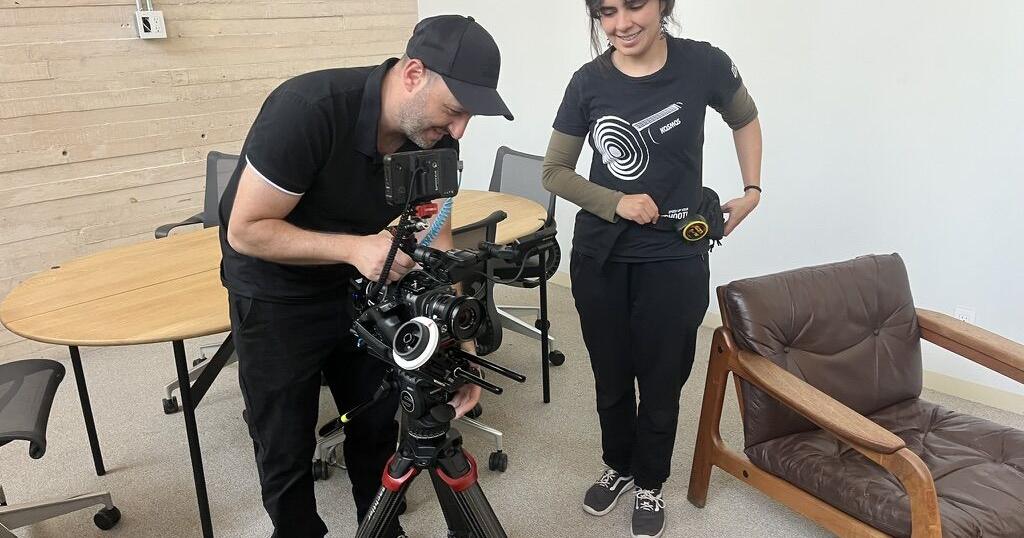
Crew members from the Mexican production company The Lift prepare cameras and microphones for promotional interviews for a Disney+ docuseries on the 2026 FIFA World Cup.
Photo by Nicolle Delgado
MEXICO CITY – There’s a quiet neighborhood near the heart of this city’s colonial downtown that defies an orchestra of urban noise from nearby tourists, hard-sell street vendors and buskers of every musical genre.
Popotla, just two blocks from the picturesque, carved doorways and family restaurants on Tacuba Street, is long known for its street-corner pharmacies and faded yellow storefronts bearing names like Frutería Las Delicias and Carnicería La Abundancia.
Now it’s known for something else: filmmaking equipment in constant motion, like the crew hoisting a bulky camera rig through an apartment window on a recent early afternoon with slow, synchronized pulls.
The area has been transformed into a set for a Netflix series produced by the film production company Perro Azul. An alleyway is decked out with wooden carts and staged counters displaying local candy and snacks beneath shaded awnings.
The movie magic unfolding in Popotla is far from unusual in today’s Mexico City. Between 25 and 30 shoots take place each day – a testament to the nation’s growing appeal as a hub for international and domestic production companies.
In 2023, Mexico set a record, hosting 259 feature film productions, according to the Mexican Cinematography Institute.
The boom has entertainment industry observers calling Mexico the Hollywood of Latin America and coincides with a difficult stretch for the actual Hollywood. Employment in Los Angeles County’s film, television and sound industry has fallen 30%, while the motion picture employment workforce has shrunk by 42,000 jobs over the past three years, according to the U.S. Bureau of Labor Statistics.
The Mexican boom is reminiscent of past filmmaking flurries; cycles of boom and bust often shaped by the nation’s shifting political priorities and fluctuating government support.
But this time the surge — fueled by online streaming giants, new tax incentives and a seemingly insatiable appetite for content — could become lasting growth in production spending and employment.
Production activity since the COVID pandemic has been extraordinary, said Israel Gonzalez, founder and managing director of Kanan Films, headquartered in Cancún. Kanan has worked on projects ranging from Olympic commercial campaigns and feature films to Harry Styles’ music video “Lights Up.”
In February, Mexico’s President Claudia Sheinbaum Pardo announced a 30% income tax credit for productions that use at least 70% Mexican services – support worth up to roughly $2.3 million per individual project.
The incentive follows Netflix’s 2025 announcement of a $1 billion investment in Mexico’s film industry.
Other major US-headquartered streaming services such as Amazon Prime Video and Max have dedicated infrastructure for producing Mexican originals.
Prime Video’s adaptation of “The Office – La Oficina,” which premiered in March – was filmed in a real office building in the Mexico City suburb of Tlalnepantla.
Horacio Rodríguez, a location manager whose credits include the Oscar-winning film ‘Roma,’ overlooks the central ballroom of the Club de Periodistas.
Photo by Nicolle Delgado
A complicated success story
Mexico’s recent rise is part of a broader global trend rather than an isolated phenomenon.
Toronto, London, Warsaw and several U.S. cities are increasingly attractive to production companies, offering financial incentives like lower wages and tax breaks.
Gonzalez believes the Mexican film sector’s growth is more fundamental – something closer to the vision he’s long had.
“Now that the (government) incentives are good in Mexico, obviously all the producers are going to say: ‘Let’s change the story. If the story was happening in Brazil, but it’s easier to shoot in Mexico, well, don’t call it Rio, call it Mexico City!’” he said.
Film veterans and academics caution the new status may be just another return to previous eras when Mexican sets and backdrops thrived.
Long before the international prominence of Mexican filmmakers like Guillermo del Toro and Alfonso Cuarón, and actors such as Diego Luna, the country had its Golden Age of cinema between the 1930s and 1950s. Back then, the boom was also fueled by abundant talent and strong government backing.
At the time, it was enough to make cinema Mexico’s fourth-largest industry.
But dependence on state support also contributed to the industry’s later decline when Mexico’s public finances deteriorated in the 1970s. In the 1990s, amid broader economic reforms tied to the North American Free Trade Agreement, the government shifted support to manufacturing and agriculture.
Bettine Mackenzie, a development executive at Mexican production company The Lift, acknowledges that Mexico’s new tax incentives are modest compared with write-offs offered in Canada, the United Kingdom and Spain, where they’re up to 70%.
Still, she believes the current government has introduced other support programs that make a meaningful difference.
“I think it is a good final key because there are already so many clients coming here and filming and loving the experience and coming back, and it’s already so popular for big productions,” she says. “It’s just going to be that extra thing.”
Among other government-sponsored programs benefiting companies like The Lift is EFICINE — Estímulo Fiscal a Proyectos de Inversión en la Producción y Distribución Cinematográfica Nacional — a federal incentive program that distributes grants of up to 20 million pesos (just over $1 million in the U.S.) twice a year to support Mexican film production and distribution.
Mackenzie is also collaborating with the Mexican media firm, Filmland Hunters, on a campaign promoting the diversity of film locations across Mexico and the capital city.
They’ve found landscapes near Guadalajara that can double for the outskirts of 1930’s Los Angeles, and the historic mining town Cananea, which, to location hunters, is a place “stuck in time.”
Mexico’s film industry has historically operated “ … not to produce more Mexican films, but rather to use the Mexican industry as a strategy for economic development,” said Ignacio M. Sánchez Prado, professor of Spanish, Latin American Studies, and Film and Media Studies at Washington University in St. Louis and author of Screening Neoliberalism: Transforming Mexican Cinema, 1988-2012.
Sánchez Prado said the recent tax incentives cut both ways: they’re extractive when foreign productions rely on Mexican talent and labor at comparatively lower costs. But they also help generate a robust production ecosystem.
One of the many rooms in the Club de Periodistas that filmmakers often use to recreate the look and feel of the 1950s.
Photo by Nicolle Delgado
Location, location, location
In 2019, Horacio Rodriguez became the first Mexican location manager to win the Location Managers Guild International Award, earning recognition for Outstanding Locations in a Period Feature for his work on the Oscar-winning film “Roma.”
That prize gave Rodriguez the credibility to suggest that filmmaking in Mexico is inseparable from politics.
Today, he works with the Film Commission on a series of workshops for Mexican women interested in location management, an audiovisual development collaborative including Netflix’s Fund for Creative Equity and various industry guilds.
It’s all adding up to a measurable economic boost. The audiovisual industry contributed approximately 138.7 billion pesos — equivalent to 0.5% of Mexico’s GDP — in 2022, according to Oxford Economics. The number surpassed Mexico’s computer manufacturing industry.
“How do you think the president is going to treat us?” Rodríguez asks, opening his arms in a hugging gesture. “Welcome, guys.”
He is seated inside Café de Tacuba, the historic restaurant in downtown Mexico City. This area served as a location for the 2015 James Bond film “Spectre.” Rodriguez recalls the challenge of persuading the owners to close the busy restaurant, something the café had done only once before. He also shut down the surrounding street for three days.
“’Estás loco,’” he says, mimicking what the owners told him — you’re crazy.
Rodriguez notes that Mexican productions rarely have budgets for such large-scale closures, but the backing of a major British studio made the scene possible.
“The texture, the spaces — that’s what directors look for,” Rodriguez said later, as he gave a tour of the Club de Periodistas de México, a popular filming location prized for the variety of architectural styles found throughout the building. Rooms inside the sprawling property have been transformed into everything from 1970s bathrooms and 1950s diners.
That essential texture in a backdrop is on display at Gimnasio Nuevo Jordan in Centro Histórico, where Victoria, Mexico’s oldest beer brand, recently filmed a commercial.
The ad’s directors are Chicanos – Mexican Americans – from Los Angeles. RJ Sanchez and Pasqual Gutierrez sit in a half-circle, staring intently at a monitor displaying the camera feed.
“I think what’s amazing about filming in Mexico is that there’s just so much character,” Sanchez said of an ornate backdrop displayed on the screen. “There’s so much history here.”
Nicolle Delgado is a student at the UC Berkeley School of Journalism. Her work has been featured in SFGATE, the East Bay Express, and the graduate publication Oakland North. This story was co-published with Puente News Collaborative a bilingual nonprofit newsroom, convener and funder dedicated to high quality, fact-based news and information from the U.S.-Mexico border.