MGM+ and BBC One’s A Tale of Two Cities is neither the best of adaptations nor the worst of adaptations, but Daniel West’s take on the Charles Dickens classic may well be the meh-est of adaptations.
The four-part series benefits somewhat from the lack of an instantly identifiable definitive filmed interpretation of A Tale of Two Cities (depending on how you feel, I suppose, about the best picture-nominated 1935 feature) — a minor oddity given that the novel is in many ways Dickens’ most streamlined, featuring one of his best beginnings, best endings and most approachable narrative hooks.
A Tale of Two Cities
The Bottom Line
Fails to stand out as a romance, thriller or period piece.
Airdate: Sunday, September 6 (MGM+)
Cast: Francois Civil, Kit Harington, Mirren Mack, Roxane Duran
Creator: Daniel West
It’s a love triangle and a thriller set against the backdrop of the French Revolution. It features the usual Dickensian melange of colorful characters, breathless cliffhangers, shocking twists (not Oliver) and trenchant social commentary. It’s very much the epitome of a ripping yarn.
Ultimately, though, freedom from negative comparisons to previous adaptations is not enough to prevent this take on A Tale of Two Cities from being a bland disappointment — one of the least Dickensian adaptations of a Charles Dickens work since Steven Knight adapted A Christmas Carol around the question, “What if Ebenezer Scrooge could say ‘fuck’?” It’s still a love story, but with virtually no passion between any of its three principals; and while it may be a tale of two cities, they both look like nearly identically designed stages in a warehouse in some affordable Eastern European country.
For those who haven’t read A Tale of Two Cities or seen one of the forgettable previous adaptations — none, apparently, since a 1989 take that aired in the States under the Masterpiece Theatre banner — the plot is at once simple and convoluted.
After a brief prelude in Paris in 1764, in which a young Lucie Manette watches her father apparently be killed, the action jumps forward 18 years. Lucie (Mirren Mack) is now living in London hoping to follow in her late father’s footsteps as a doctor. Lucie’s concrete interest in medicine is not, if memory serves, a part of a book in which she’s a more nebulous “healer,” nor is it all that relevant to the series after a strange introduction in which she’s practicing surgery on a corpse. It’s a nearly pointless choice, one of many.
Lucie is living with Mrs. Lorry (Sharon Duncan-Brewster) and doing just fine for herself when her life is turned upside down with the arrival of Charles Darnay (François Civil). Charles is working on behalf of French revolutionaries, embodied by Roxane Duran’s Madame Defarge, to smuggle a generally irrelevant woman to safety in England. He’s also bearing a letter that suggests that Lucie’s dad (Yannick Renier) isn’t actually dead. The letter contains the evocative words “recalled to life,” which are potent on the page and nearly meaningless in the series.
At the English border, Charles is wounded, which lets Lucie utilize her medical knowledge briefly. Then he’s arrested as a spy. Lucie seeks out legal representation for the heroic Charles, but finds only the generally drunk and uncouth Sydney Carton (Kit Harington).
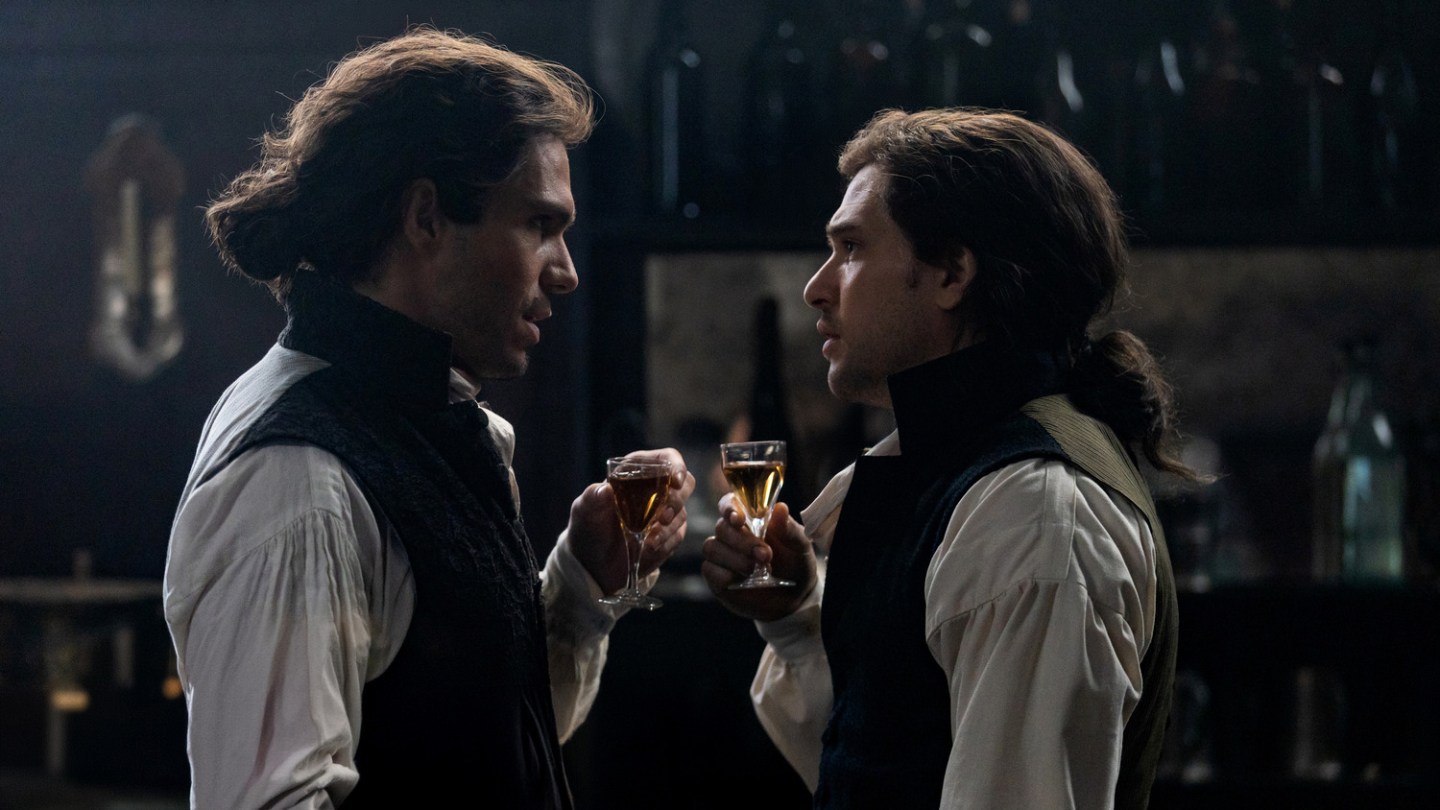
Both Charles and Sydney immediately fall in love with Lucie, because she’s somewhat the protagonist of the story and she’s pretty. Lucie, for her part, falls in love with both Charles and Sydney, which makes a little bit of sense since they look almost identical (assuming they aren’t standing next to each other, allowing one to see that Civil is a lot taller) and they’re both in constant need of chaste undressing. It makes less sense, though, because nothing in her interactions with either man comes across as the least bit romantic and the chemistry between Mack, Civil and Harington is wholly lacking, regardless of the permutation.
As Lucie is reunited with her father, seriously psychologically damaged by his two decades in the Bastille, she learns shocking truths about Charles and his lineage and about the revolutionary motivations of Madame Defarge, whose general intransigence has caused her to be viewed as the villain of the piece, regardless of logic.
Watching A Tale of Two Cities, it’s almost impossible to gauge what attracted West and the producers to the book, other than the IP and the reality that there are only so many times one can adapt Great Expectations, David Copperfield, Oliver Twist and A Christmas Carol before it becomes necessary to cycle back into the Dickens catalogue. The inspiration is nowhere to be found here.
And A Tale of Two Cities is, as I’ve already said, a ripping yarn, featuring doppelgängers and surprises and the French blooming Revolution — featured in one thoroughly lifeless scene — plus it’s eternally timely since the story is one of those reliable Dickens screeds in which the impoverished masses are on the verge of toppling the heartless elite. Madame Defarge is — whether or not you buy her as a villain — one of fiction’s great adversaries, and her backstory is, itself, both eternally timely and specifically timely at a historical moment when you might have noticed one or two headlines about immoral wealthy men preying on defenseless young women.
One could certainly adapt A Tale of Two Cities in a way that steers into the complications of Madame Defarge as a character, resulting in something that might almost resemble Hulu’s summer hit, Furious. She is, as a character, at best a righteous crusader and at worst a rigid zealot, but she’s hard to make uninteresting. Duran captures Defarge’s rage and, in a series plagued by thinly sketched characterizations hers comes closest to rising to the level of interesting. But her cause and her connection to that cause are mechanical pieces of the plot here, making it impossible to hate her or empathize with her. She’s just the person stirring up trouble whenever we go to Paris.
Plus, it’s hard to know when we’re in Paris. As directed by Richard Clark, A Tale of Two Cities is temporally choppy and fails to build any emotional or geographical momentum. Though two cities are in the title, we’re treated to maybe a block or two of London and a block or two of Paris, visually interchangeable in a way that offers no real tangible connection to either staged location.
Presumably, making Paris and London interchangeable is intentional, a parallel to the similarities between Charles and Sydney? Except that the entire purpose of the story’s arc is that one should be able to chart the life Charles was born into and the changes he made (all before the start of the story, since he’s pretty much stagnant onscreen throughout) and compare that to Sydney’s journey from the man he is when we meet him to the man he becomes by the end of the tale. In this case, though, since Harington and Civil are comparably solemn and earnest throughout — the actors do, if nothing else, look as similar as the story necessitates — there isn’t much evolution to trace.
There are supposed to be comparable parallels to the arcs of Lucie and Madame Defarge, one as a force of optimistic good and the other as a force of all-consuming vengeance, but neither progression is all that engaging. Like Duran, Mack brings a little fire to the series, but Lucie is one of those Dickensian women who are unexplained rays of light who exist mostly to fuel the growth of the main male characters.
As for the supporting ensemble from the page, from the bloodthirsty revolutionaries collectively known as Jacques to Sydney’s partner Mr. Stryver (a wasted Fehinti Balogun) to the figure known as The Vengeance, they’re either gone entirely or written so thinly here as to leave no impression.
A Tale of Two Cities is in such a hurry to get from that memorable opening (rendered poorly as a voiceover at the end of the first episode) to that tremendous closing (rendered poorly as another voiceover) that the adaptation might as well have been as a two-hour movie. Certainly the cliffhangers at the end of each episode lack the urgency that Dickens himself understood so well how to evoke. The story itself is probably good enough to pull some viewers along from episode to episode, but the telling definitely is not good enough to inspire anybody to seek out MGM+.
Regardless, there’s a far, far better adaptation of A Tale of Two Cities than has ever been done. This is not it.
Credit: Source link