
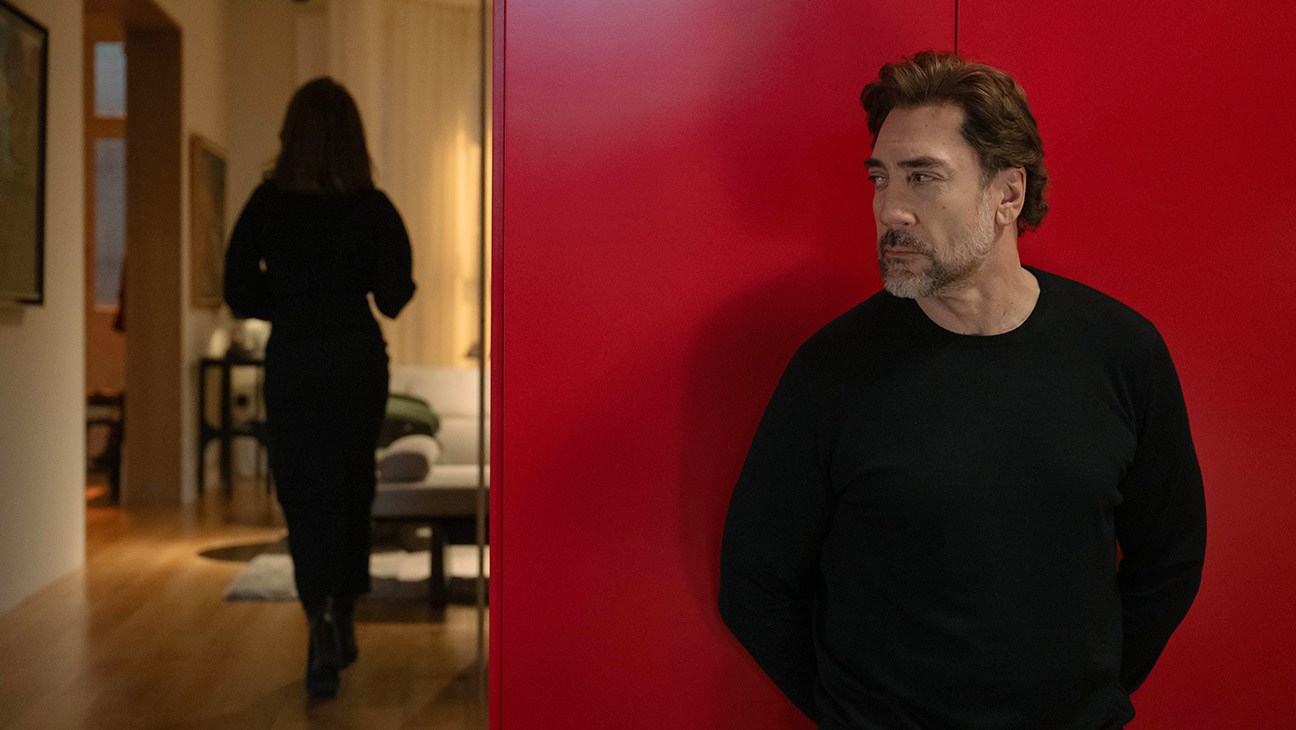
Since expanding from theater into film, writer-director Florian Zeller has specialized in examining the pressure of mental health issues on families — dealing with dementia in The Father and depression in The Son, both based on his plays. His third feature, Bunker, puts an outwardly happy marriage under the microscope as fissures start forming and it’s most rewarding when the psychological give and take between two people who love each other remains in tight focus. That’s in large part due to the galvanizing performances of real-life couple Penélope Cruz and Javier Bardem, for whom the film was written, bringing an electric emotional charge to scenes of both intimacy and estrangement.
A characteristically incisive supporting turn from Stephen Graham lends added value to a film that is less satisfying in its commentary on wealth inequality. A hard swerve into genre territory late in the story, when it becomes a violent thriller, feels abrupt and a little forced as a catalyst for crisis resolution. But the actors keep you watching, as do the impeccably controlled visual compositions, striking use of color and strong sense of spatial dynamics.
Bunker
The Bottom Line
Flawed but compelling.
Venue: Venice Film Festival (Competition)
Cast: Penélope Cruz, Javier Bardem, Stephen Graham, Paul Dano, Patrick Schwarzenegger, Mark Gattis, James Bisping, Karen Ascoe
Director-screenwriter: Florian Zeller
2 hours 6 minutes
Zeller drew inspiration from the 2009 Argentinian dark comedy thriller The Man Next Door, whose co-directors, Andrés Duprat and Mariano Cohn, get executive producer credits here. That film centered on a festering conflict between neighbors from different wealth brackets over a property dispute, which is woven here into a story about the strain that clash — and other factors — place on the marriage of celebrated architect Miguel Moreno (Bardem) and Sofia (Cruz), an editor at a publishing house.
Having relocated from Madrid to London when his stock went up after receiving a prestigious international award, Miguel, Sofia and their two young daughters have taken up residence in a gentrified neighborhood. Their remodeled home is prime real estate porn, flooded with natural light, designed in a sleek minimalist style and afforded maximum privacy by a walled garden off the house’s glass-exterior living, dining and kitchen areas. (Production designer Alain Bainée has done an impressive job constructing the house in its entirety on a Madrid soundstage, allowing Zeller to explore connections between architecture and psychology.)
That protective bubble, sealing the Morenos off from the outside world, is violated when their working-class neighbor Toby (Graham) begins a project to convert his garage into a studio by installing a window in the two properties’ adjoining wall. Zeller sets this up ably by incorporating the sledgehammer blows of the builder hired by Toby into percussive passages of Volker Bertelmann’s ominous score.
Indignant about never having consented to this structural intrusion, Miguel gets into a tense faceoff with his neighbor, who is unapologetic, offering only the matter-of-fact justification that he wanted sunlight in his studio. But he agrees to repair the wall to its original condition — at Miguel’s expense — without hiding his contempt for the well-heeled new residents transforming the suburban enclave.
Zeller deftly sidles into this set-up via a television interview being conducted with Miguel, who reveals a tender side when recounting the story of how he and Sofia met. His wife watches and listens with obvious fondness in her eyes but also an inscrutable hint of emotional detachment, perhaps even irritation.
As the story evolves, it becomes clear that Sofia resents having left behind a rewarding publishing career in Madrid to pack up the family and follow her husband to England. She’s dissatisfied in her job as senior editor of the foreign literature department, meaning she spends more time dealing with translators than authors. The head of fiction position is about to open up, but Sofia is skeptical about the chances of a non-Brit landing that spot.
While Miguel in most respects is an ideal loving husband, father and provider, he remains oblivious to Sofia’s growing distance. That gradually becomes more apparent as she starts coming home later while squiring rising-star American novelist Jeremy (Patrick Schwarzenegger) around town to do press ahead of his book’s U.K. release. But Miguel’s jealous suspicions miss the point of what’s gnawing at her.
The bigger factor threatening to drive a wedge between them surfaces when Miguel receives a proposal to design an enormous bunker in Hawaii for an unnamed tech billionaire. That character is played in a terrific single scene by Paul Dano as a man unaccustomed to hearing the word “no.” His face is a mix of affectlessness and self-satisfaction, putting him somewhere between Elon Musk and Mark Zuckerberg, with a touch of the Cheshire cat. When Miguel initially declines, the client doubles his offer, dangling what would be a life-changing sum.
Sofia has strong feelings about the ultra-rich looking out for themselves as the world teeters toward disaster, shutting out everyone else. That’s of course another version of what Miguel is doing by attempting to block the obstinate Toby from visual access to their home and garden. Not that anyone could blame him. Sofia, not one to hide her feelings, is incensed that Miguel would even consider the Hawaii project, breathlessly described by his business manager (Mark Gattis) as “pharaonic.”
All this plays out in riveting fashion as Sofia’s many misgivings about the family’s life in London spill out in anger. The tension in the marriage conveyed by Cruz and Bardem simmers and scalds, bringing a welcome shot of fire to Zeller’s normally colder and more clinical style. The fact that the Morenos speak Spanish at home also adds a fresh spark to the work of a filmmaker who generally favors glacial restraint and muted emotions. The same goes for the rancor socked across by Graham (so memorable in Adolescence), whose Toby looks about ready to headbutt Miguel at any moment.
What detracts from the film is the clumsily emphatic foreshadowing of a dramatic plot turn, which is pretty much spelled out by an alarm company technician who sells Miguel on the wisdom of upgrading to a next-level home security system. There’s some didactic dialogue about the fragility of relationships, masquerading as dinner party conversation, and clanging symbolism in a painting Sofia admires at a gallery opening — even if the visual echo it yields in the film’s closing moments is inevitably affecting.
Other heavy-handed touches intrude on the film’s sophistication, such as the female protagonist of Jeremy’s novel being like a character trapped in her own existence, unsubtly indicating what Sofia is feeling. But the issue is mostly that Zeller’s psychological insight into his characters runs a lot deeper than his thoughts on the privileged insularity of wealth. The actions of an unlikely rescuer during a harrowing ordeal for the Morenos also make for a conclusion that feels like an easy out.
As uneven and schematic as it is, however, Bunker is a great-looking movie that again shows Zeller’s discerning eye — aided by his regular cinematographer Ben Smithard. The placement of Cruz and Bardem in key moments against an eye-searing firetruck red kitchen wall is highly effective. It’s considerably more emotionally involving and less punishing than the unrelentingly dour The Son, with performances from an accomplished cast that cannot be faulted.
Credit: Source link