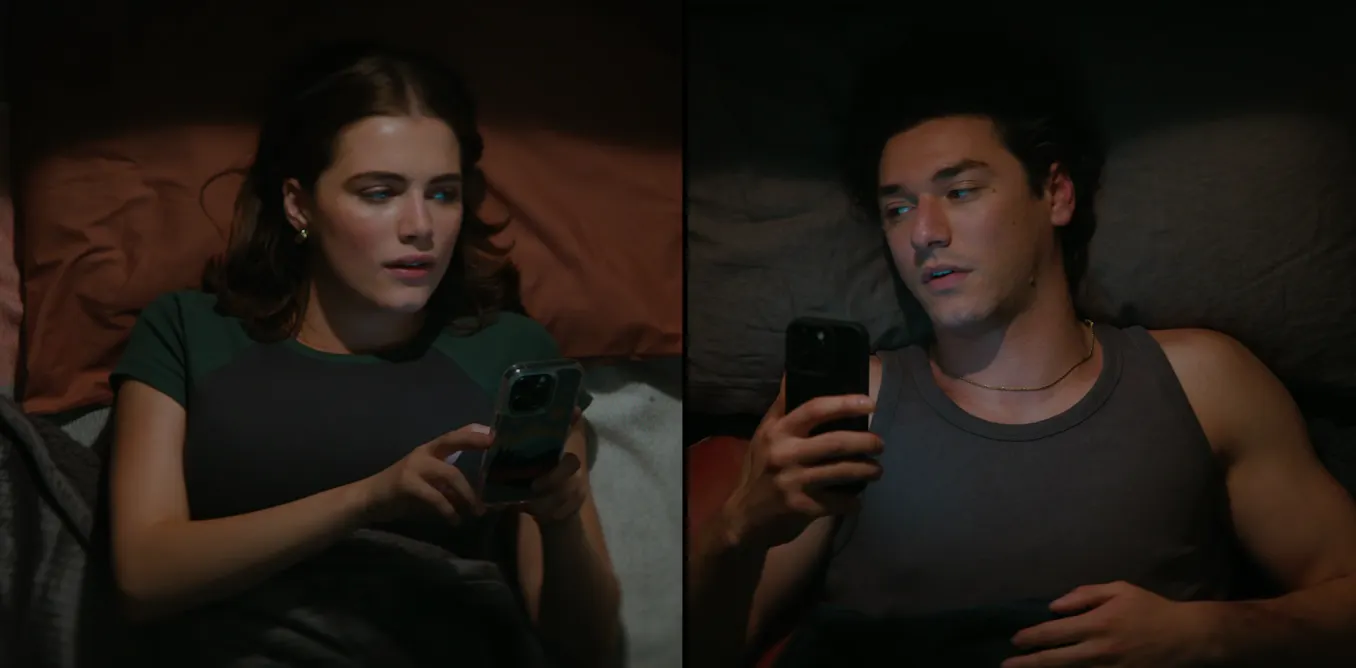
One of Prime’s greatest hits this year has been the teen romance series Off Campus. The show follows hockey player Garrett and musician Hannah as they try to reconcile sex, adulthood, college life, and their feelings for each other.
The show makes use of a split screen on various occasions, such as when it simultaneously shows Garrett training and Hannah dancing, or both of them having a phone conversation.
In its simplest form, the split screen effect is the frame divided into two or more simultaneous images, showing the viewer multiple perspectives. Off Campus continues a long tradition of the technique’s deployment in coming-of-age media; it was also used in Carrie (1976) and The Rules of Attraction (2002).
It can be used to heighten tension, as in The Thomas Crown Affair films (1968 and 1999) and The Boston Strangler (1968), or to show a fractured mental state, such as in Requiem for a Dream (2000).
The history of this dynamic visual trick goes back to the earliest days of cinema itself.
Early pioneers
French filmmaker (and toymaker and magician) Georges Méliès invented or popularised many film techniques that are still used today, including the dissolve effect, substitution splice (or stop trick) and time-lapse photography.
But it was his multiple exposure cinematography where the real innovation occurred.
Méliès would cover a portion of the camera’s lens, shoot a scene, and then rewind the film. He would then cover the inverse of what was previously masked, and shoot new footage.
When the film was developed, the two separate images would be merged as a composite with a near-invisible split. In his 1898 short film Un homme de têtes (The Four Troublesome Heads), this creates the illusion of talking bodiless heads.
This approach also allowed Méliès to divide the screen vertically – a trick which has since been co-opted to create the doubling/twin effect, such as in the film Adaptation (2000), and both of the Parent Trap films (1961 and 1998).
In 1927, Méliès’ countryman Abel Gance ended his nine-hour epic Napoléon with the simultaneous projection of three reels arranged horizontally to form a triptych, or ultra-wide panorama.
Since these early experiments, the split screen has been used sporadically across film history.
CC BY
Most of us have a list of our favourite films and TV series of all time. But do you ever wonder how these were made?
In this series we go behind the scenes to reveal the ingenious tricks and innovations that have transformed screen production over the course of a century.
One of its most ardent champions is American filmmaker Brian de Palma, who has deployed divided screens extensively across his films from Sisters (1972) onward.
His Dressed to Kill (1980) depicts a woman being followed through a museum; Blow Out (1981) uses the technique to emphasise the protagonist’s paranoia; and Snake Eyes (1998) shows an assassination from multiple perspectives.
Reading between the lines
The split screen is often used to show conversations on the phone, a well-known trope that also has its roots in early cinema. One early example comes from the 1913 American short film Suspense.
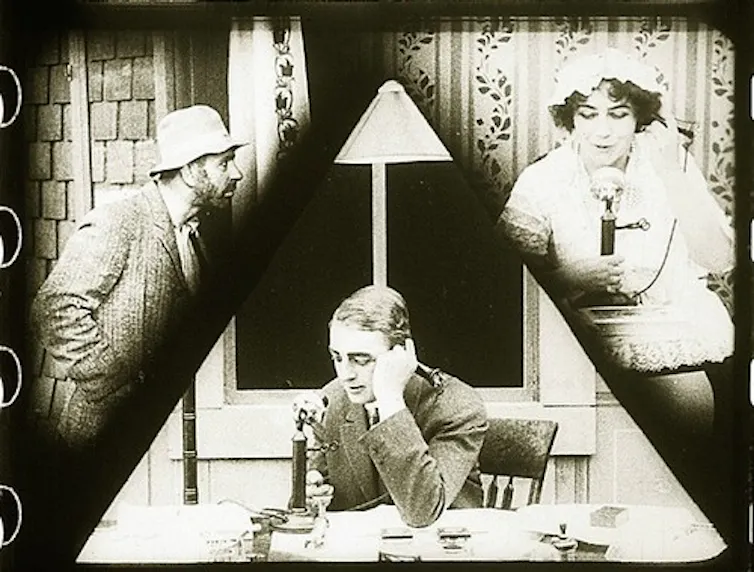
Wikimedia
The technique has also been judiciously deployed to get around censorship rules, including the infamous Motion Picture Production Code – better known as the Hays Code – which was in effect from 1934 to 1968.
In Stanley Donen’s 1958 rom-com Indiscreet, Cary Grant phones Ingrid Bergman from bed, and a split slides across the screen to reveal Bergman, also in bed. Showing an unmarried couple in bed together was too scandalous for the time; the split offered a palatable compromise.
This skirting of censorship also inspired the central format of the 1959 hit Pillow Talk, where a telephone party line is used by romantic leads Doris Day and Rock Hudson. The most risque shot in the film shows Day and Hudson in adjacent baths, their feet “touching” at the screen’s centre.
Pillow Talk, among other “no-sex sex comedies”, inspired 2003’s Down With Love starring Renée Zellweger and Ewan McGregor.
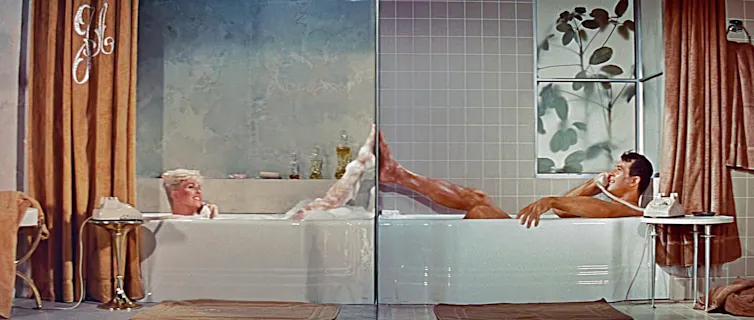
Universal Pictures
The divided frame today
Why has the split screen persisted for so long?
Trends in cinematography and editing come and go, but the split screen’s longevity may be more specific than just fashion: it hands the work of meaning-making to the viewer.
As Richard Fleischer, director of the The Boston Strangler put it:
In effect, you do your own editing, as you look from one image to the other.
As the split screen evolves, this demand on the viewer hasn’t changed.
In recent “screenlife” films such as Unfriended (2014) and Searching (2018), the screen is divided by apps, windows and the ubiquitous video call. The technique is the same, but the story is structured through the multi-perspective logic of modern digital life.
More than a century after Georges Méliès first divided the frame by hand, the split screen remains an invitation to the viewer to connect what the frame leaves apart.
Credit: Source link