
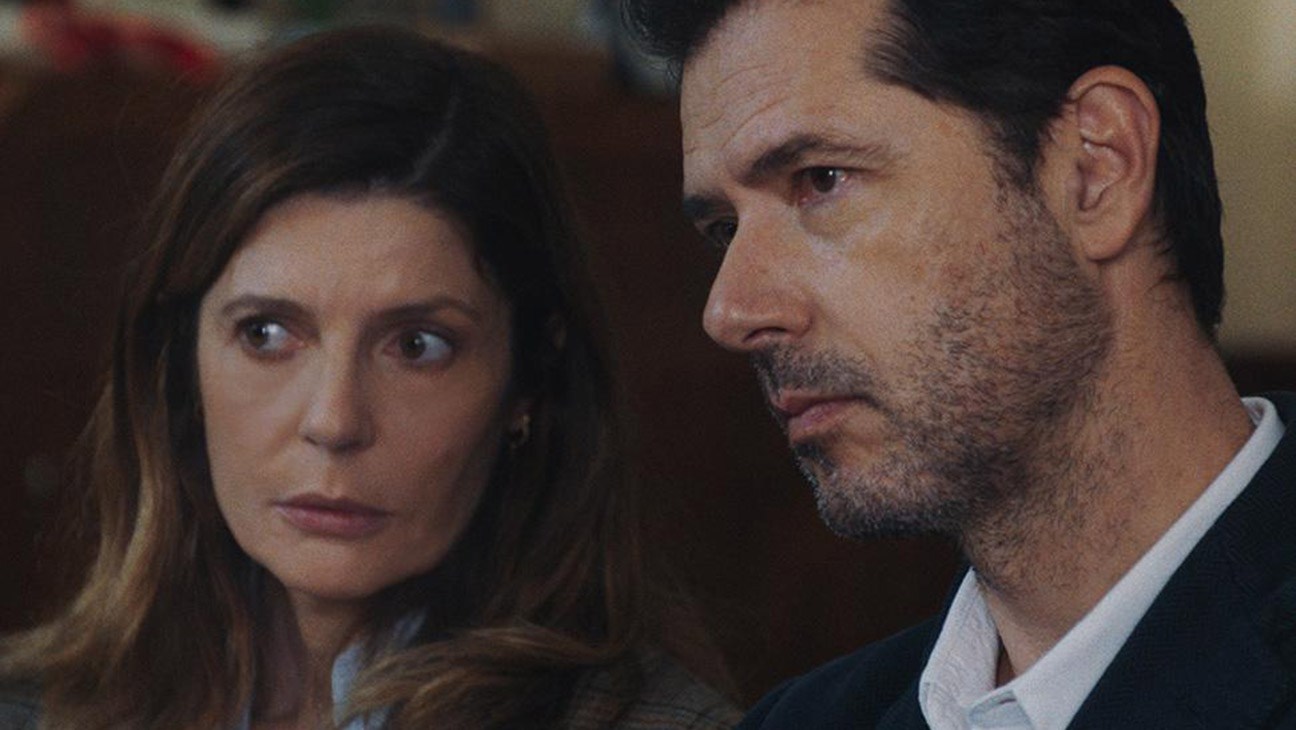
Léo (Melvil Poupaud), a former journalist turned untenured college professor, is not exactly what you’d call a success story, although he’s far from being a failure. Thoughtful, fairly seductive, still handsome despite some visible hair loss, the 49-year-old single dad seems to have led a relatively good life, so why does he seem so down on himself?
Those who seek out French director Nicolas Pariser’s latest feature shouldn’t expect a definitive answer to that inquiry, or any answers at all, really. One Minute to Midnight (Un peu avant minuit) is very much a film about a guy asking lots of questions — both of himself and of the coterie of old friends and lovers he runs into during a brief stay in Paris — wondering aloud who he once was and who, for better or worse, he’s become.
One Minute to Midnight
The Bottom Line
He’ll always have Paris.
Venue: Venice Film Festival (Competition)
Cast: Melvil Poupaud, Chiara Mastroianni, Anaïs Demoustier, Golshifteh Farahani, Léonie Simaga, Clara Pacini, Micha Lescot
Director, screenwriter: Nicolas Pariser
1 hour 51 minutes
Charming, melancholic and a tad too Parisian, the movie sometimes feels like an Eric Rohmer flick updated for an era of #MeToo reckoning and political upheaval, sprinkled with some Woody Allen-style urbanite humor. Partially inspired by the director’s own backstory as a film critic for a fledgling culture mag, it gets a bit lost in its own navel-gazing but makes some worthy observations along the way, especially about how we each wind up viewing our collective past differently as the years go by.
That past haunts Léo throughout his week-long trip to the City of Lights, where he’s waylaid before heading to Italy to deal with the death of his estranged and supposedly wealthy father. Shacking up in his deceased mother’s Left Bank apartment, Léo arrives at a time when Paris indeed seems to be burning: Riot police are everywhere and the French president is threatening to declare martial law, although what caused all the chaos is never specified.
Politics were front-and-center in two of Pariser’s previous features (The Great Game and Alice and the Mayor), but here they’re merely a backdrop (albeit an omnipresent one) to show how disconnected Léo and his generation seem to be from current events. This is made crystal clear when the professor meets up with his teenage daughter, Emma (Clara Pacini), at the start of his trip, embarking on a long and rather expository walk-and-talk before Emma heads out to a street protest along with other young rebels.
Composed of several such conversation pieces that Pariser often captures in lengthy single takes, Midnight follows Léo’s circuitous trajectory as he goes on to reconnect with some of the journalists he worked with back in the day, most of whom have moved on to other endeavors. Only the busy François (Micha Lescot), who founded their first magazine over 20 years ago, remains knee-deep in the press world, running a small media empire while producing a TV series about the now defunct publication where Léo and the others all got their start.
François is in fact modeled on the real-life Franck Annese, founder of So Foot, So Film and other titles in the popular So Press banner. Reference is also made to a certain Luc, who’s been accused of rape by several women he once employed (clearly a nod to So Film co-founder Thierry Lounas, who’s currently facing criminal charges in France). Many of these allusions can feel like inside baseball that will make sense to only a microscopic portion of the French population, most of it based in Paris. But Pariser manages to use those stories to tackle something more universal, portraying a middle-aged man trying to come to terms with his own questionable behavior, as well as that of his former peers.
In the film’s best dialogue scene, Léo has a long sit-down with Armelle (the evanescent Anaïs Demoustier), an intern he once had a fling with and who’s since gone on to become a major figure in the Socialist party (or, as she explains it, part of “the disappointing left”). Léo feels some remorse about their affair — he was a good decade older at the time and clearly in a position of power — whereas the rather bubbly Armelle seems to be more understanding: “Then, it seemed normal. Today, it probably isn’t,” she tells him, which summarizes many of the issues One Minute to Midnight is wrestling with.
If you’re not a fan of attractive Parisian intellectuals pontificating about their messed-up love lives in chatty scenes such as these, then Pariser’s movie probably isn’t for you. Thankfully, the director has brought together a seasoned cast that dishes out a fair amount of charisma and warmth, whether it’s Poupaud (who also starred in The Great Game), Lescot, Demoustier or the excellent Léonie Simaga, who plays a friend’s unhappy wife whom Léo winds up sleeping with after running into her at a party.
Old habits tend to die hard in Paris, even if the city is in the midst of a civil war. Steering clear of all the tear gas and dodging all the roving paddy wagons, Léo meanders his way through town in the hopes of eventually reconnecting with his long-lost object of desire, Tina (Golshifteh Farahani), who’s obtained a mythical status in his catalogue of exes. In the meantime, he’s set to take off for Italy and meet up with a stepsister (Chiara Mastroianni) he never knew, finally piecing together fragments of his own backstory.
The closing scenes forego some of the earlier humor — including a funny one-on-one between Léo and a movie critic turned devout Jew played by Pariser himself — for more straightforward sentimentality, trying to tie up all the loose ends before it’s too late (in other words, before Léo hits 50). If the ending of One Minute to Midnight isn’t exactly convincing in that regard, it does gives Léo something to be, well, not exactly happy about, but at least persuaded that his journey through life hasn’t toally been wasted.
Credit: Source link