
There’s been a lot of chatter in recent weeks about the new movie “Project Hail Mary.” With a tone of pleasant surprise, both average folks and critics have noted that, for once, Hollywood produced a decent, enjoyable film.
I haven’t joined the throngs attending “Project Hail Mary,” so I can’t comment on whether I agree with the above assessment; however, I did have a similar, “why-can’t-Hollywood-make-films-like this” response when I recently stumbled across an old film entitled “The Impatient Years.”
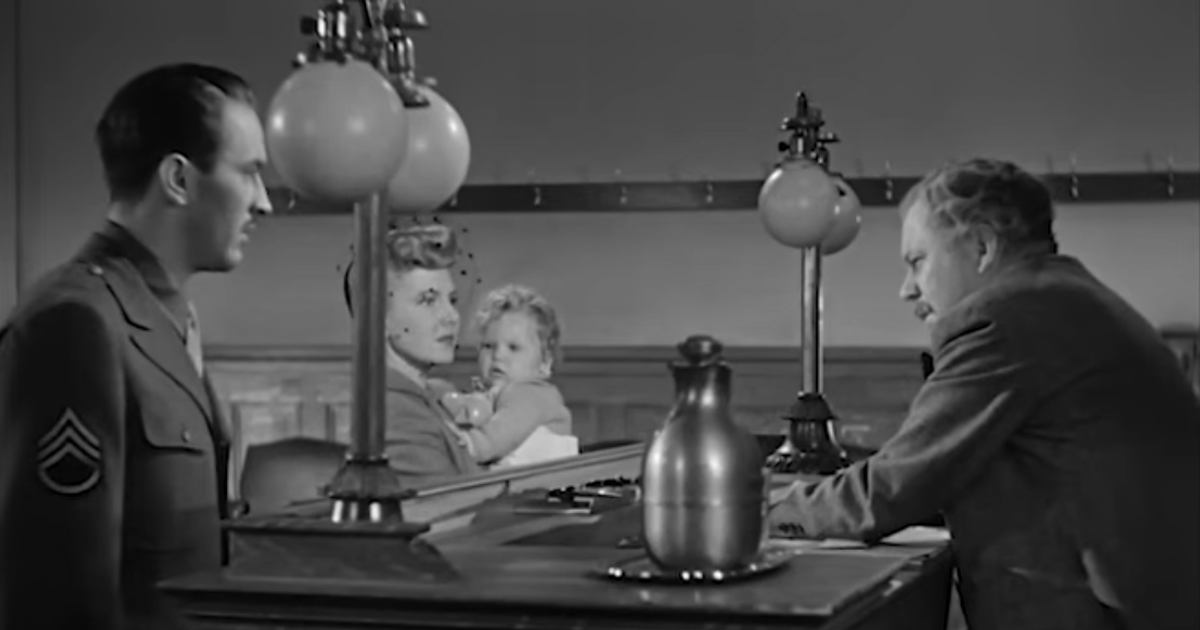
Originally released in 1944, “The Impatient Years” addressed the many hasty marriages that took place during World War II. Actress Jean Arthur plays one such war bride, who meets and marries a man named Andy in four days, then doesn’t see him for a year and a half because he’s flying planes in the Pacific. When Andy comes home on leave, he’s greeted by a wife he barely knows who is more absorbed in their baby and her housekeeping than him. In less than 24 hours, tensions rise and the two seek a divorce, wondering why they were ever interested in each other.
Yet divorce efforts are thwarted when the judge orders them to return to the place where they met and married, retracing the original steps which led to their union. At first resistant and determined to go through the motions in order to divorce, the couple gradually falls back in love despite screwball mishaps. By the end, Arthur’s character tells the judge, “I don’t want a divorce,” explaining that she’s realized that it’s her duty to stick with her husband through thick and thin simply because he is her husband.
“See what you people don’t seem to realize is that it’s after the honeymoon that’s the best about marriage,” she says. “It’s the living everything together with your feet in the housekeeping and your hearts in the sky. And it can be done!”
Such a movie may seem trite and ordinary today in a world of special effects and optics, yet I stepped away from it in awe. Its story was so genuine and heartfelt that it taught a profound life lesson without the cheesiness that often accompanies films which aim to advance morality. To reiterate the question I asked above, “Why is it that Hollywood can’t make films like this anymore?”
One possible answer to that question is found in author Russell Kirk’s book, “Enemies of the Permanent Things.” According to Kirk, the problem with the “Marxist writer” – a description which could easily be applied to many in Hollywood and pop culture at large today – is that his ideology has denied him the main “themes or sources of inspiration” undergirding storytelling in Western civilization.
“The first of these is religion,” Kirk writes, “the description of the order that is more than human and more than natural.” Yet religion is taboo to Marxist storytelling because it is “the opiate of the masses,” he explains.
“The second of these is love: the devotion of a truly human person to a truly human person,” Kirk continues. But in the Marxist imagination, love is not the selfless giving of oneself to another; instead, it “has become the gratification of physical impulse.”
“The third of these is heroism: the triumph of honor, duty, and fortitude,” Kirk says. Yet in the Marxist mentality, “heroism has become service to the production-consumption State: it is servile.”
Finally, Kirk labels “private fortune” as the fourth element of strong storytelling in Western civilization, where “the adventures of human individuals within the labyrinth of a diversified society of classes and orders” exist. Under the ideology of Marxism, however, “private fortune, with the abolition of class and order and social diversity, has grown subversive: it is anathema.”
Now consider these four elements in light of the plot of “The Impatient Years.”
Religion? It’s not explicitly mentioned, yet in advancing marriage as a lifelong commitment, it upholds an institution ordained by God from the very beginning.
Love? Definitely. In fact, it shows how love which starts as physical gratification can grow into something selfless and lasting, a partnership between two struggling souls each seeking the other’s best.
How about heroism? Here we see several examples, including the husband’s willingness to fight for his country, as well as the couple’s realization that it was honorable and right to do their duty and remain true to their vows, regardless of their feelings.
Finally, while this movie doesn’t outright address the conflict between economic classes, it does address the clash which comes between males and females and their different mentalities, a “diversified” reality that many today don’t want to admit exists.
These insights not only explain why many of today’s movies are such a disappointment, but they also teach us how to discern what constitutes high-quality entertainment. When we remove the basic components of a good story – faith, love, heroism, and class differences – because they no longer fit with a politically correct view of the world, we’re left with boredom and apathy. Yet those willing to embrace the discomfort that these topics bring will understand more about themselves and the world around them – and will enjoy themselves while doing so.
Annie Holmquist is the culture and opinion editor for 1819 News. Her writing may be found at The Epoch Times, American Essence Magazine, and her Substack, Annie’s Attic.
This culture article was made possible by The Fred & Rheta Skelton Center for Cultural Renewal, a project of 1819 News. To comment on this article, please email [email protected].
The views and opinions expressed here are those of the author and do not necessarily reflect the policy or position of 1819 News.
Don’t miss out! Subscribe to our newsletter and get our top stories every weekday morning.
Credit: Source link