
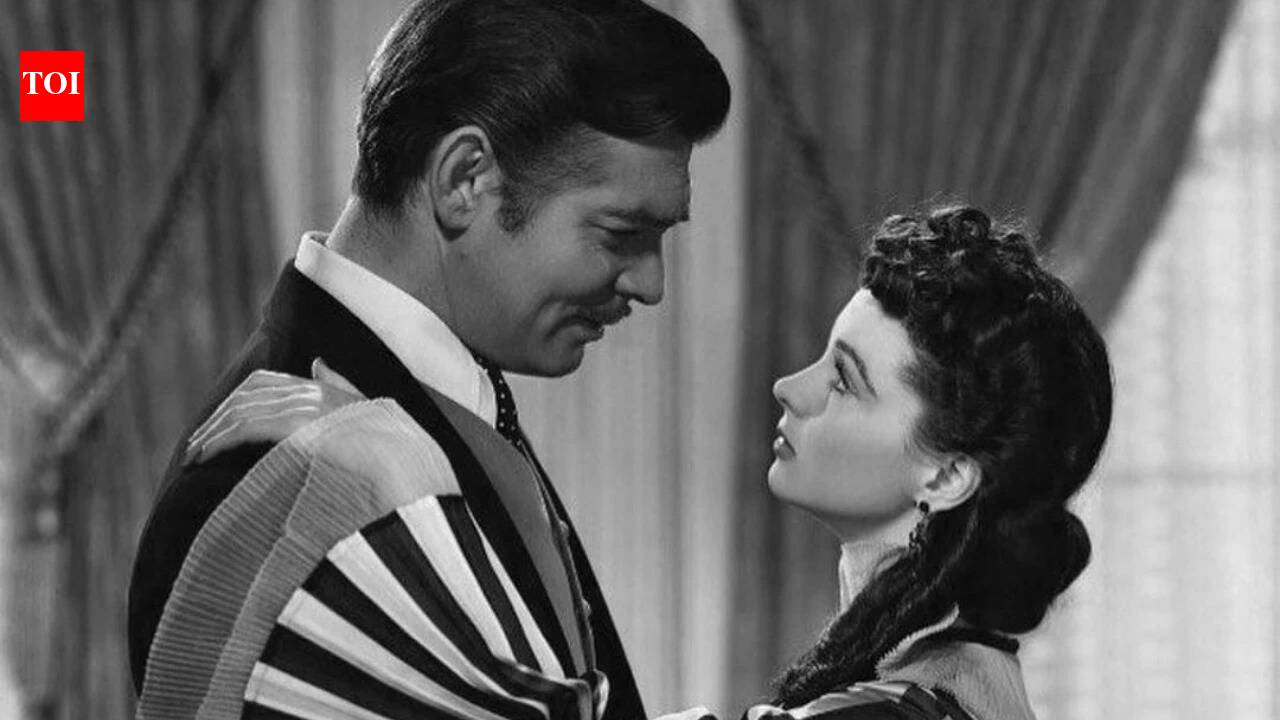
Few lines remain etched in our minds in the pages of cinema’s history.“Frankly, my dear, I don’t give a damn”, is one among the many. One of the most painful and heart-breaking climaxes in Hollywood is remembered through the dialogue, delivered by Clark Gable as Rhett Butler in the 1939 film Gone with the Wind.In the final moments of the film, Rhett walks away from his wife Scarlett O’Hara, played by Vivien Leigh, leaving their stormy relationship on a devastating note. The film, directed by Victor Fleming, is based on the 1936 book of the same name by Margaret Mitchell, which later won the Pulitzer Prize. The film is set during the American civil war and reconstruction. It follows the life of the willful Scarlett O’Hara, the daughter of a rich plantation owner in Georgia.Amidst the war that transforms the American South, Scarlett finds it difficult and continues struggling to shield the cotton plantation estate, Tara, which her family owns.During that time she navigates her complicated relationships, personal ambition and emotional loss.Throughout the film, the pampered socialite and petulant Scarlett remains obsessed with her first love, Ashley Wilkes played by Leslie Howard, whom she has always desired.Ashley is a tall and thin, soft-spoken young man who doesn’t feel the same way that Scarlett feels for him.But, on the contrary, Scarlett’s love and admiration grew more towards Ashley, which made her request him to marry her instead of her sister Melanie.Rhett Butler, the male protagonist, was a guest invited to Ashley’s home for an engagement at Twelve Oaks and there Scarlett had noticed him.Following a series of events, she ended up marrying Rhett Butler. He was a charismatic and worldly blockade runner who genuinely loved her.Their marriage had all the qualities of passion, jealousy, misunderstandings, and tragedy, including the death of their young daughter, Bonnie Blue Butler in an accident. Gradually their marriage started turning bitter and also Scarlett’s inability to fully appreciate Rhett’s love gradually eroded their relationship.Around the same time, Melanie Hamilton who had married Ashley dies which made Scarlett realize whatever she felt there through the years for Ashley was nothing but an idealized fantasy.Gradually, the famous scene unfolds where the quote has been spoken after Rhett realized that he has reached his emotional breaking point.Scarlett, believing that she loves her husband and can save her marriage, desperately pleads with Rhett, not to leave her. She asks, “Where shall I go? What shall I do?” Rhett, exhausted by years of emotional neglect and heartbreak, responds with the now-immortal words: “Frankly, my dear, I don’t give a damn.”He then walks out of their mansion, leaving Scarlett alone on the staircase.The moment was groundbreaking for another reason. At the time, the word “damn” was considered inappropriate under Hollywood’s strict Motion Picture Production Code, commonly known as the Hays Code, that began to be enforced in the beginning of 1934.Producer David O. Selznick successfully argued that the line was essential because it appeared in Margaret Mitchell’s original novel and was crucial to preserving the emotional impact of the ending. According to CBR, they chose to pay a fine rather than omit the “damn” from the classic final confrontation.The filmmakers received special approval to retain the dialogue, making it one of the earliest high-profile exceptions to the censorship rules.
Credit: Source link