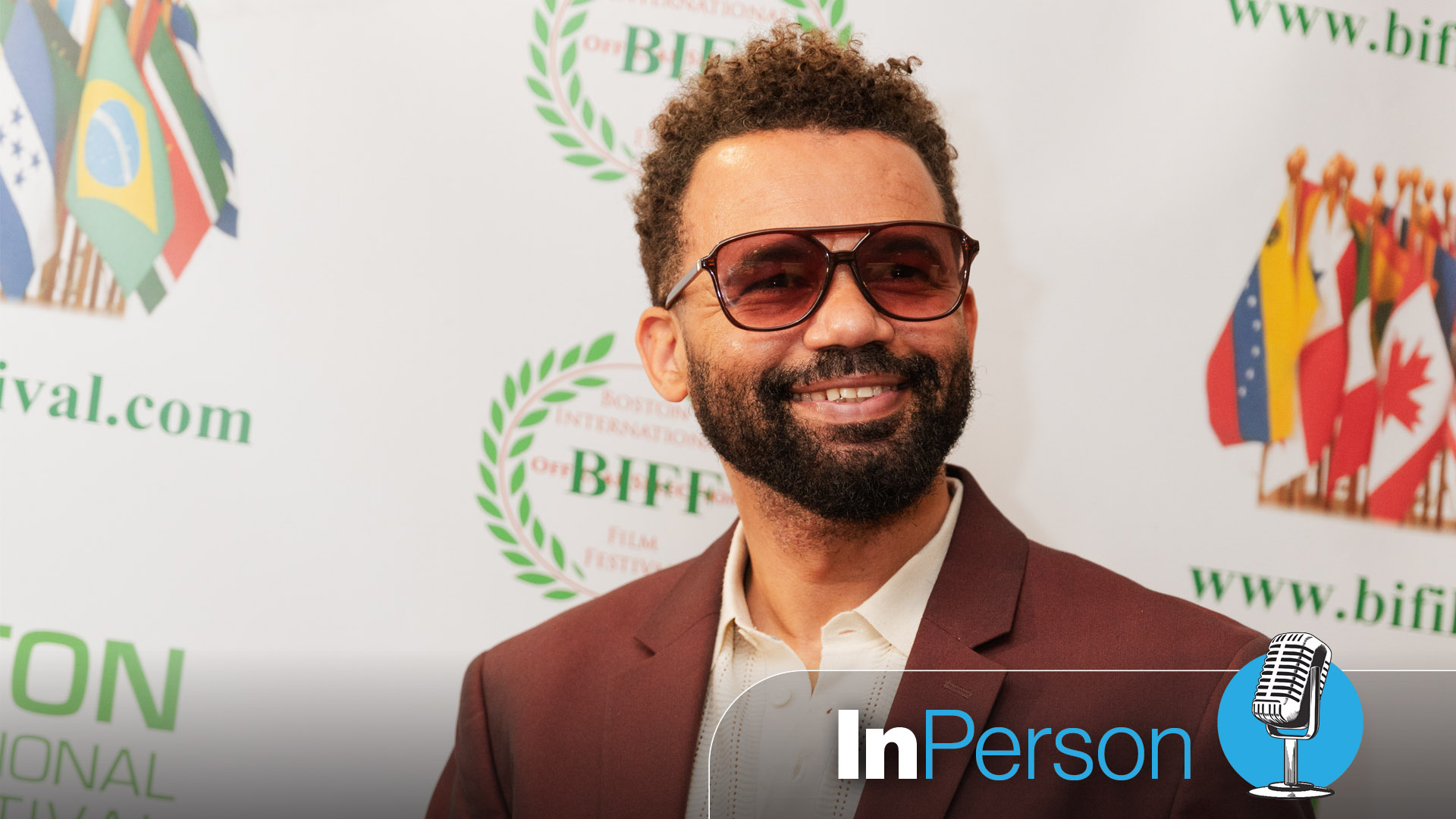
Jean-Claude Van Damme, Bruce Lee, Arnold Schwarzenegger. These names may be familiar to the average action film buff, but to Carlitos Do Souto, they mean something much more.
As a young boy, Do Souto watched action films like “Bloodsport,” and sometimes he became so captivated that his parents would have to call him away from the television for dinner. He was particularly drawn to the action-packed sequences because he couldn’t speak English, having emigrated to the United States from the island of Fogo in Cabo Verde with his mother and brother when he was 12.
They joined his father in Boston and spent nine months there before settling in New Bedford, where his father opened Tropical Barbershop.
Do Souto graduated from New Bedford High in 2000 and attended Bristol Community College in Fall River for two years before moving to Los Angeles to attend Loyola Marymount University, where he studied theater. Now, still living in Los Angeles, he is a real renaissance man, writing scripts and acting.
He is the writer, director, producer, and star of “Radio Sky,” an original film about a hacker under house arrest who must work from the confines of his home to rescue a NASA astronaut from a hostage situation on the International Space Station.
At the recent Boston International Film Festival, “Radio Sky” was the only film to win two awards. It beat out more than 6,000 other entries from 60 countries for the Audience Choice Award and the Best Original Screenplay.
The film, which also features actor Dennis Haysbert as the NASA director of communications, premiered at the Pan African Film & Arts Festival in February and won the Programmers’ Award for Feature Narrative. “Radio Sky” also won an award for best editing at the Hollywood Diversity International Film Festival in March.
For Do Souto, submitting his work to festivals is key to gaining exposure in the film industry.
“Hollywood moves on momentum, on heat, and by winning these festivals, that’s how it will expand your reach,” he said. “Then the industry will start to want to pay attention to it. And at the moment, it’s done exactly that.”
Do Souto spoke with The Light about his passion for creating “Radio Sky,” his experience growing up as an immigrant in New Bedford, and diversity in the filmmaking industry.
New Bedford Light: You grew up with roots both in Cape Verde and New Bedford. How would you describe your upbringing and the role these places had in shaping you as a person?
Carlitos Do Souto: I would say, growing up in Cape Verde, it’s very cultured, very grounded, very small country. So the family is very together, and I still maintain that connection with family. And then you come to New Bedford, it’s like another version of Cape Verde. They have their own little community there. So that was very, very resembling what the ethics in Cape Verde are because of the people that I was surrounded by.
NBL: When did your interest in acting and storytelling first begin? Was it at New Bedford High School, or was there a particular moment that you realized that this might be the path for you?
CD: It was at a very young age when I realized that in life, we all had to make a decision. That was the only thing that made sense to me, and everything else seemed to me like work. You know, that’s the only thing that I was like, ‘yeah, I can see myself doing this,’ and when I die, that’s what I want to be known for.
NBL: Were you involved in theater at New Bedford High School or any other extracurriculars?
CD: Yes, very briefly. I did plays there. I think one of the plays I did there was “Guys and Dolls,” but because my English was so terrible and I was still in the bilingual course in New Bedford High School, I would say I was the guy who would always play the dancer or the gambler or just the non-speaking role.
I remember taking theater classes in New Bedford High School, and I remember struggling reading. I couldn’t read. I used to be very embarrassed whenever we used to read scenes, because just your regular reading was very challenging for me. So it was a very tough time for me.
NBL: When you act, reading is important to be able to understand the script, but do you feel that theater and performance can transcend language and culture in other ways?
CD: Absolutely. I think if you watched the Oscars … you know everybody there, they were pulling for humanity, for the people around the world who are in some odd situation where they’re crying for their freedom. So I think in theater, you find that in the materials that you work with and what you represent.
NBL: What influence does your heritage and culture have on your art and filmmaking?
CD: I would say the ethics, the hard work. When you’re an immigrant growing up in Cape Verde, you have a good contrast of how much that this country can offer you. I would say that the hard work, the cultural effect of it, just being grounded as a person in who you are, I think that has led me to where I am, regardless of the struggles. You find a lot of people that will come to Los Angeles for the entertainment industry that will deviate to different paths because they lack that groundedness. I think for me, it doesn’t matter what the struggle is, but because of my upbringing, I’m always resilient and sticking to my path because of my background that I grew up with.

NBL: Did you always want to be an actor, or did you know you wanted to be a writer, director and producer as well?
CD: In the beginning, most people start out very naive thinking, I just want to become an actor. But then once you pursue it for a long time, you realize that it’s a very powerless position, and a very small percentage of people get to live the dream.
And from that point on, most of us ended up, eventually, branching to different aspects of the arts. So from that point on, I began enrolling in different community colleges and writing programs in LA. I’ve been writing scripts for about 10 years, and then I also enrolled at the New York Film Academy and studied filmmaking and directing, because the days of just doing one thing and waiting for people to rescue you or give you the opportunity is over.
NBL: Have you primarily worked in English, or have you worked on any bilingual projects as well?
CD: Very little (bilingual), because the opportunity is very little around here to do other bilinguals. And whatever opportunities there are, I would say, would be Spanish, Portuguese, and you have those native people that can do that. In terms of being Cape Verdean, the community in Hollywood is basically inexistent.
NBL: You mentioned you like to create opportunities for yourself. Do you see a future in which you’re pursuing more bilingual projects, or do you hope that more Cape Verdeans get involved with the arts in Los Angeles?
CD: More people are starting to come. So we have a little group of people here in the industry, but I would love to go back there. I actually have a script that I plan to do next that actually takes place in downtown Boston. I also have ideas about scripts in Cape Verde, and I have a friend of mine who’s actually a professional writer on TV here who is Cape Verdean American who has a script that takes place in Cape Verde.
So at some point, yes, that’s definitely something that I would like to venture into, given that the story there and just the place is interesting, to bring a fresh idea into the filmmaking in Hollywood. Because if you look at the materials and the films out there, it’s just a recycle of the same thing. So going to a place like Cape Verde or a different country that Hollywood is not accustomed to seeing brings us a different perspective to the industry.

NBL: I wanted to move to talking about “Radio Sky.” You’re the director, writer, producer and actor behind the movie. What inspired the idea for the film?
CD: Most of my scripts take place in one location or very limited locations, because I love creativity. One of my backgrounds is inventing. So I like to take something that’s challenging and make something out of it, but then at the same time, budget wise, it’s very executable to try to do scripts in very limited locations.
When I decided to do this script, I wanted to tell a story that’s contained, but also that will sound big and look big, and that’s why I created a story where a hacker is inside his apartment and he has to deal with the major challenge of hacking the International Space Station in search of missing astronauts.
NBL: There are many movies about space and many more movies about hackers. What do you think makes “Radio Sky” unique, and what do you want audiences to take away from it?
CD: I would say what makes “Radio Sky” unique is that most space films are about spectacles and explosions. “Radio Sky” is a very grounded sci-fi film. It’s a film that starts in one room on Earth and then expands into space. So because of that, it deals with more human connection than just a movie that takes places in space and deals with aliens and explosiveness.
If you look at the themes of the script, it deals with everyday struggles. You have a hacker who’s been framed by the government. It deals with the distrust that society is dealing with the government, and regardless of what he’s going through with his arrest, he decided to sacrifice himself in search of other human beings and hopefully bring them home.
NBL: The film explores the connection across distance and technology. What do you think “Radio Sky” says about how people are connecting in our increasingly digitized world?
CD: Technology in “Radio Sky” is used in a positive sense, to find connection, to find signals. You have a first time astronaut who her entire life she aspired to be an astronaut, and she finally made it there. But then something happens in space. NASA lost contact with them, and she’s lost, so in this premise, technology is used in a useful way, because the hacker was able to use technology and save the lives of human beings.

NBL: The film also features veteran actor Dennis Haysbert, who’s also an executive producer on the film. What was it like working with him, and was there anything that you took away from that experience?
CD: So when you do something, an independent film, it’s always a great idea to have star power in the project. I was looking for the character of the Director of Communications at NASA and there was nobody out there in Hollywood that I thought would have captured the essence of that character as Dennis. He’s got a unique authority in his voice that just fulfilled the character in a way that was very satisfying for me, and the fact that he’s also played the president of the United States before on the TV show “24.”
I was very fortunate to be able to land an actor like that in this film. At the same time, working with a veteran actor like that, and getting through the process successfully is satisfying in a way that it gave me confidence that I’ve done what I’m supposed to do. I’ve done the training, and I was able to execute a script and direct a guy of such capability on my first feature film.
NBL: Given that your film won Best Feature Film at the Pan African Film & Arts Festival, why do you think it’s important right now to create films with diverse perspectives and cast as well?
CD: So I was actually shocked that it won the award there, given that Pan African is more of a cultural theme festival that shows films on racial injustice, African related stories. And I went there with a Sci Fi thriller. So the fact that it won is actually a plus, given that it was able to stand out at a festival where it was not its strength.
What I see for this film, in terms of diversity, is that most directors or actors or talented people of color, the complaint that you have in Hollywood is that you know the project that’s available for us is not anything that is of any consequence. Sometimes they give us roles that, when we read it, do not really appeal to what we want to do. So for me, I wrote a film that’s very smart, a film that deals with NASA, cyber security, government, space, to put people of color in positions where they can elevate themselves, rather than write stories that’ve been written for us that we don’t really see the hunger to do.
NBL: You’ve lived in Cape Verde, Boston, New Bedford and Los Angeles. What place do you think has had the biggest impact on your creativity?
CD: I would say definitely LA, because it’s all around you.
NBL: Many people have dreams of moving to LA and becoming an actor, as you’ve mentioned before. Do you feel that your decision to pursue filmmaking would have still been possible if you hadn’t made that big decision to move to LA?
CD: I would say no. Because, when you think of LA, it’s the capital of the entertainment industry. When you think of New Bedford, it’s the whaling city, it’s the fishing industry. There’s nothing there. Even when I was in New Bedford, I did theater at BCC.
When I used to go there during the summer in college, I used to apply to auditions in New York. It’s just very, very tough. I remember one time I made a trip to New York to audition for a play, and when I got to New York, I couldn’t find the address. Then I called a cab, and the cab couldn’t find the address, so I had to drive back home. I was embarrassed.
One of my parents asked me, ‘how did it go?’ I said it was great, because I didn’t want to tell them I drove to New York for no reason. So it’s very challenging to get an opportunity in New Bedford, unless you just want to do something local.
NBL: How do you think a city’s culture or environment impacts the type of art that’s able to flourish in its community?
CD: I think with LA, even though production companies are moving out of LA due to tax incentives, here you have all the platforms. You have the agents, the managers, you have the studios, you have the resources, the schools. It keeps you very focused.
Whereas if you go to New Bedford, sometimes I go there and, if I want to, I’ll drive to the beach and sit by myself. It’s very raw in LA — you go to a coffee shop, you find a bunch of people doing the same thing, you know? It keeps you going, but it’s very challenging to do that in New Bedford.
NBL: What is the main piece of advice you would give to either students from New Bedford High or people from New Bedford who may not realize that careers in filmmaking are possible for them?
CD: Well, I think it’s really within you. You have to know how much the passion is in you, if the passion is strong to where you know there’s nothing else for you. Then, that’s the path. Then you have to pursue it.
When I said the opportunity is not in New Bedford, I don’t mean to be negative, but I’m just being very real, because in the film industry, people are very real with you. They’re not afraid to break your heart, break your spirit. I would say, if someone wants to pursue filmmaking, make sure it’s the only thing that they can see themselves doing, because it’s extremely difficult to get those opportunities.
The general consensus here is that if you have anything else that you can do that generally makes you happy, do that, because if you think you’re just going to come here and make it, it’s very challenging.
I remember when I first came to LA, the percentage of people that made it in the film industry was like 4% to 6%. I think now they say it might be 10% to 12%, so that means you have about 90% of people who come here and don’t make it. So if that’s what you want to do, then work hard at it.
But if I were to do it again, I would try to enroll in one of the top five acting institutions in the world. On the East Coast, you have Yale, you have Julliard. Those institutions make a difference when you come to LA.
Kiva Bank is a former New Bedford Light intern and is a freelance writer and contributor.
This interview has been edited for length and clarity.


Credit: Source link