
The more conventional Obsession, written, directed, and edited by Curry Barker and reportedly made on a meager budget of $750,000, concerns a sad-sack young man named Baron aka “Bear” (Michael Johnston) who’s in apparently unrequited love with his far cooler music store coworker Nikki (Inde Navarrette). Fearing he’s been permanently “friend-zoned,” he buys a novelty wish-granting gizmo from a spiritualist store and uses it to wish that Nikki would love him more than anyone else in the world.
Immediately Nikki’s behavior changes, becoming alarmingly clinging and frantic, then turning murderously possessive. Navarrette’s powerhouse performance as the paranormally possessed Nikki, edged in a kind of ironic humor and awareness of playing a nightmarish male fantasy cliché, is getting her a lot of well-deserved attention.
Both horror films offer characters living dead-end lives in spaces that hark back to a more stable and prosperous past. Though that past seems appalling in a different way than the present — it’s a dead, used-up husk that haunts the living and foretells our doom. Backrooms is especially sensational because it finds a way to represent the United States in steep decline without prancing about it in any didactic way. It’s a terrifying reality we’re trapped in here, and twenty-year-old director Kane Parsons roots our shared angst in bleak spaces representing our desiccated nation grinding to a halt. Those spaces include the deserted ones of old analog America, circa the 1980s, that haunt the more precariously situated contemporary characters.
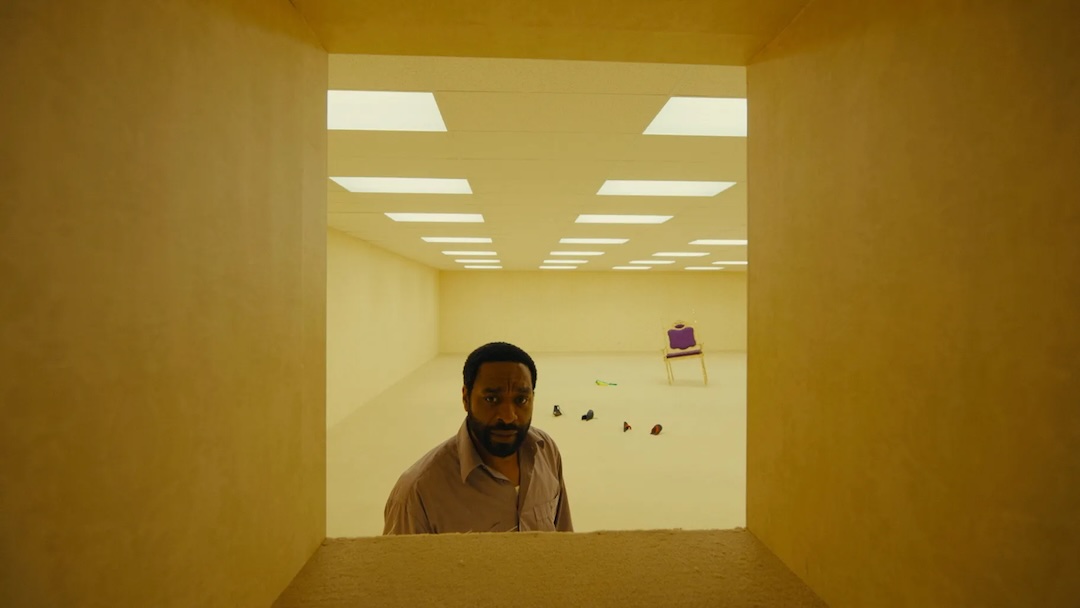
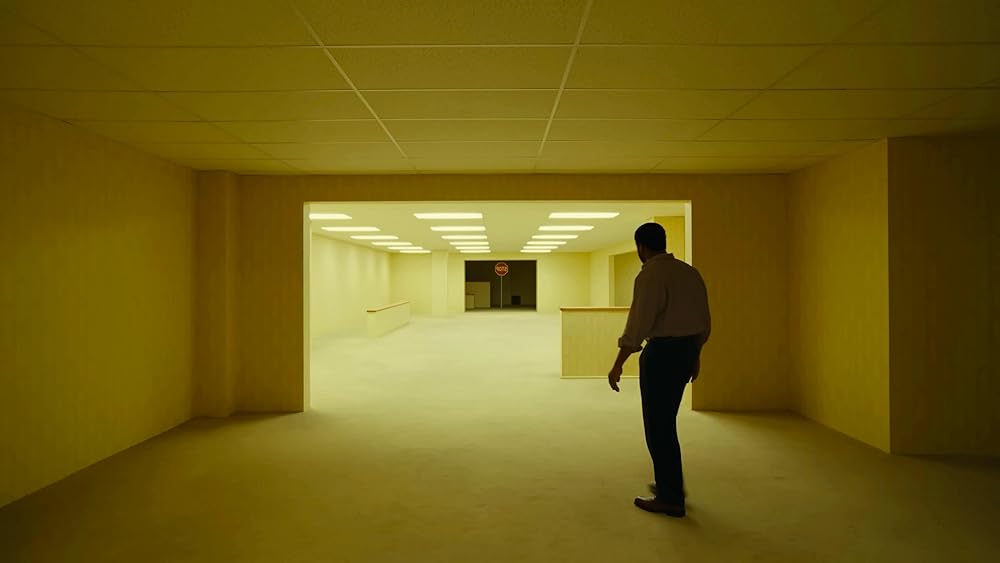
Those horror-infused spaces aren’t just the abandoned office buildings and commercial complexes — one beige box opening out from another in dreadful no-exit labyrinths — that Parsons made chillingly memorable in his inspired “creepypasta” web series on YouTube. No, the other ordinary but still terrible spaces are lived in and worked in by the main characters. There’s a reason these characters are willing to cross over into a kind of fourth-dimensional hell world of endless deserted space featuring low ceilings, stained tan carpets, no windows, and fluorescent lighting that casts an unwholesome sulfurous yellow glare on everything. And that’s because their own spaces are also dreadful — more insidiously dreadful because they’re still in use. But they’re deadening traps just the same.
Clark (Chiwetel Ejiofor of 12 Years a Slave) is the owner of a strip mall furniture store, one of those vast, flat, one-story, hugely depressing places loaded with the ugliest furniture ever seen, for sale at bargain rates. Its advertising takes the form of those frantic, pathetic TV ads boasting about “crazy” prices. Clark plays a peg-legged pirate character in these ads, sweating with humiliation while shouting nonsense about looting the store, and it’s no surprise that the ads don’t bring in any customers. Someone has spray-painted angry red graffiti on the storefront reading “RIP OFF.”
Clark is also living at the store, sleeping in one of the cheap for-sale beds, because his wife recently kicked him out of the house. It’s no wonder that his alcoholism has reached a drinking-directly-from-the-bottle stage. He’s seeing a therapist named Dr Mary Kline (Renate Reinsve of Sentimental Value), who gets him to express through role-play some of his bottled-up rage at his estranged wife, his apparently useless degree as an architect, his grim failing business, his money terrors, and the overall hopelessness of his plight.
His ordinary life is so grim, it figures that Clark is willing to explore at length the vast, forbidding limbo on the other side of one wall of his downstairs furniture storeroom. It’s no wonderland on the other side of this porous Alice Through the Looking Glass barrier. It’s apparently just old, abandoned office space from the 1970s or ’80s. But acres of it, miles of it, an eternity of the worst kind of interiors ever designed to torment a suffering workforce, and the farther you travel within it the stranger it becomes in terms of skewed angles and weirdly placed windows that open into more box-like rooms, never the outside world.
Confounding remainders of previous human activity appear in the form of heaps of clothing, frantic scribbles on the walls, a stop sign hung over one entryway, a cardboard cutout figure wired for audio that spews out corporate-speak in various languages. And then there are the disturbing sounds of distant movement that gradually coalesce into roaring, smashing, and a rhythmic tromping noise and gets suddenly, alarming louder. . . .
When Clark has been missing for some time, Mary Kline tries to figure out what happened to her client. We also get a look at her life, which is certainly more financially stable that Clark’s but has a similar entrapped quality to it. Her office and home spaces are anonymous, stultifying, deindividualized. Her life with husband and son has a creepy still-life tableau quality to it, as if they’ve become paralyzed while sitting on generic furniture staring at the TV. She has nightmares of her abusive childhood trapped in a house with her mentally ill mother.
Her practice is boosted by her book advertised on television in which she provides therapeutic wisdom about the way people become trapped in loops of habitual behavior, blocked behind metaphorical glass windows that aren’t locked and could be opened at any time. It’s a familiar line of therapy talk that always makes salvation an act of simple personal willpower, as if the toxic effects of living in a world of destructive systems were negligible factors. “Open the window,” she intones.
But what if a version of “the window” is a porous door-shaped area on a wall in a furniture storeroom that leads to an inexplicable netherworld? And that other world features “windows” everywhere that only open onto other rooms, never to the outside world?
Credit: Source link