
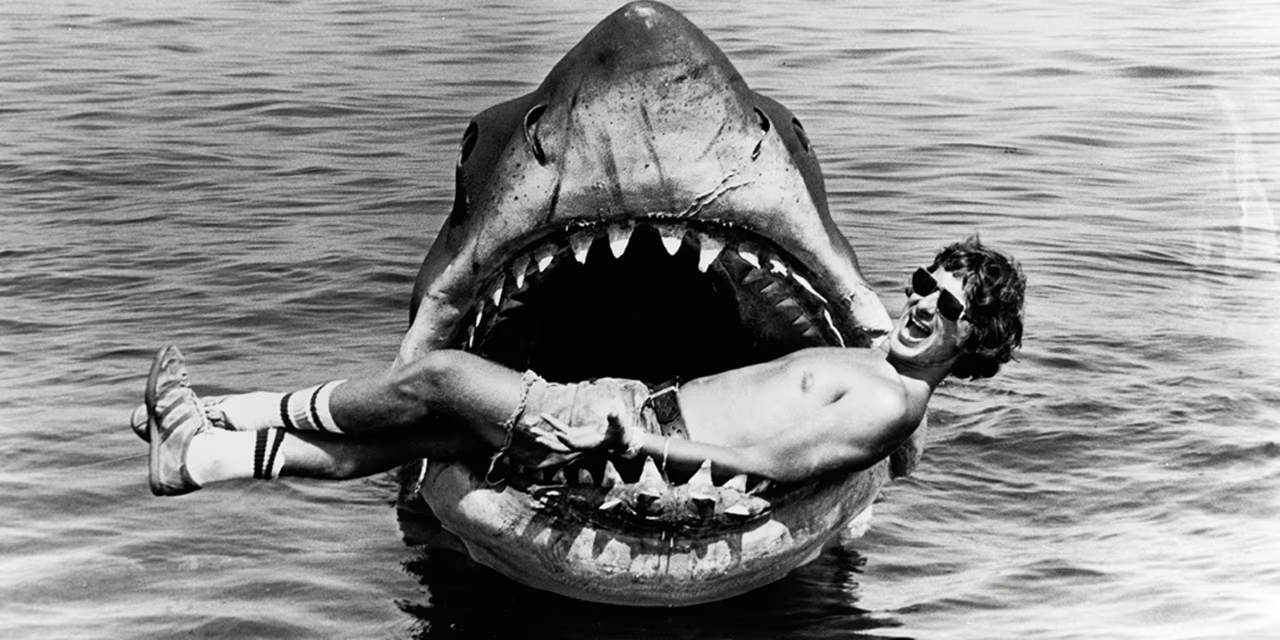
It’s November 1977. Three men are flying in a private plane from Los Angeles to Washington, D.C., for a gala event at Jimmy Carter’s White House. They are filmmakers, each of whom has directed, in succession, the biggest box-office moneymaker of all time. And, as Paul Fischer relates in “The Last Kings of Hollywood,” all of them are miserable.
Francis Ford Coppola was the first to break the record, with “The Godfather” (1972), but it’s five years later now, and he’s sinking under the psychological and financial deadweight of filming “Apocalypse Now,” whose release United Artists has just delayed for a third time. Steven Spielberg broke Mr. Coppola’s record with “Jaws” (1975), but he’s chewing his nails as, down below on Earth, his longshot aliens-among-us movie “Close Encounters of the Third Kind” opens in theaters this very night. And while George Lucas is counting the days until his space opera, “Star Wars,” will surpass Mr. Spielberg’s record—he’s done the math and has calculated it will be at 7:05 p.m. the Saturday after next—even he’s unhappy.
These men are literally and figuratively on top of the world, yet, as Mr. Fischer tells it in his triple biography of the directors, the only thing they can talk about is how depressed they are. As you read the book, you begin to understand why: Mavericks all, they’re slowly hardening into the cinema establishment they once fought against. Or, in Mr. Coppola’s case, trying to become a new establishment and failing spectacularly at the job.
“The Last Kings of Hollywood” is a brisk, engaging account that breaks no new ground and offers few fresh insights, in large part because all three of the author’s subjects declined to be interviewed. But if you don’t already know the story of how the movies were made safe for the multiplexes in the 1970s, this is as good a place as any to start. Mr. Fischer, a British filmmaker, has done diligent research, consulted the many previous works on the era and spoken to a great number of people who aren’t named Coppola, Lucas or Spielberg but who worked or lived with these directors.
There were other filmmaking upstarts at the time—including Brian De Palma and Paul Schrader, both of whom spoke with Mr. Fischer—but these directors stay on the sidelines in this telling. The exception is Martin Scorsese, who lurks in the background of “The Last Kings” like a dark prince. (He, too, declined to be interviewed.) That makes sense: Mr. Scorsese’s work bristled with New York sin, guilt and violence, while the author’s three subjects were all schooled and made their homes and films in California. More to the point of Mr. Fischer’s thesis, the three kings of his title worked with one another over the course of 15 years, producing and writing one another’s films, providing career-changing opportunities while also sometimes cutting one another out of the profits with malice aforethought.
Copyright ©2026 Dow Jones & Company, Inc. All Rights Reserved. 87990cbe856818d5eddac44c7b1cdeb8
Credit: Source link