
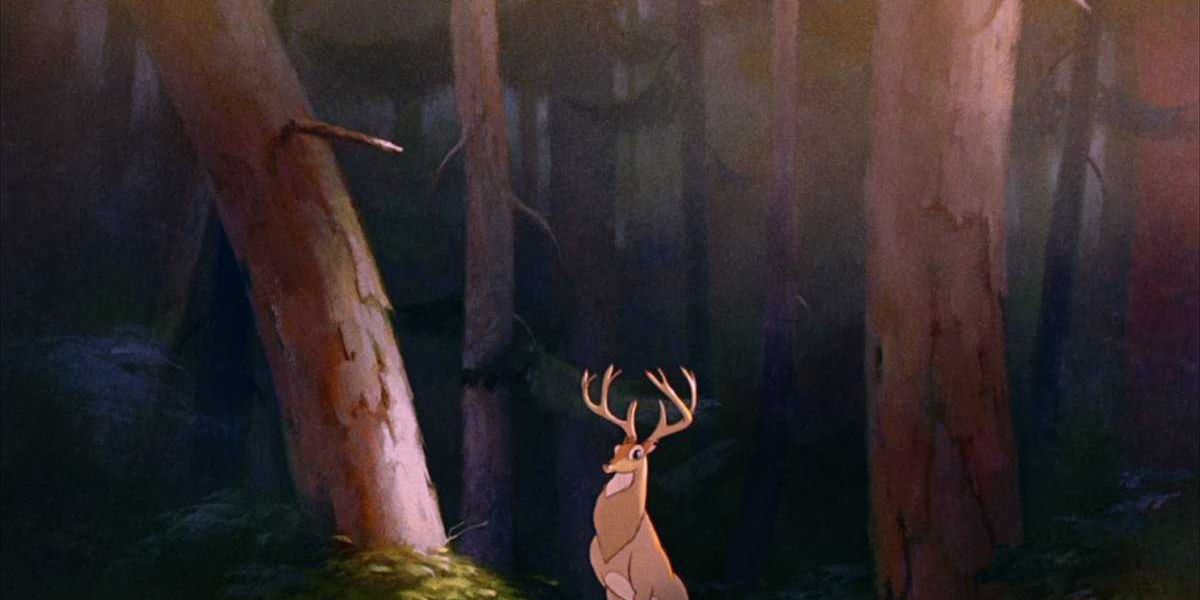
A few years back, the American Film Institute released its list of the 100 greatest heroes and villains in Hollywood history. Voted on by more than 1,500 figures from the film community, the company it keeps is about what you’d expect… Hannibal Lecter, Darth Vader, the shark from Jaws. It’s a who’s who of baddies.
Number 20 on the villains list, sandwiched between Captain Bligh and Mrs. Iselin, is a character named “Man.” No actor is credited. No face is shown. In 70 minutes of this character’s film, the villain never once appears on screen.
“Man” is the hunter from Walt Disney’s 1942 animated feature Bambi, and it’s the only character across all 100 entries on either list who never appears on screen.
The unique entry can teach us a lot. Are you trying to figure out how to build dread without complicating your shoot or storyline? Or what about how to make an antagonist land, even if you can’t show them? Let’s learn more.
– YouTube www.youtube.com
Man Is a Presence, Not a Character
Bambi is based on Felix Salten’s 1923 Austrian novel, which Disney acquired in 1938 after a producer at MGM couldn’t crack how to make it work as a live-action film.
In the source novel, Salten included extended sequences of graphic violence. A large hunting party enters the forest and kills multiple animals in gruesome detail.
Disney stripped that out entirely. What replaced it was something that was still scary to kids—just the suggestion of the antagonist.
Sound design carries much of Man’s menace in the film. You hear gunshots. You see animals scatter. Tension runs through the entire forest.
The death of Bambi’s mother happens entirely off-screen. One moment she’s there, telling Bambi to run, and then she isn’t. Audiences in 1942 were reportedly shocked into silence. A famous anecdote from a test screening involves a teenager shouting, “Here I am, Bambi!” into the void after the mother fails to appear (via Classic Movie Hub).
Why the Imagination Beats the Image
This is the central filmmaking lesson Bambi taught the industry, even if that lesson keeps having to be relearned. The threat you can’t see is almost always more terrifying than the threat you can.
Spielberg figured this out with Jaws (yeah, partly by necessity, since the mechanical shark kept breaking), and we’ve written about how Jaws built its most effective sequences around the shark’s absence. The same goes for the early parts of E.T., which absolutely terrified me as a child. Bambi got there more than three decades earlier with its cartoon deer.
What makes Man so effective is that he’s a collective fear, not an individual one. He doesn’t have a name or a face or a motive the audience can latch onto. As Bambi’s mother puts it in the film, “Man was in the forest.”
The terror is ambient and encroaching, familiar but also unfamiliar, so it’s not a conventional villain. Because viewers can’t see Man, they project onto him whatever frightens them most.
As we’ve written before, imagination is one reason why we love horror in the first place, and letting an audience fill in what you won’t show them is often scarier than anything else.
– YouTube www.youtube.com
Sound Does Heavy Lifting
The sound design deserves its own consideration here. One of the most powerful tools for conveying an unseen threat is sound. You can use footsteps, off-screen reactions, the abrupt absence of ambient noise. And Bambi uses all of it.
Music runs nearly wall-to-wall through the film, as noted in the 1994 documentary The Making of Bambi: A Prince Is Born, the only two moments of silence in the entire picture both involve Man.
“I think Walt realized that music was going to have to play an exceptional role in Bambi because the dialogue is so minimal,” historian Charles Solomon said.
Conductor John Mauceri added later, “From the beginning of Bambi to the end of Bambi, there’s almost not a moment without music. There are two 18-second silences. One is when Bambi’s mother says, ‘Man was in the forest.’ … The other time is after Bambi’s mother dies. These moments of silence are powerful because they’re surrounded by wall-to-wall music.”
Since we don’t see the villain here, the music is essentially all we have, which means it carries the full emotional weight.
Jordan Peele used the same principle in Nope, building the creature’s menace almost entirely through sound design before audiences ever saw it clearly.
That’s a screenwriting and production design lesson conveyed here through a film score. Trying to build tension? What you withhold forces the audience to participate in their own fear.
The Only Character on the List With No Credit
Of the 100 characters across both the heroes and villains lists, Man is the only one who never appears on screen at all. Every other entry, human or otherwise (whether it’s HAL 9000, the shark from Jaws, the Martians from War of the Worlds) has at least some physical screen presence.
And he’s one of only three animated characters to make the villains list at all, alongside the Evil Queen from Snow White and Cruella de Vil.
That kind of cultural footprint, using a villain audiences never actually saw to generate decades of emotional response, is what researchers have called the Bambi effect, or the idea that a film can shift attitudes toward animals and nature without ever making the explicit argument for it.
The Library of Congress added Bambi to the National Film Registry in 2011.
What This Means for Your Work
This doesn’t mean you always have to hide your villain, although it’s definitely an option. Plenty of unforgettable antagonists earn their power through presence. Sometimes they’re big, flamboyant—the opposite of Bambi‘s villain. However, minimalist storytelling is a harder discipline than it looks.
Man works because Disney trusted the audience to complete the picture. In the case of Bambi, the animals’ terror tells us everything we need to know about what’s out there. The gunshot tells us the rest.
Credit: Source link