Lonnie G. Bunch III, the secretary of the Smithsonian Institution, knows well the complaints from some (including this presidential administration) that his museums focus too much on what is painful or ugly about the country’s history at the expense of what might be hopeful or uplifting about it. But as he sees it, the two aren’t mutually exclusive.
“How do you understand a nation if you don’t look at all the challenges a nation has faced?” he asks in The American Experiment. “A great nation doesn’t run from its past, doesn’t hide from its past, but looks at it, learns from it and has been made better by that past.”
The American Experiment
The Bottom Line
Dignified and intelligent, if a bit frustrating.
Airdate: Wednesday, June 24 (Netflix)
Cast: Martin Sheen
Director: Brian Knappenberger
The Netflix docuseries, from director Brian Knappenberger (The Internet’s Own Boy: The Story of Aaron Schwarz), is an attempt to do just that — to look back with eyes wide open so that we might be able to see our present and envision our future more clearly. If it’s questionably successful with the second aim, it’s persuasive in the first, painting an impressively thorough portrait of the country’s founding and the men behind it.
The overarching tone of The American Experiment — which, over six hours split into five parts, covers the nation’s founding roughly from the years leading up to the Declaration of Independence in 1776 to the end of George Washington’s presidential term in 1797 — is one of insistent dignity. This might please those who watch history docs for fun, and U.S. history teachers looking for an easy lesson; it’s unlikely to attract, much less enthrall, those who fall into neither camp.
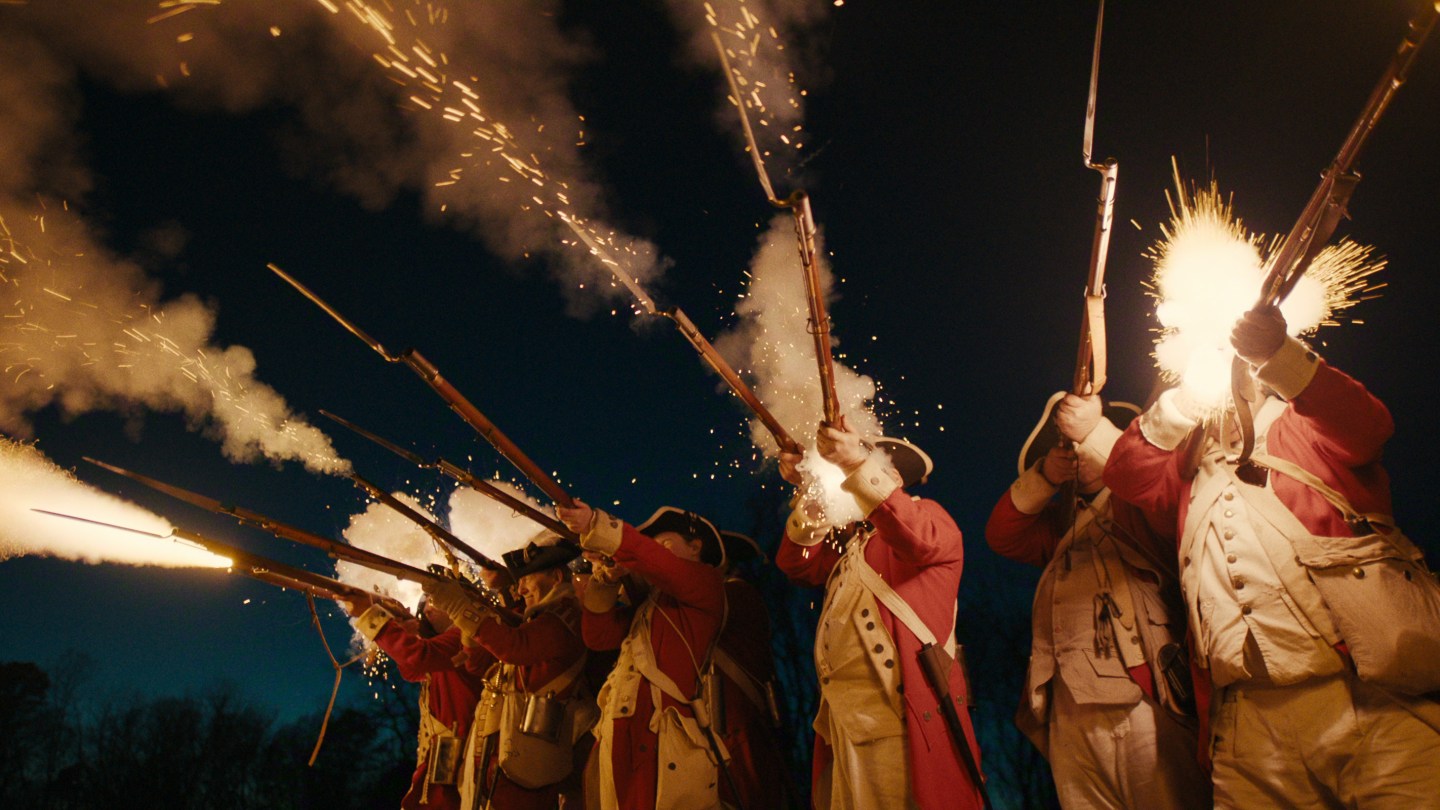
But for those who do delight in such things, the framing has all the polish of a museum display — clear lines and serif fonts and tidily framed images guiding us from one key chapter to the next. Its judiciously deployed sequences of war or debate are not cheap AI slop but re-enactments as lavishly produced as any in a prestige drama. The West Wing’s Martin Sheen lends further gravitas as the voice of Washington in readings of his personal correspondence. In another signal that we’re emphasizing education over entertainment, the only other movie star involved is Tom Hanks, who produces through Playtone.
Its roster of talking-head academics, authors and politicians runs dozens of names deep, including Black and Native scholars to lend a slightly different perspective on the Eurocentric version of this story we’ve been taught since grade school — though only to an extent, since The American Experiment is less concerned with reorienting our understanding of history than simply deepening it.
As suggested by its name, its main project is to remind us again and again that the so-called “American experiment” is just that: an experiment, set into motion by imperfect people and yielding imperfect results, rather than a preordained outcome determined by infallible gods.
Sometimes, the series makes this point by humanizing the players. Only Washington is consistently central enough that his growth from braggadocious 20something to wise elder statesman amounts to a major subplot, but other key figures are brought to life through bits of vivid biographical detail. Is it directly relevant to the outcome of the Constitutional Convention that Gouverneur Morris, the Pennsylvanian who penned the Preamble, was a womanizer whose peg leg was rumored to be the result of a botched escape from a lover’s bedroom window? No. Does knowing that make it easier to understand him as one of a bunch of guys in a sweltering room just trying their best? It does.
Mostly, though, the show achieves its sense of urgency by zooming in close enough to demonstrate that no single step in the country’s founding was a given — not the decision to rebel in the first place, not the outcome of the war, not the choice to stay together as a single union. When a historian explains the low price of the tea that would be dumped into the Boston Harbor, it becomes possible to imagine the colonists deciding to simply drink it. When another relays how Washington dismissed Black soldiers (only for the British to recruit them), one can see how such short-sightedness might have cost him the war.
Amid all those hard-won victories, The American Experiment acknowledges, are plenty of failures, most notably involving the “1,000-pound elephant in the room” that was slavery. But the doc proves better at grappling with the past than it does our present. Having laid out in precise terms the hideous implications of the three-fifths compromise — as Columbia Journalism School dean Jelani Cobb puts it, it allowed states to “use the bodies of enslaved people to subsidize the political authority of the people who are enslaving them” — it declines to draw the explicit connection to, say, the Black Lives Matter protests shown in sporadic montages of more recent history.
In later chapters, the series puts forth hyper-partisanship as another major problem the Founding Fathers failed to anticipate, then tries to serve as a corrective by offering up a stridently bipartisan cast of modern politicians. Sometimes, their relevance is obvious: Love or hate her, it’s easy to understand the logic in having Hillary Clinton usher in a segment about the shortcomings of the Electoral College, or January 6 target Mike Pence on the importance of peaceful transfers of power.
But the overall effect, depending on your own political leanings, might be less inspiring than irritating, even infuriating. It’s tough to listen to Ted Cruz praise George Washington for not being “power-hungry” without rolling your eyes at Cruz’s own support for the most nakedly power-hungry U.S. president in modern memory, or Clinton talk up the importance of “principled compromise” without grumbling over where that over-eagerness to compromise has gotten her party.
In a way, it’s comforting to be reminded that the anxiety and uncertainty plaguing this country now are not new. As one political analyst points out, every generation of Americans has wondered if they might be the last, going all the way back to the very first. But the reminder that this experiment could have failed at any point doubles as a tacit reminder that it could still.
It’s fitting, then, that the whole thing ends not with some triumphant celebration of patriotism but a sigh. “I’m not gonna lean back. I’m not gonna quit. I’m not gonna stop,” declares Delaware senator Lisa Blunt Rochester. “Democracy is worth it.” But the camera keeps rolling. She draws a breath. She starts to speak again, then stops. She looks off into the distance, as if unsure what should happen next. This, The American Experiment would have us understand, is the real American experience in a nutshell.
Credit: Source link