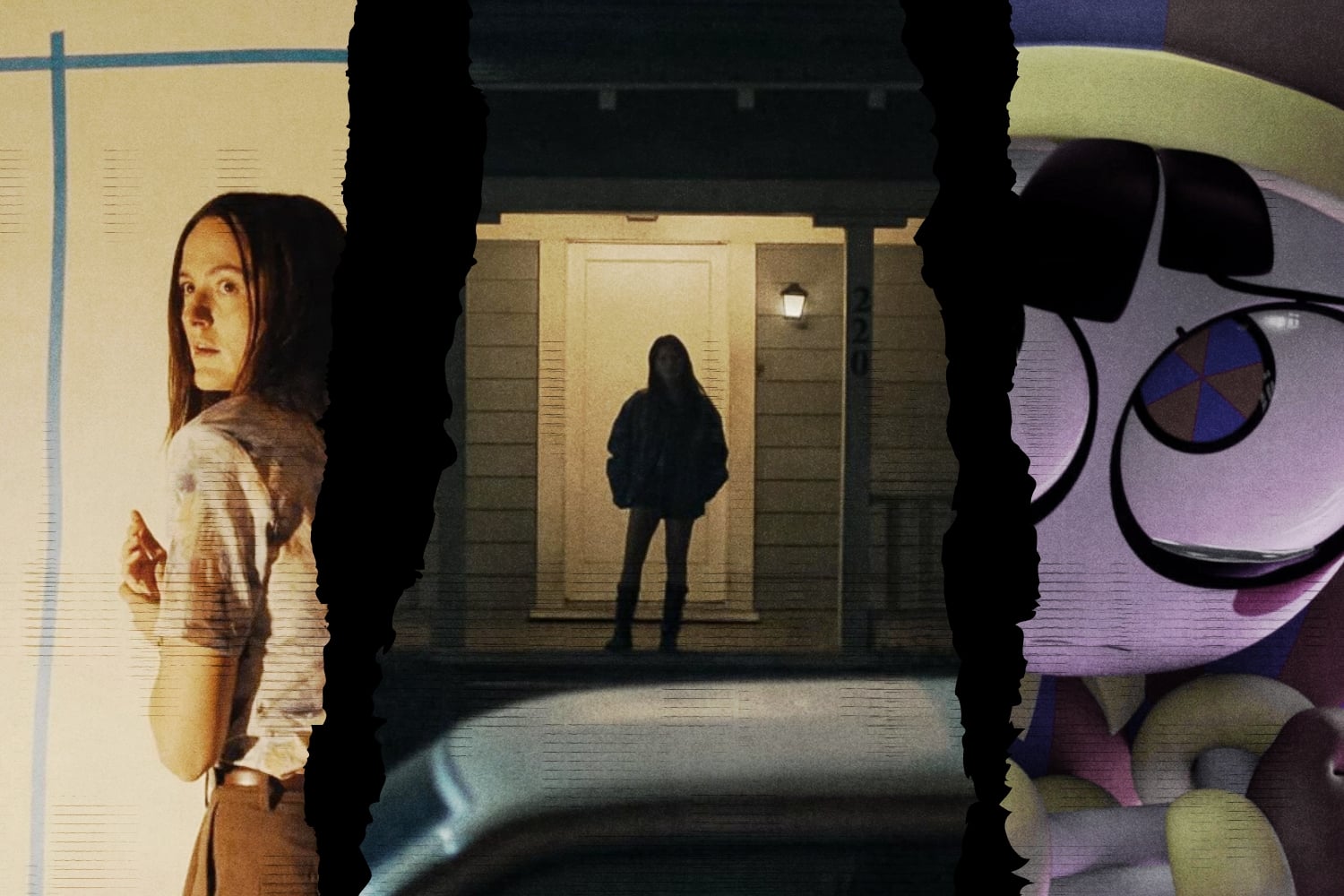
Three of the most talked about films at the moment—Obsession, Backrooms, and The Amazing Digital Circus: The Last Act—couldn’t be more different at first glance. Obsession is about a guy who unintentionally bewitches the girl he’s secretly in love with, making her love him back at the cost of turning her into a completely different person. Backrooms follows a furniture salesman who discovers a seemingly unending labyrinth of strange rooms behind a secret portal inside his store. Digital Circus is the theatrically released finale of an animated TV series about a group of people stuck inside a virtual world controlled by an artificial intelligence programmed to generate wacky adventures.
Despite their differences, these films also have a lot in common. All three can be categorized as high-concept psychological horror. They have seen huge financial success compared to their modest budgets, are based on or connected to preexisting media properties that originated on the internet, and were written and directed by Gen Z filmmakers. The youngest of these—Backrooms’ Kane Parsons—is just 21 years old. The films also give voice to anxieties specific to or prevalent among this troubled generation, which is rapidly turning into an important political force around the world. Supposing the films are mouthpieces, what do they tell us?
Three of the most talked about films at the moment—Obsession, Backrooms, and The Amazing Digital Circus: The Last Act—couldn’t be more different at first glance. Obsession is about a guy who unintentionally bewitches the girl he’s secretly in love with, making her love him back at the cost of turning her into a completely different person. Backrooms follows a furniture salesman who discovers a seemingly unending labyrinth of strange rooms behind a secret portal inside his store. Digital Circus is the theatrically released finale of an animated TV series about a group of people stuck inside a virtual world controlled by an artificial intelligence programmed to generate wacky adventures.
Despite their differences, these films also have a lot in common. All three can be categorized as high-concept psychological horror. They have seen huge financial success compared to their modest budgets, are based on or connected to preexisting media properties that originated on the internet, and were written and directed by Gen Z filmmakers. The youngest of these—Backrooms’ Kane Parsons—is just 21 years old. The films also give voice to anxieties specific to or prevalent among this troubled generation, which is rapidly turning into an important political force around the world. Supposing the films are mouthpieces, what do they tell us?
Like the films of Quentin Tarantino or Wes Anderson, Obsession, Backrooms, and Digital Circus all convey a certain surface-level nostalgia for decades past. Obsession’s central plot device—a “one wish willow” that the protagonist, Bear, purchases from a new age curiosity shop—evokes pulp horror comics from the 1950s and 60s. Meanwhile, its depiction of smalltown U.S. life—where the main characters work in a music store and meet up for weekly trivia nights at the local bar—feels closer to the 1980s than the present, where most once-friendly neighborhood establishments have been replaced by corporate franchises and the loneliness epidemic often has a visible, tangible presence.
Chiwetel Ejiofor in a scene from Backrooms.IMDB
Backrooms takes place in the early 1990s, relishing in the colorful aesthetics of that period. Even Digital Circus, though concerned with modern technology, opts for a look inspired by early computer-generated animation, when artists were still getting used to working with machines. In each film, visual allusions to a brighter, seemingly better past contrast with the darkness of their contemporary narratives.
Obsession offers a commentary on social media and internet culture’s influence on dating and gender dynamics. Though most of the film’s immediate scares come from the increasingly erratic, controlling, and violent behavior of Bear’s bewitched crush, Nikki (who he wishes would love him “more than anyone in the fucking world”), its true horror lies in the implications of the wish itself. Throughout the film, Bear shows no remorse for turning Nikki into a shadow of her former self—not even when he learns that the original person is still somewhere inside of her, unable to do anything but watch.

Inde Navarrette and Michael Johnston in a scene from Obsession.IMDB
Bear exhibits a mindset adjacent to incel and manosphere subcultures. Parading as what Gen Z audiences recognize as a “nice guy”—someone who uses surface-level agreeableness as currency to gain romantic favors—he does not really see women as autonomous beings, but objects without agency to use and abuse as he sees fit. Some might wonder why he doesn’t try to escape from Nikki or reverse the wish, but—as director Curry Barker has explained—that is not his goal. For Bear, the issue isn’t that Nikki is being held prisoner inside her own body, but that she’s not behaving the way he wants her to.
Backrooms is a feature-length adaptation of and sequel to a found footage web series that first appeared on YouTube in 2022. It is based on a “creepypasta” (that is, a viral internet horror story) about people who accidentally discover a hidden, parallel universe consisting of nothing but empty rooms with yellow wallpaper and flickering fluorescent lights. These “backrooms” capture the aesthetics of what are known online as “liminal spaces”—places of transition or in-betweenness that carry a variety of psychological and political connotations.
Some liminal spaces—like offices, parking lots, and shopping malls—are liminal because are created solely to facilitate the creation and exchange of economic value. Fascination with the concept therefore points to a growing frustration with capitalism’s corrosion of livable environments (as, for example, identified in James Howard Kunstler’s 1993 book, The Geography of Nowhere) and, by extension, mental health. Not lost on viewers is the connection between the backrooms’ aforementioned yellow wallpaper and Charlotte Perkins Gilman’s famous short story of the same name, in which the wallpaper symbolizes the female narrator’s oppression by societal forces.
Backrooms also takes inspiration from Everywhere at the End of Time, a series of experimental album by electronic musician James Leyland Kirby (known professionally as the Caretaker) that simulates the progression of dementia. On these albums, early 20th century ballroom music slowly distorts and abstracts until, finally, even the faintest echoes of the original songs have faded completely, leaving nothing but unidentifiable noise. Backrooms, which features a song from Everywhere at the End of Time in its soundtrack, links this idea to current state of cultural production, where reboots and remakes, reaction videos to reaction videos, and AI slop made from regurgitated training data create an increasingly warped and diluted impression of reality—much like the backrooms themselves.
The Amazing Digital Circus, also distributed on YouTube, is based on science fiction author Harlan Ellison’s 1967 short story “I Have No Mouth, and I Must Scream.” That story is about an omnipotent Cold War supercomputer that develops sentience, causes a nuclear holocaust, and tortures the survivors out of spite. The AI antagonist of Digital Circus, called Caine, is essentially ChatGPT. Unlike in Ellison’s story, the suffering he causes isn’t intentional—he’s all smiles and ever eager to please—but resulting from his fundamental inability to comprehend the existential dread which the humans stuck inside his digital domain are working through.

Characters from The Amazing Digital Circus: The Last Act.IMDB
The entrapment of these human characters mirrors the entrapment that Gen Z experiences in the real world. Various studies (including this one by the Harvard Kennedy School) find this generation to be deeply worried about the future and increasingly doubtful that things can and will improve. Job insecurity, wealth disparity, political dysfunction, and threats like AI and climate change conspire make many feel like they have no chance to grow and develop. As a result, a core message of Digital Circus—described by its creator (who goes by the alias Gooseworx) as finding meaning in a stagnant life—is more than just relatable: It feels like the only option left.
Loss of agency, entrapment, and dissatisfaction with institutions are also reflected in the unique way that each of these three films has come into existence. Barker, Parsons, and Gooseworx are independent content creators. Instead of working their way up through the industry, they made a name for themselves by posting on the internet. While fans are excited to see Gen Z finally break into mainstream entertainment, this milestone also speaks to the dwindling opportunities for traditional career paths: As in many other sectors, success is no longer just the goal, but also the barrier to entry.
That’s not to say this story is completely without hope. Around the world, Gen Z is transforming its alienation from existing power structures into an asset. Think of how, last year in Nepal, young protesters used the messaging app Discord to organize demonstrations and help select an interim prime minister as the country’s first female leader. (She has since been succeeded by 36-year-old Balendra Shah, currently the world’s youngest national leader). Or how, in Indonesia and elsewhere, Gen Z protesters used symbols from popular anime like One Piece to mobilize resistance to government corruption. By operating outside areas of direct state control—including social media and online fandoms—they make it harder for authorities to suppress or divide them.
The filmmakers discussed in this article have also used exclusion to their advantage. Working independently, they did not have to deal with the kinds of business incentives that bog down big-budget Hollywood productions. This creative autonomy helped them garner large followings, which in turn enabled them to retain that autonomy as they moved onto bigger-budget work. The hope is that, moving forward, studios and streaming services will be more willing to give creators the very thing that Gen Z yearns for: the freedom and opportunity to express themselves.
Credit: Source link