
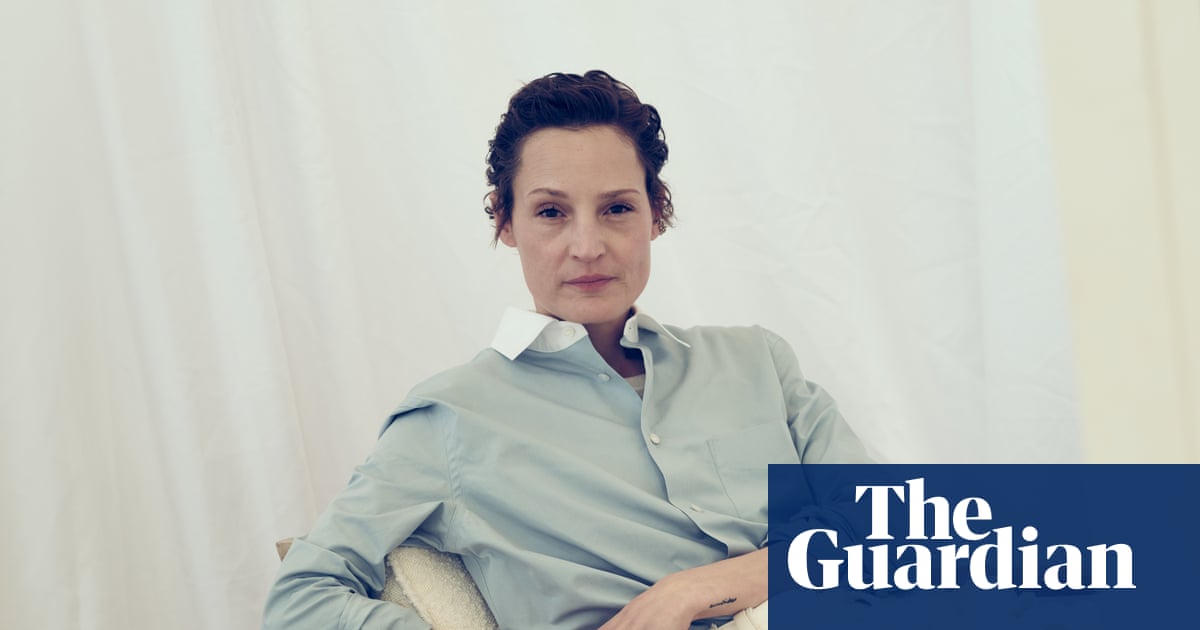
Back when she was a rising actor, Vicky Krieps had her fill of people telling her what not to do. When she got pregnant in her 20s, she was advised not to have the baby as it would derail her career, but she did it anyway. When, after playing a fashion designer’s muse in Paul Thomas Anderson’s Phantom Thread, she went back to making low-budget French films, she was, she says, “actually laughed at. It just seemed absurd to these people that I would turn my back on Hollywood and invest so much energy and passion in something that wasn’t giving me money.”
Yet Krieps’s determination to forge her own path has reaped rewards. For the last decade she has had one foot in the Hollywood mainstream, appearing in Fede Álvarez’s The Girl in the Spider’s Web and M Night Shyamalan’s Old, while keeping the other firmly in independent cinema where she has freedom to experiment. Krieps also does her utmost to avoid the pantomime of red-carpet events. On the occasions she does make an appearance, she will stick out her tongue or give photographers the finger. “I always smile when I’m doing it. But I’m telling them: ‘Guys, this is really ridiculous and the shouting is a bit much. Just talk nicely to me.’”
It comes as no surprise to learn that Krieps, 42, who was born and raised in Luxembourg and speaks four languages, has declined to make the obligatory move to Los Angeles. For the past 15 years, she has lived in Berlin – though, when we speak over video call, she is in Greece, which she regularly visits since marrying her husband, the Greek film production assistant Lazaros Gounaridis, last year. (They met on the set of the 2023 film Hot Milk.)
Sporting a pixie cut and a crisp white shirt, Krieps is open, thoughtful and speaks with unusual seriousness and candour about her job which, for her, is all-consuming. “Sometimes I feel less like an actor and more like a scientist who is experimenting on my own body,” she says.
This immersive approach can take a toll. Two weeks after wrapping her forthcoming film Love Me Tender, in which she plays a woman who loses custody of her young son, Krieps began feeling “really bad in my body. I was lying on my bed, and I couldn’t move my arms and my neck. I thought I had a serious disease.” She saw doctors and had an MRI, and found everything was fine but the pain itself was real. “I think I had assembled so much psychological pain that it became physical. You know the saying ‘My heart is aching’? I feel that in my whole chest.”
Directed by Anna Cazenave Cambet and based on the autobiographical novel by Constance Debré, Love Me Tender challenges the unfair expectations foisted upon mothers. Krieps plays Clémence, who has given up a well-paid legal career to write books. After separating amicably from her husband, Laurent, she gives away most of her belongings, immerses herself in the club scene and explores her sexuality. When she eventually tells Laurent that she is dating women, he appears to accept it. But afterwards, he makes dark allegations about her and questions her mental stability in a bid to secure sole custody of their eight-year-old son, Paul.
“Laurent,” says Krieps, “is an example of when the male ego starts to rage because it is hurting and doesn’t understand what is happening. He’s thinking: ‘Why am I not included in this? Why did this train leave without me?’” When “there is no real dialogue between men and women, men like this can become mean, sour and self-righteous”.
As their case creaks through the courts, Clémence is denied permission to see Paul. When they finally meet after nearly 18 months apart, it’s for an hour every fortnight under supervision. Those meetings, where Clémence must hold in her grief and keep it together for her son, are devastating. The tension of those scenes, Krieps realised, “caused me to hit a wall. But it was good for me to learn that the next time I work on something like this I will need to look after myself and take longer breaks while filming.”
Krieps has spent much of her career playing women trying to break out of the boxes that others have put them in. In Phantom Thread, she is Alma, a serving maid who is expected to remain meek in front of Daniel Day-Lewis’s dictatorial dressmaker but instead stands her ground and answers back. In 2022’s terrific Corsage, she is Elisabeth, Empress of Austria, celebrated in the 19th century for her beauty and her tiny waist (made tinier by ruthless corsetry), who rebels against her tightly controlled existence. In Emily Atef’s More Than Ever, she is a terminally ill woman fighting for the right to live out her days on her own terms.
“I talked to Charlotte Rampling about this after we worked on the Jim Jarmusch movie Father Mother Sister Brother,” Krieps reflects. “We realised what we have in common is that we are constantly drawn to exploring the edge of a [character], the place where it starts to hurt. I think I take this to every part.”
Where possible, Krieps tries to work with female directors – or rather, she clarifies, directors who preside over “feminine sets. I’ve worked with men where the set was not masculine and there was no male ego. And there are female directors who unfortunately operate with a male ego. A lot of film sets are run like the military and are very hierarchy-driven. It’s incredibly loud and it’s about pushing. But take a director like [Corsage’s] Marie Kreutzer: her set is extremely quiet and calm. No one is shouting. And the positive side to that is when you create silence, you start hearing each other.”
after newsletter promotion
Picking apart societal roles and rejecting authority is in Krieps’s blood. Her grandfather was in the resistance during the second world war and survived internment at Dachau. He later became a socialist politician in Luxembourg and successfully mounted a campaign to abolish the death penalty. “Knowing that someone so close almost lost his life to fight for humanity, this is something you can’t forget,” reflects Krieps. Meanwhile, her mother “is just a crazy hippy, in the best way, and raised me to question everything: how do I know this is what they say it is? I think this made me dare to be brave and risk my livelihood.”
That daring surfaced when a teenage Krieps attended her school graduation ceremony and thanked her teachers for giving her “proof that I know how to learn off by heart, that I know how to copy and how to shut my mouth”. The incident made the papers in Luxembourg. It is also evident in her habit of tweaking the words and actions of her characters mid-scene. In Corsage, she launched herself out of a window in frustration at her onscreen husband (she emerged unscathed; the scene was filmed on the ground floor). The moment was not in the script but nonetheless made the final cut, with Krieps’s character sustaining a fracture from the fall. “These things are not premeditated but sometimes you just feel something that feels like the truth, and it wants to come out,” Krieps says.
True to her straddling of popular and arthouse entertainment, this autumn Krieps can be seen in Ryan Murphy’s series Monster: The Lizzie Borden Story playing the Borden family’s maid Bridget Sullivan. She has also just finished work on Emma Doucet, a film by the French director Élise Girard about a single mother who falls in love with the French prime minister and which, she says, is “close to a poem. It’s very nouvelle vague.”
Krieps acknowledges that her questing spirit and single-mindedness as an actor wouldn’t have been possible even 20 years ago. “You wouldn’t have a woman who’s allowed to do all these different movies, and not give a fuck, cut off her hair and generally misbehave. The fact that I exist shows me change is happening and is possible.”
Love Me Tender is in UK and Irish cinemas from 7 August.
Credit: Source link