
It’s been my experience that people who hate cats and people who love them describe them exactly the same way; it’s only the tone that differs.
The former scowl as they complain that, “Cats are such jerks.” The latter say it with an indulgent smile. To the feline fan club, of which I count myself as a card-carrying member, a-hole behavior is part of the allure — they’re so stubbornly, fascinatingly, often hilariously self-interested that even the dim bulbs seem possessed of complete inner lives. Besides, they’re not always mean. Just as often, they can make you melt with their softness, their sensitivity, their loyalty.
Alley Cats
The Bottom Line
Short but shaggy.
Airdate: Friday, Aug. 7 (Netflix)
Cast: Ricky Gervais, Tom basden, Jo Hartley, David Earl, Diane Morgan, Andrew Brooke, Kerry Godliman, Tony Way, Natalie Cassidy
Creator: Ricky Gervais
Alley Cats, Ricky Gervais’ new animated series for Netflix, gets that much. In the manner of my own furry sons, the show follows its own unhurried rhythm, turning on a dime between casually vicious and ooey-gooey sweet. But lacking the creative depth to make either tone land, it winds up a comedy of existential angst that’s rarely all that funny and only occasionally kind of moving.
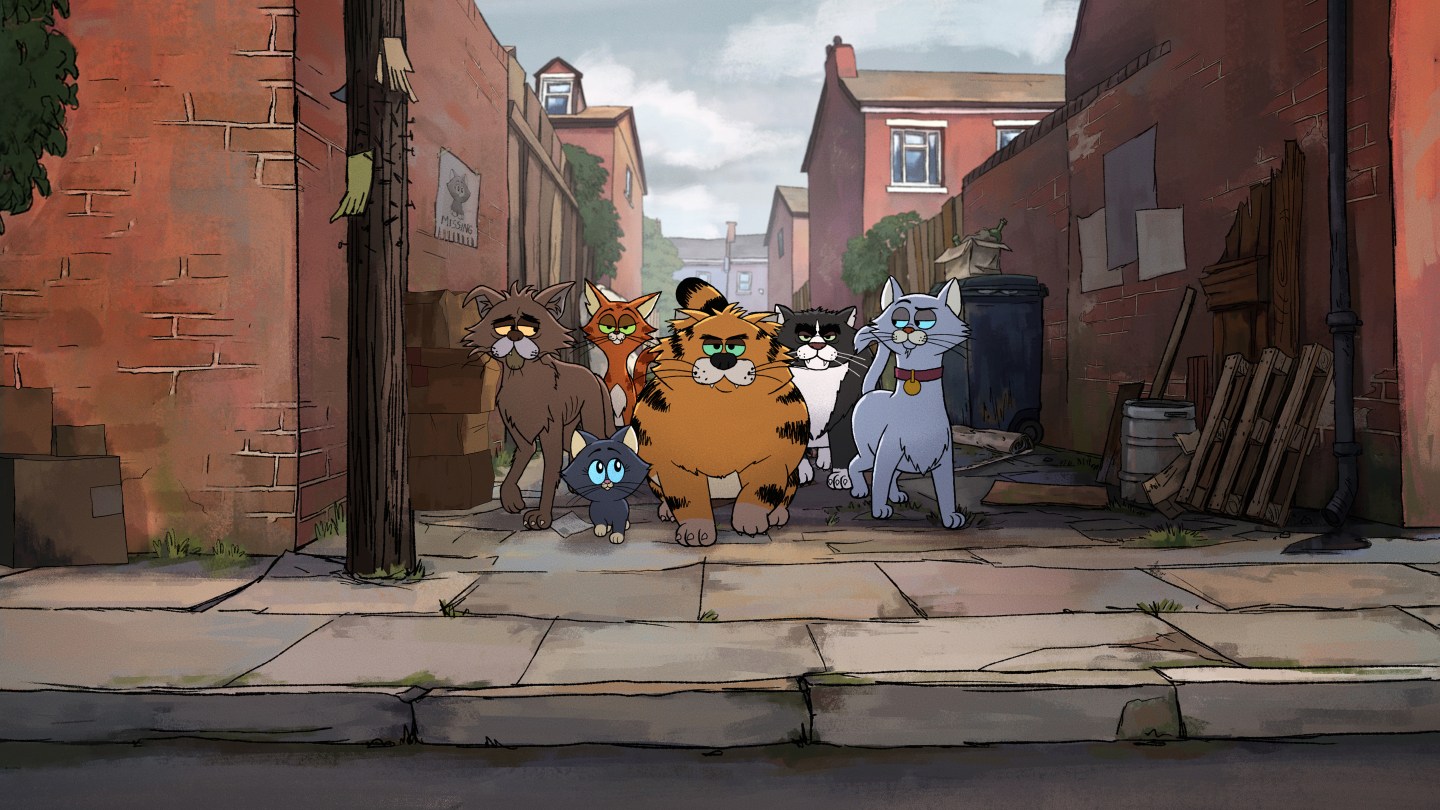
In addition to writing and directing, Gervais leads the cast as Gus, a chunky orange fella who’s the de facto leader of a gang of strays. To call them a ragtag bunch would be putting it politely; though the animation by Blink Industries is clean and crisp, the cats’ personalities are anything but.
Fang (Andrew Brooke) is a beefy tuxedo perpetually raring for a fight. Olive (Diane Morgan) is an orange space cadet desperate to breed. One mangy beast is simply called Puke (David Earl), presumably for the sort of reaction he tends to elicit with his many tales of screwing and/or eating every disgusting thing you can imagine. The only one of their number fit for polite society is Ponce (Tom Basden), a pet cat whose primary function within the clique is to get dragged for everything from his lack of balls to the way he says the word “interesting.”
Every day begins with the crew in the abandoned hovel they call home, watching whatever happens to be airing — dating shows, history docs, news reports — on a TV that somehow still works. Eventually they’ll head outside to look for food, visit friends and foes, settle whatever silly argument has been sparked by their latest viewing (e.g., “Are bees scary?” or “Could four cats murder a human child?”). Then they’ll retire back to their shack, to do it all again tomorrow.
Gervais has said that the voice performances were captured in group sessions rather than solo ones, and it shows in the relaxed chemistry of the cast. They sound like nothing so much as a group of longtime pals busting each other’s balls over a third round of beers, and there’s some appeal in getting to sit with that loose and shaggy vibe.
But as anyone who’s been seated next to a group of longtime pals busting each other’s balls over a third round of beers knows, just because they find themselves entertaining doesn’t mean it’s inherently interesting to listen to them. Though the season runs just six episodes, each under 20 minutes, it feels much longer when so many of those minutes are spent on aimless, mindless chatter.
The cats’ low-key routine is interrupted when, during one of their daily outings, they encounter a tiny gray kitten (Jo Hartley) who’s gotten lost. In a burst of generosity, Gus promises Kitten they’ll help return her home. Their efforts (primarily, wandering around until Kitten spots a home that looks familiar) comprise what amounts to the season’s driving plot — though in typical feline fashion, it’s never long before they’re waylaid by one random side quest or other.
Alley Cat functions in two sharply distinct modes. The first is rude, crude shit-talking. Gus, Fang, Puke — and, okay, not so much Ponce — spend their days riffing about the things they’ve done or want to do with their dicks, bickering about who’s tougher than whom, showering each other with elaborate insults.
One particularly self-satisfied diatribe ends with Gus imagining Puke dying from AIDS after getting sodomized by infected monkeys; it’s edgy in a way that’s sure to impress tweens whose parents have just removed the controls from their Netflix profiles, and not many others. Mostly, though, their conversations just blend into an undifferentiated drone of meaningless sniping, lurid sexual descriptions, colorful empty threats and many, many bad words. If you think a lengthy exchange about whether “Bitches be trippin’” is a Gandhi quote — Gus insists yes, Ponce correctly disagrees — is the height of hilarity, maybe you’ll find the cats’ chats more amusing then I did.
The other tone Alley Cats traffics in is an almost cloying sentimentality. As braggadocious as Gus and his friends can be, they’re acutely aware of both their insignificance and vulnerability. Cats they know are hit by cars, replaced by supposedly loving owners, left to wither away in some dirty corner; as one sadly puts it, they’re all just “future roadkill.” Kitten’s wide-eyed questions about the permanence of death or the cruelty of humans only further underline how painful the mere fact of existence can be.
But Kitten’s presence also, naturally, encourages Gus to open up, and show a softer, happier side as he sings to her or cuddles her or generally guides her through life’s terrible uncertainties. In one vulnerable moment, he even tries to bargain with a God he’s not convinced exists — shocking stuff from a character created and performed by one of pop culture’s most exhaustingly noisy atheists. It’s all very moving in theory, and less so in practice. These two-note characters simply aren’t built to shoulder such heavy yet predictable emotionality.
But then, I guess, neither are real cats. I might have big existential feelings about my own kitties — the purpose I get from caring for them, the joy I get from loving them, the preemptive grief I experience knowing that they will die in the hopefully very distant but definitely inevitable future. I might thus relate pretty well to Gus’ protectiveness of Kitten, to Kitten’s heartbreak at how indifferent the world can be to animals, to the gang’s sorrow as they watch an aging acquaintance carted off for euthanasia.
My cats themselves, though, I suspect would more likely relate to the show’s opening scene. “What was that for?” complains Ponce, after getting a swat to the face. “I’m a cat. That’s just what cats do,” Gus shrugs in return. It’s not a satisfying reply. But it is, indeed, just what cats do.
Credit: Source link