Photographs taken by Farah Sosa, provided courtesy of the Los Angeles Philharmonic Association.
For more than half a century, John Williams has given audiences some of the most recognizable music in movie history. On Saturday night at the Hollywood Bowl, an audience of thousands got the chance to give a little of that love back—and then, in the evening’s biggest surprise, Williams himself appeared to receive it.
What has become one of the Hollywood Bowl’s most beloved traditions, the annual three-night celebration of Williams’ music has always been more than just another concert. It’s part symphonic spectacular, part movie-lover pilgrimage, and part unabashed celebration of a composer whose music has become inseparable from the films—and memories—of generations.
Over the years, Williams has often conducted the entire evening or shared the podium with his friend and esteemed composer David Newman. More recently, Williams has stepped away from conducting the full program but still makes an appearance, often during an encore that can stretch to three or four songs. Last year, however, Williams was absent due to illness, and now, at 94, there was an unspoken understanding that an appearance was hardly guaranteed. So when the beloved composer eventually emerged, the response was more than enthusiastic. It was thunderous.
But before that wonderful surprise, the evening was devoted to celebrating not only Williams’ extraordinary music, but the man behind it.

Photographs taken by Farah Sosa, provided courtesy of the Los Angeles Philharmonic Association.
In previous years, the music largely spoke for itself, with a few stories sprinkled throughout. This year felt different. With actress and director Bryce Dallas Howard serving as host, the concert became something of a musical biography, as she shared memories and anecdotes from Williams’ remarkable career before each selection.
We heard how he created those ominous two notes that would forever make audiences afraid to go into the water in “Jaws,” how he landed the “Star Wars” gig, and what inspired the unforgettable themes from “Raiders of the Lost Ark.” Suddenly, music we’ve been humming for decades had stories attached to it. The evening became about more than hearing beloved movie themes performed by a world-class orchestra. It was a chance to better appreciate the imagination, brilliance, and warmth of the man who created them. And what a body of work there was to celebrate.
The music from the man who has received an astonishing 54 Academy Award nominations included excerpts from “Close Encounters of the Third Kind,” the barrel chase from “Jaws,” selections from “Harry Potter,” “The Throne Room and Finale” from “Star Wars,” the soaring “Superman March,” selections from “Lincoln,” “Jurassic Park” and “Schindler’s List,” his triumphant “Olympic Fanfare,” and the entire 13-minute finale from “E.T. the Extra-Terrestrial.”

Photographs taken by Farah Sosa, provided courtesy of the Los Angeles Philharmonic Association.
Many of the pieces were accompanied by film clips and montages, but this year the visual component felt more prominent than ever. Scenes from the films were joined by behind-the-scenes footage and glimpses into Williams’ career, turning the evening into something more personal and retrospective. We weren’t simply hearing the music. We were reminded of where we were when we first heard it, the characters we associate with it, and how deeply Williams’ work has embedded itself in our collective memory.
Few composers can claim that two notes can conjure a shark, a few bars can make us believe a man can fly, and a swelling melody can make us feel like a bicycle might actually lift off the ground. And then came the moment everyone will remember. John Williams appeared.
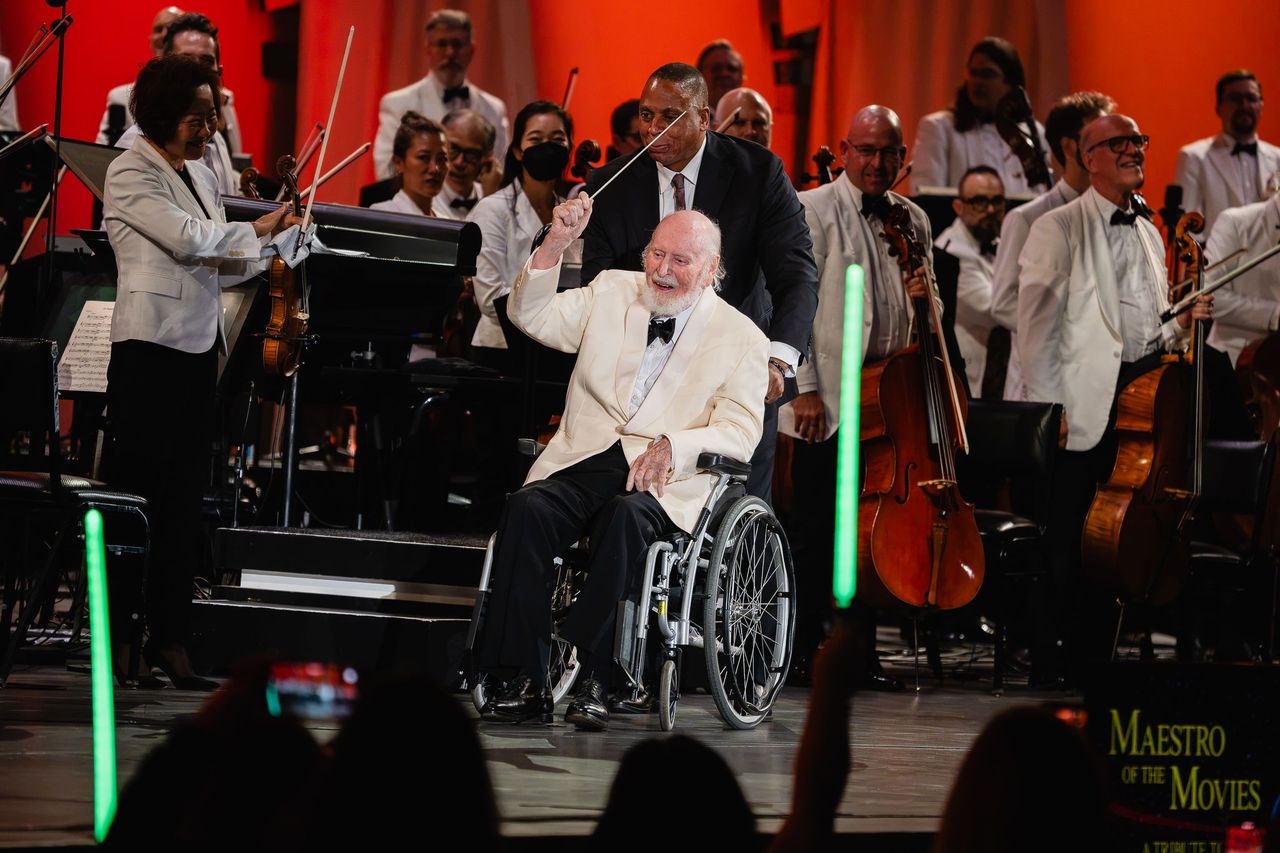
Using a wheelchair, the ever-debonair music man took his place before the orchestra to conduct one of the most famous pieces of his career: “The Imperial March” from “The Empire Strikes Back.” The Bowl erupted. Thousands of glowing lightsabers suddenly illuminated the amphitheater as Williams led the orchestra through Darth Vader’s unmistakable theme. When the final notes landed, the audience was already on its feet. Williams smiled broadly, waving as the cheers continued to wash over him. It was impossible not to be moved.

Photographs taken by Farah Sosa, provided courtesy of the Los Angeles Philharmonic Association.
Here is a man who has spent his career making millions of people feel something. Adventure. Wonder. Terror. Heartbreak. Triumph. The ache of saying goodbye to an alien friend. The thrill of seeing a dinosaur for the first time. The instant dread of realizing there might be something swimming beneath you. Williams didn’t simply write music to accompany movies. He helped create the emotions we remember them by.
And watching him absorb the overwhelming affection of the Hollywood Bowl audience made the evening all the more heartwarming. He remains a one-of-a-kind master of his craft, a warm-hearted human being, and quite possibly the Hollywood Bowl’s best friend. Heck, they even named the stage after him!
But aside from the man and the music, one of the greatest pleasures of these concerts is simply looking around. The Bowl is filled with young and old, lifelong movie fans and children experiencing this music for the first time, all sharing the same unbridled happiness. Kids wave lightsabers to music written decades before they were born, sitting beside adults who remember hearing those same themes for the first time in a darkened movie theater. For a few hours, thousands of strangers are connected by melodies that have somehow become the soundtrack to pieces of their lives. And perhaps that is John Williams’ greatest achievement.
His music doesn’t belong to one movie, one decade, or even one generation. It keeps finding the next one.
“Maestro of the Movies: A Tribute to John Williams” ran Sept. 4-6, 2026, at the Hollywood Bowl, Los Angeles, CA.

Photographs taken by Farah Sosa, provided courtesy of the Los Angeles Philharmonic Association.
Credit: Source link