There’s a wonderful montage of shots and scenes from across Bernardo Bertolucci’s storied 50-year directing career that dances through time, through eyes, faces, places and shifting themes, near the end of Luca Guadagnino’s unapologetically digressive labor-of-love documentary about the legendary Italian filmmaker, Joie de Vivre. That sequence, bursting with vitality, lushly textured visuals and provocative images, feels like a reward for staying the course with this sprawling two-part director’s cut, which runs an epic seven hours and 25 minutes. At its best, the film shows a similar spirit of curiosity and passion, but there’s a great 4-hour doc inside here trying to claw its way out.
What kind of life this extended conversation might have after its Venice premiere is an intriguing question, though the most obvious guess would be a streaming sale, broken into four or more parts. Museum film departments seem also likely to bite.
Joie de Vivre
The Bottom Line
Equal parts exhilarating and infuriating.
Venue: Venice Film Festival (Venice Open — Out of Competition)
Director: Luca Guadagnino
Writers: Luca Guadagnino, Carlo Antonelli
7 hours 25 minutes
No one will be able to drink in all this abundance of Lucalucci and come away unconvinced about Guadagnino’s profound esteem and affection for the man and his movies, even if he defies expectations by declining to make it a comprehensive survey. What, you would have needed 11 hours for that?
The choices about what to omit and what to include are sometimes genuinely puzzling. Guadagnino says at one point that part of his goal was to turn Gen Z audiences onto a director whose work seems somewhat to have fallen out of favor. But arguably the Bertolucci film that might have spoken the loudest to that generation, 2003’s The Dreamers — a Jules et Jim-like romantic triangle set against the 1968 Paris student riots — is dispensed with in a brief clip or two, sans commentary.
The same might be said of Stealing Beauty, which starred Liv Tyler as a 19-year-old American spending the summer at a Tuscan villa with the culturati friends of her poet mother, who has recently committed suicide. The 1996 film was widely eviscerated when it premiered in Cannes, but seems like a contender for rediscovery by young audiences, if only so they can blow a gasket over its pervy male gaze.
Guadagnino confesses his dislike of the film, which doesn’t even merit a clip, unlike Little Buddha, which probably has fewer defenders. But we get to hear at considerable length about Tragedy of a Ridiculous Man, a dirge of a kidnapping drama from 1981 that was barely even part of the cultural conversation when first released.
That’s part of a maddeningly protracted section near the start of Part Two in which Guadagnino resuscitates four films “lost to time.” Never mind that there could be good reason. The other three are 1998’s Besieged, discussed only in passing; Me and You, of interest primarily in that it was Bertolucci’s 2012 swan-song feature, a lightweight entry that precisely no one wants to revisit; and 1979’s La Luna, an Oedipal drama about a teenage boy and his opera diva mother, played by a fearless Jill Clayburgh. I could never get past her lip-synching to Il Trovatore, but of the four films, Luna might be the most deserving of reconsideration, having shot up in the estimation of many critics since its cool initial reception.
The impression that surfaces repeatedly is that Guadagnino’s sensibilities may ultimately be ill-suited for documentary, which unless it’s an impressionistic mood piece, requires ruthless pruning and hard choices that the director seems unwilling to make. That’s evident even from the eye-roller of a generic title, a cliché that reeks of preciousness. But it has nothing on the doozy of a subtitle: Notes, Thoughts, Words, Reflections, Faces, Visions, Around Bernardo Bertolucci and the Cinephilia of the 20th Century That Is No More. Girl, are you serious?!
The reluctance to make choices pertains also to some of the interviewees, though the majority deliver useful contributions — notably directors Martin Scorsese, David Cronenberg and the very droll James Gray.
But then there’s Francesca Manieri, Guadagnino’s collaborator on the terrific miniseries about teens on a U.S. military base in Northern Italy, We Are Who We Are. In Joie de Vivre, Manieri spends what feels like hours traipsing across a wintry hillside spouting gender studies academic-speak; every time the movie returns to her, which is a lot, my inner Thelma Schoonmaker was shrieking “CUT!” Removing that and, say, the 50 percent of Mark Cousins’ screen time that veers into windbaggery would possibly trim the film by an hour or more.
If it sounds like I’m being gratuitously mean here, my bad, but that’s because there’s so much that will be compelling, even thrilling at times, for Bertolucci admirers and it risks being smothered.
The doc skips in disappointing haste over head-turning early films The Grim Reaper and Before the Revolution, and the potent 1970 telemovie The Spider’s Stratagem. All three are superb introductions to Bertolucci in his establishing years as an important new voice — aptly described by Cousins as a “pathfinder.”
But who’s going to complain when that lets us arrive faster at his magnificent 1970 political drama, The Conformist, hands-down the most sensual film ever made about fascism? One bone to pick, though: a queer director who ignores the sizzling tango scene with Dominique Sanda and Stefania Sandrelli? Calling the pink police.
Guadagnino deserves credit for refusing to tiptoe around the controversy that has made Last Tango in Paris such a hot potato. Instead, in an extensive section on the 1972 cultural and commercial sensation, he shows the entirety of the infamous butter scene, a simulated rape that later became a major #MeToo talking point.
The doc is similarly unflinching in showing the horrific scene from 1900 in which Donald Sutherland’s sadistic fascist murders a young boy in a shockingly callous way, while Laura Betti as his equal in cruelty dissolves into blood-curdling cackles. Those scenes, as uncomfortable as they now are to rewatch, are far more likely to steer Bertolucci virgins toward his audacious filmography.
There’s a solid section, too, on The Last Emperor, the sumptuous historical epic that unfolds in Beijing’s Forbidden City, which won 9 Oscars including best picture and director in 1988. But I kept hoping in vain that Joan Chen might show up to talk about her experience on what became her international breakthrough, or the now retired John Lone, who might have had something to say about what a rare window of major Hollywood exposure the film represented for actors of East Asian descent at the time.
Actors are mostly absent, though Margot Robbie stops by to share her arthouse bona fides with recollections of the first time she saw 1900, and sure, why not? More essential input, however, comes from Debra Winger, gorgeous in her silver mane and sharp as a tack on The Sheltering Sky, the divisive Paul Bowles adaptation in which she starred opposite John Malkovich, about “the existential malaise of living.”
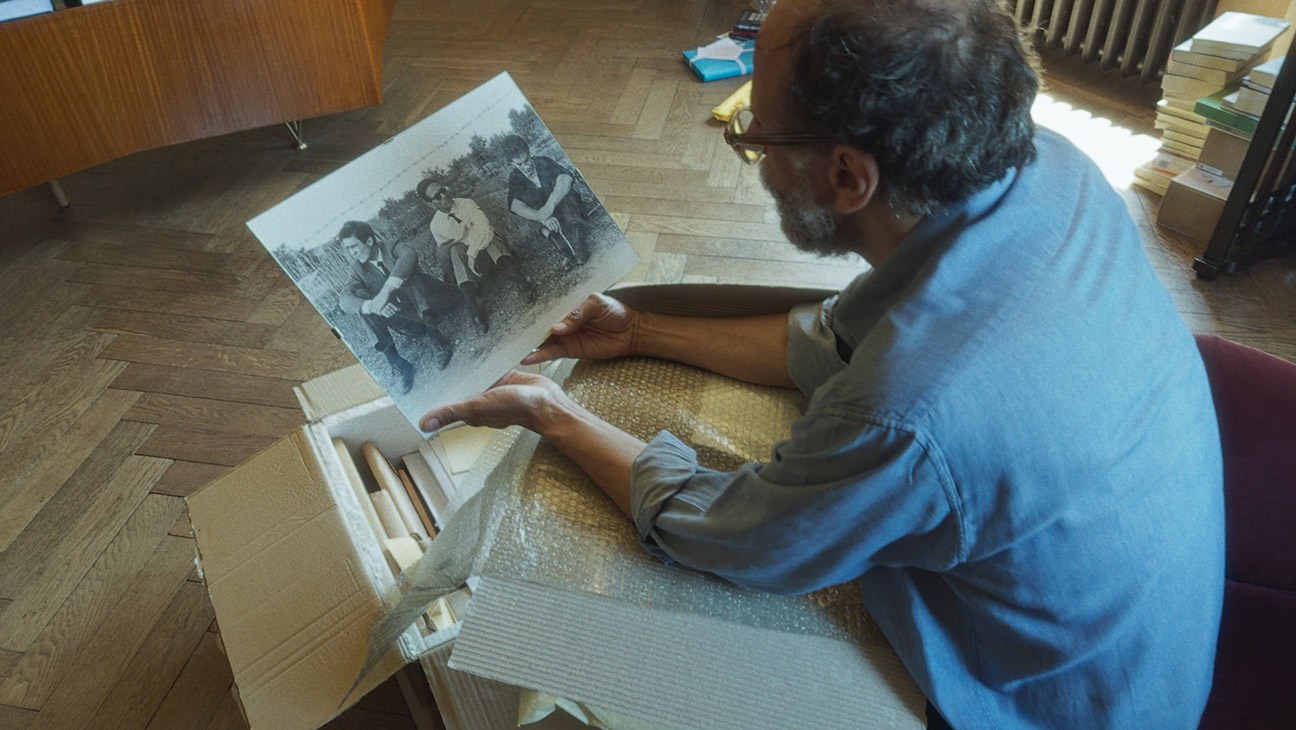
Guadagnino is understandably moved while exploring the trove of books and photographs and documents in the apartment in Rome’s Trastevere district where Bertolucci lived for the last 45 years of his life. If it looks at times like Guadagnino might be inserting himself a tad too forcefully into the picture, he pulls back quite early, even while engaging intensely with his interview subjects.
The wealth of clips here, unsurprisingly, is exceptional, and one of the most fascinating takeaways, for me at least, was Guadagnino’s skill at using exactly the right film snippets to address Bertolucci’s sexuality, something the late director never discussed publicly. But a degree of queerness was a subject of frequent speculation from critics and scholars, dissecting the robust strain running through much of his work of androgyny, sexual ambiguity, transgression, homoeroticism and carnal fluidity.
While no direct statements are made, Guadagnino’s extraordinary assortment of clips that touch on those themes — and I don’t just mean the young Robert De Niro and Gerard Depardieu comparing penises in 1900 — will have many newcomers to the Bertolucci canon concluding without doubt that he was queer.
Beyond that, admirers of Bertolucci’s work will find plenty to appreciate, though I would have been happier to see five or six one-hour episodes, each of them focusing on a major film, say, Before the Revolution, The Conformist, Last Tango in Paris, 1900 and The Last Emperor. Everyone should sit down to a 12-course banquet at least once in their life, but there’s also something to be said for a simple square meal.
Credit: Source link