Homer’s The Odyssey takes us back to the very beginning of epic storytelling. And epic it is: a ten year, twenty-four book combination of poetry and horror mythology that is somehow also a very human adventure. Over the years it has been adapted into many media: television, childrens books, animations. Even Nikos Kazantzakis wrote a sequel, (using iambic verses instead of the original’s hexameter).
Over the years Hollywood had its own go at the story, including a 1950s sandals and swords movie with Kirk Douglas, and a more recent prisoner escape frolic set in the U.S. deep south. Some have strived for some authenticity to Homer, others have veered far, such as in James Joyce’s unpunctuated novel Ulysses, which compressed the original story’s ten years into a single day in Dublin.
Christopher Nolan must have been aware of all these retelling styles when he was putting together his new film project. It’s pretty clear from the first scene that Nolan wanted to get closer to home and give his movie the kind of grandeur which Homer is owed.
Much has been said about the film’s authenticity, or the lack of it. It is difficult to talk about authenticity of something that probably never happened. Or at least not in the way Homer told it. His poem fictionalised the Trojan War story with abandon, bringing in quarrelling gods and semi-deities, witches and a range of unlikely monsters. It may not be possible to be authentic to the facts of a war about which we know very little, but it is possible to be authentic to the original text and to the times, and this is where the film’s critics do have a point. There is Nolan’s decision that all his characters would have American accent, even the British born Robert Pattinson. The director may have done this for consistency, but a neutral accent would have better choice. And there’s no escaping that some of the script was wildly out of it its time. ‘Rest up,’ Odysseus calls to his men in a very marine type voice. Odysseus’s son Telemachus talks about his “dad” and his “mum” which is ridiculous, as are modern lines like ‘it’s okay’. Such lazy writing that is more obvious because they contrast with the beautiful, almost poetic passages elsewhere in the film, such as the rhythmic and delicate exchanges between Odysseus and his female protagonists: Circe, Penelope and Calypso. The breadth of the story is also something that Nolan struggles with at times. Because he has treated the story as a memory play, it is necessarily episodic and non-linear. Odysseus has memory loss and his means that we revisit in snatches what happens to his crew as they meet the many challenges on the journey home. This style of narrative means that every time we go back to the crew it seems they are being chased by a new set of bad people, the crew running into the ocean again and again to escape yet another danger. Escapes were never so repetitive, even if that was how it was in the original poem.
We could also question the treatment of the Trojan Horse, the device invented by Odysseus so the Greeks could finally win the war. It is a beautifully unlikely bit of kit. How the bedraggled, exhausted Greeks could have sculptured such a gift is anyone’s guess.
Also the horse, which is only eleven metres high, somehow hides many dozens of Greeks. I have heard it rightly called the Trojan tardis. Nolan also felt free to add to the original text, such as his wholly invented assertion that Agamemnon laid siege to Troy not just because of his brother’s wife Helen, but because he wanted to take over a trade route. A nice bit of invention, a diversion from Homer’s motivations but one that places the Odysseus story in with current world events. He also manipulates one of the original text’s most emotional moments. When the king left Ithaca, Odysseus’ dog Argos was a puppy. When he returns, the 20-year-old dog is on a dung pile outside the palace gates, the only character to recognise Odysseus.
All this as Homer wrote it, but then Nolan heightens the emotional tension by having the dog abused by Penelope’ suitors, the would-be kings of Ithaca. This highlights, perhaps, the cruelty on the times. These scenes and others make the film as emotionally exhausting as the book.
For all this, most production choices are successful. Obviously Nolan wanted the colour to be selective. At times it is sepia, sometimes grey. Sunsets and fires are brilliant reds, oceans a superb blue. The same applies to the soundtrack which isn’t a soundtrack as such.
There are no songs (that would have presented their own authenticity issues), as much as a thumping, musically throbbing background that highlights the emotional moments and works as portents without giving the game away. There are other moments of brilliance, such as the skew-eyed Polyphemus, or the scene when the Greeks are trying to open Troy’s gates as the Trojans charge towards them. The tension here is worthy of Hitchcock.
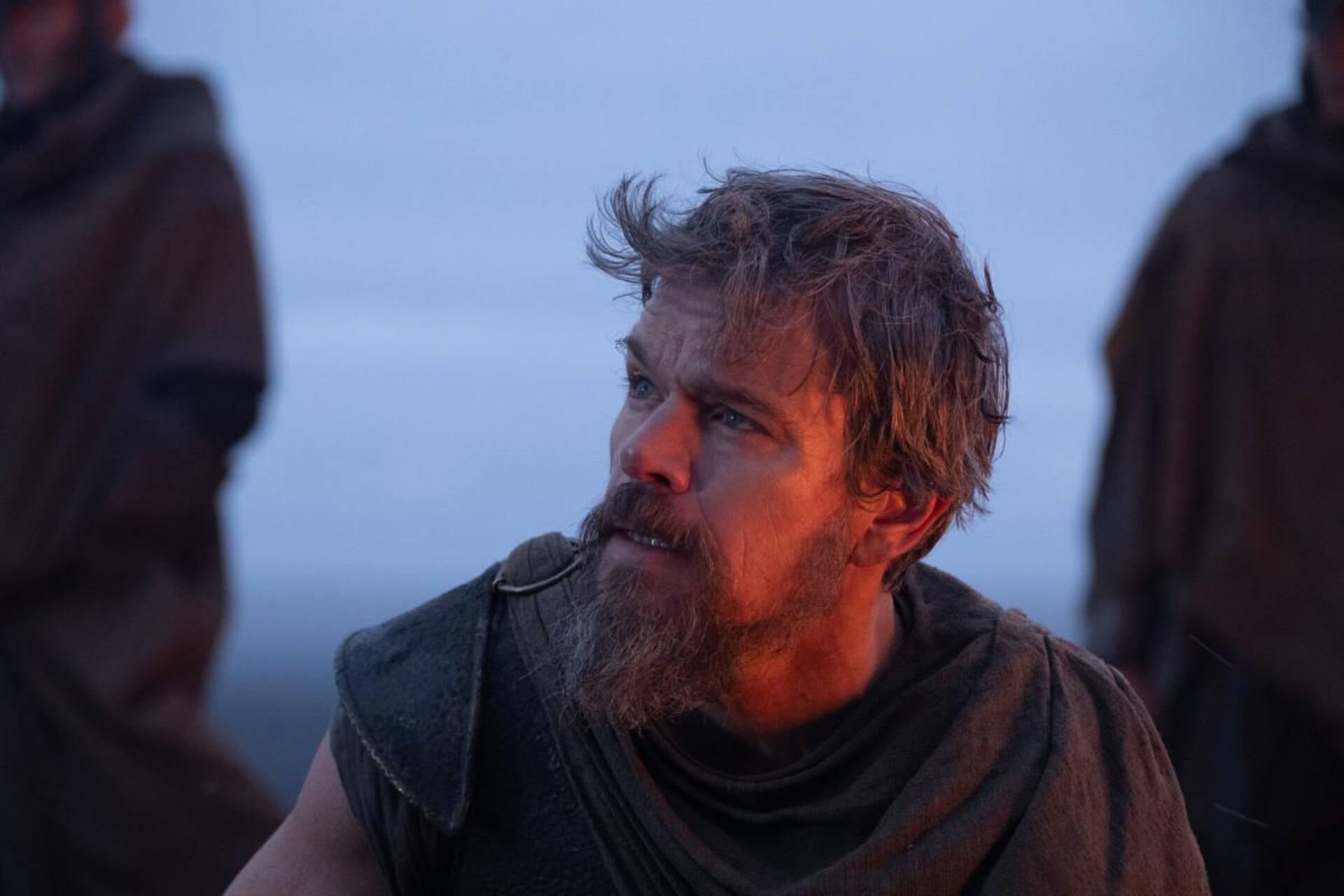
Nolan also gave his actors scope to interpret their characters. Samantha Morton’s Circe scene is as terrifying as anything in the cyclops’ den, the actor giving us a nuanced performance of the witch, who beguiles Odysseus’ crew, but not the man himself. Jon Bernthal as Menelaus gives a character of truth, wisdom with restrained menace. Charlize Theron is relegated to a sounding board as Calypso, but that’s all that’s needed. Much has been made of the lack of Greek actors in this production, but each actor here has justified their inclusion. A Greek Odysseus may have been a wise choice, but Matt Damon does not disappoint on any level, especially because the script makes the story a personal one, where Damon’s Odysseus is ridden with guilt for what happened to Troy, a regret that was not in the original story. It is a performance of restraint, until of course Hollywood intervenes and we get to his final showdown with the suitors, and the film reverts into the action genre of some earlier versions. But that was in the original Homer.
It may have slathers of Nolan’s own storyline invention in it, but even Homer might grant him this, because the bard was unlikely to bemoan another’s art, and that is what Nolan has produced: a work of art that is also celebrates, not detracts from, the original. It’s not perfect and not always authentic to the original text or even to the times, but every scene shows it was made with love. It’s a worthy, often beautiful, addition to the Odyssean canon.
*Dr Phil Kafcaloudes is an academic and writer. His PhD looked at the authenticity of writing history in a fictional form, with a focus on Homer and Herodotus. In 2018 he presented his research on the adaptations of The Odyssey.
Credit: Source link