
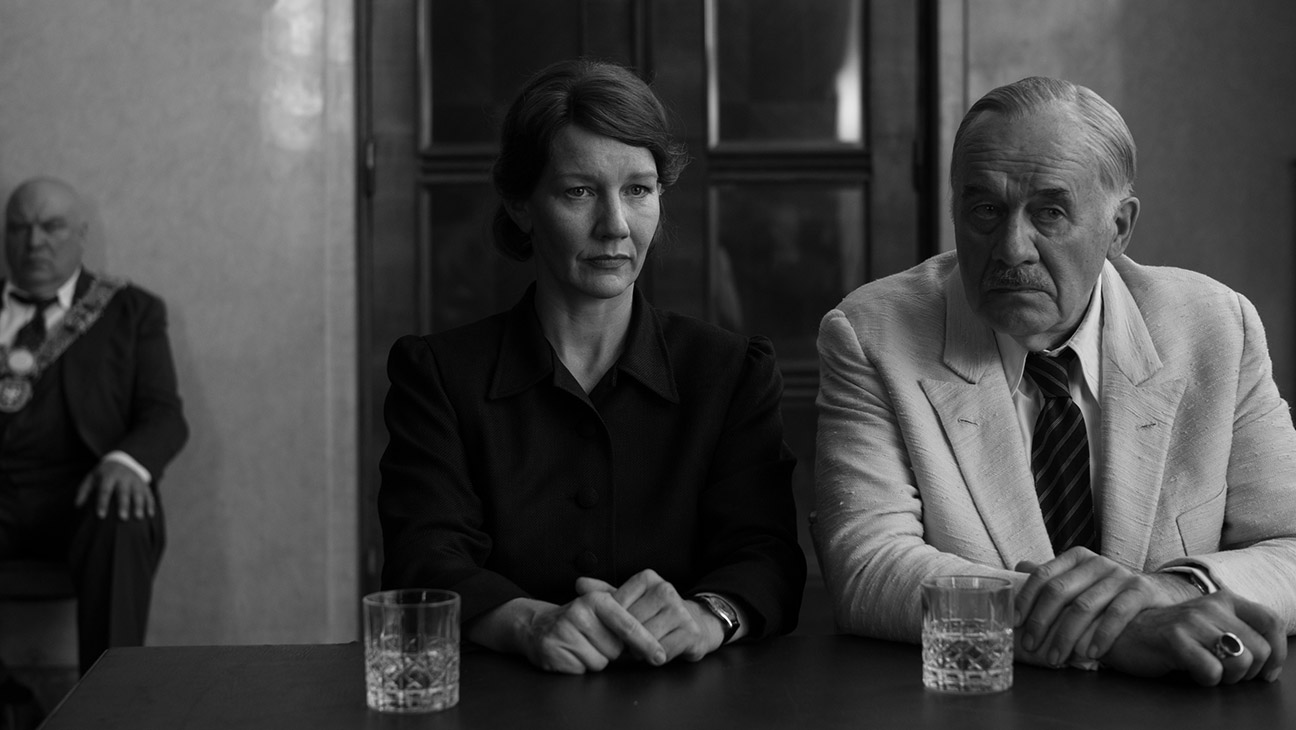
The Nobel-prize-winning novelist Thomas Mann (Hanns Zischler) and his daughter Erika (Sandra Hüller) go on an unsentimental journey in 1949 through West and East Germany in Pawel Pawlikowski’s damn-near perfect period piece Fatherland.
Told with exacting restraint yet as layered as the lacquer on an ebony Biedermeier console, this forms a loose triptych with Pawlikowski’s last two features, Ida and Cold War, both of which were set at least partly behind the Iron Curtain. As with its predecessors, the characters here go through the ringers of personal crises, with extra rolling pressure applied by the politics of the times. In Fatherland‘s case, Mann finds himself compelled to confront his failings as a parent and also make an invidious choice between the ideologies of “Mickey Mouse or Stalin” when the lofty rhetoric of high art can no longer offer ivory-tower sanctuary.
Fatherland
The Bottom Line
A masterful exploration of family, history and angst.
Venue: Cannes Film Festival (Competition)
Cast: Sandra Hüller, Hanns Zischler, August Diehl, Devid Striesow, Anna Madeley, David Menkin, Joachim Meyerhoff, Enno Trebs, Theo Trebs, Waldemar Kobus, Daniel Wagner, Fritzi Haberlandt, Milan Peschel, Joanna Kulig
Director: Pawel Pawlikowski
Screenwriter: Pawel Pawlikowski, Henk Handloegten
1 hour 22 minutes
It is immaculately performed by Zischler and especially Hüller, grounding the film throughout with an uncanny, expressive stillness. But it is also exquisitely rendered in the same boxy ratio and silvery monochrome lensing Pawlikowski and DP Lukasz Zal (The Zone of Interest) deployed on Ida and Cold War, and scrupulously detailed down to the ruined buildings, sharply cut suits, surly restaurant service and eclectic selection of jazz, classical and folk tunes chosen by Pawlikowski, all of which is sure to set discriminating viewers swooning.
That said, those who prefer to have every motivation spoken aloud, plus diagrams showing precisely where they should stand on ethical issues raised in the drama, may whinge that the screenplay, credited to Pawlikowski and Henk Handloegten, is insufficiently didactic, too elusive and sidelong compared to much Anglophone prestige cinema. Almost nothing, for instance, is ever spelled out about the queer sexualities of the leading characters, even if the evidence is there in hungry looks, tiny gestures, costume choices and elephant-sized, room-squatting unsaid feelings.
Similarly, scholars may nitpick over the film’s historical veracity, even though the end credits’ disclaimer acknowledges that liberties have been taken with the known facts in the interests of drama. Nevertheless, given the reputations of the cast and crew here, awards consideration, not just in Cannes‘ competition strand where it premieres, could follow.
Toggling nimbly between public and private spheres, the story unfolds through a mix of scenes in crowded auditoriums, hotel ballrooms and Party-sponsored events thick with extras, as well as quieter moments where someone is alone or just two characters talk, argue or sit in silence behind closed doors. Alternatively, sometimes they’re practically alone in cavernous spaces that were once public or are supposed to be, like a ruined church, a near-empty restaurant in East Germany (where we get that aforementioned glimpse of socialist service culture), or the semi-sequestered space of the Buick sedan that Erika, a former race car driver, is chauffeuring through Germany as her father’s factotum.
The opening scene unfolds in that private register as we listen in on a conversation inside a Cannes hotel room occupied by Erika’s brother Klaus Mann (August Diehl), as well as a barely glimpsed androgynous lover lolling naked in bed. Klaus talks to his sister in California on an elegant brass and Bakelite 1940s telephone (the props are divine throughout), complete with operator interruptions. She implores him to meet her and their father in Frankfurt in West Germany or Weimar in the East, where Thomas is coming to celebrate the 200th birthday of Goethe, Mann’s revered literary predecessor. Klaus will never come to Germany, but the phone call reveals much about the Mann family dynamics, especially Klaus’ fraught relationship with his father and the deep bond with his sister.
After that, Pawlikowski and his team plunge us into the ruined world of Germany in 1949 via a long traveling shot out the Buick window observing block after block of crumbling freestanding facades and smashed masonry. (Apparently it was created via practical sets built in Poland, where most of the film was shot.) Erika and Thomas arrive at the Metropol hotel in Frankfurt, where their first engagements will proceed, including a speech from Thomas in an austere church-like space, followed by a party full of fresh and familiar faces, from the sinister CIA operative (David Menkin) assigned to watch over them; AP journalist Betty Knox (Anna Madeley), with whom Erika appears to have some history, possibly of a romantic nature; and her ex-husband Gustaf Gründgens (Joachim Meyerhoff), a Nazi collaborator whom Erika can barely tolerate. Familiar to us Pawlikowski fans but not necessarily to the characters in the film is the sultry blonde jazz singer belting away period classics, played by Joanna Kulig, the co-lead of Cold War.
Particularly notable in these early scenes is how often figures are positioned in the lower half of the frame, with acres of empty space above their heads. You can lay any number of meanings over this like a palimpsest. Perhaps it’s meant to suggest the weight of history or the state apparatuses crowding characters into the bottom of the frame, or space that’s occupied by unseen spirits (Goethe himself? Folks killed in the war?) hovering above in the ether. Whatever metaphor you might prefer, it mostly suggests that these people, made to look diminished and small, are somewhat powerless.
That said, this bilateral framing becomes less notable, or at least less frequent, as the film goes on — especially in relation to Erika, who begins to defy her father’s authority, arguing with him about his treatment of Klaus and questioning his precarious apolitical stance in relation to the regimes hosting their visit. Thomas’ dialogue is often full of airy, vapid pronouncements that sound sonorous but mean almost nothing, especially as they go deeper East, finishing their trip in Weimar. While the oppressiveness of the German Democratic Republic is acknowledged — especially through an unexpected visit from a local who wishes to draw Erika and Thomas’ attention to how the nearby concentration camp in Buchenwald has been repurposed to house political prisoners — the film’s streak of dry dark humor comes through strongest in these later scenes. That’s especially true of the satirical fun had here with Colonel Tulpanov (Daniel Wagner), a Soviet soldier who is both sinister and a pretentious buffoon, especially when he wants to debate dialectical materialism with Thomas.
It should be noted that both Pawlikowski and Hüller themselves grew up behind the Iron Curtain, in Poland and East Germany, respectively, and the same probably goes for many members of the cast and crew. While the film is never blindly nostalgic for the Cold War, there’s a sense that insiders and survivors know this world from the inside out, that they remember the secret police and the bad food just as much as the choirs singing songs about birch trees and the generosity of people who barely have anything to share.
At the risk of sounding wishy-washy like Thomas Mann at his worst moments, that understanding of the full spectrum of experience in both types of society and all the attendant nuances that made neither order much better or worse than the other comes across affectingly here. The film may be in black and white, but the world it depicts is not.
Credit: Source link