
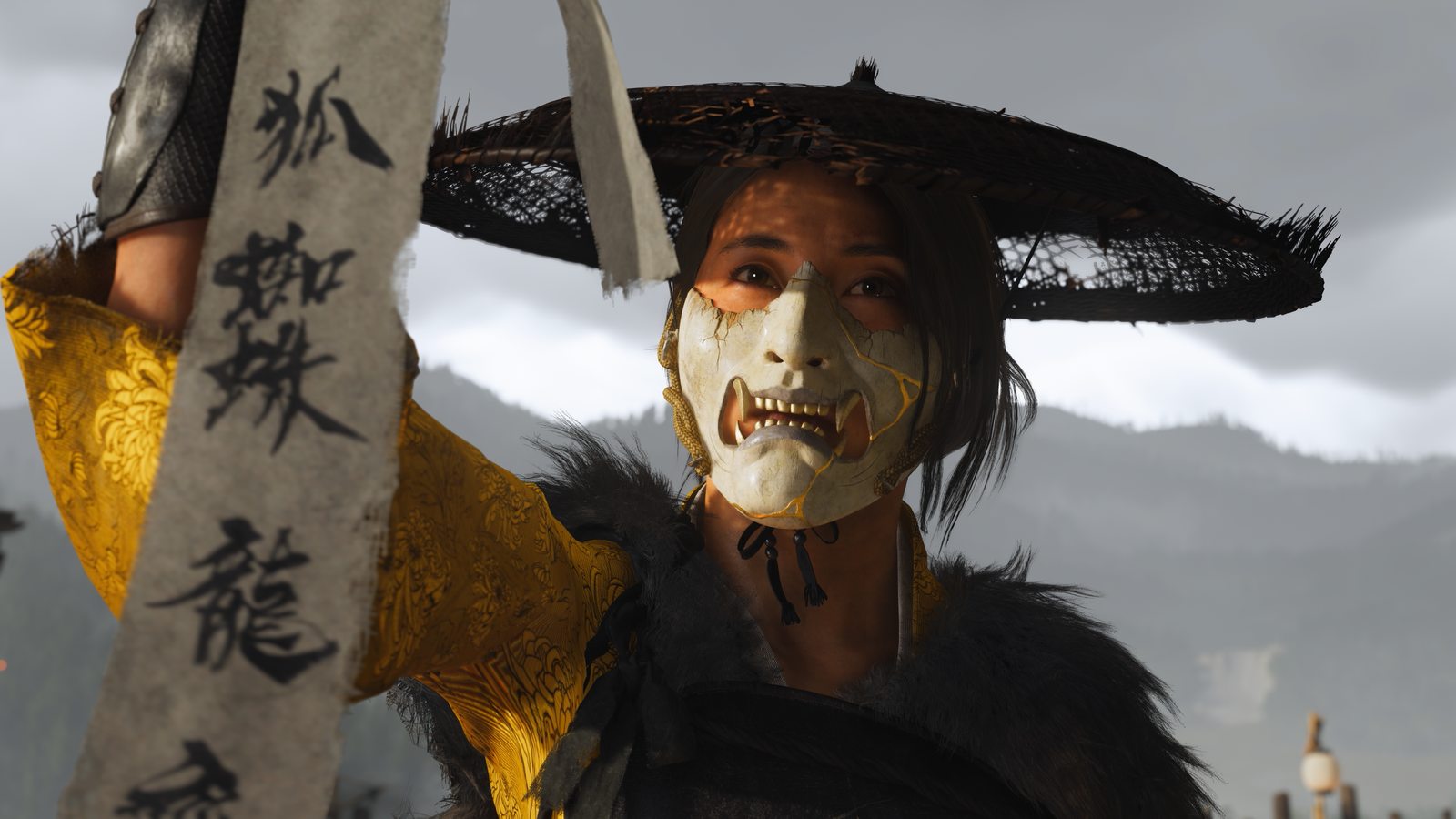
I had just spent a dozen hours slaughtering foes in Ghost of Yōtei when I was finally tasked with saving a life. In a quiet sidequest, Atsu, the vengeance-seeking hero of Sony’s Ghost of Tsushima sequel, finds herself rescuing a bear cub left fending for itself after its mother is killed. After transporting it to safety, Atsu sits by a campfire with her mission companion, Haci. In the calm of the night, far from the bloodshed on the plains below, Haci poses a question that hangs in the air alongside the fire’s smoke: “What role do you play in this world?”
It’s a small moment in a wide open world, but a crucial turning point in Sucker Punch’s new samurai epic. Here, I’m not asked to moralize about the nature of violence and revenge. Instead, I’m left to consider something I rarely think about in action game stories like this: What life awaits after the last drop of blood has been spilled?
Set in Japan’s Ezo region circa 1603, Ghost of Yōtei follows in its predecessor’s action adventure footsteps while telling a more personal, standalone story. There’s a simple revenge tale at its core: After witnessing her family’s brutal murder as a child, Atsu makes it her life mission to one day take down her parents’ killers, taking on the mythical title of Onryō across Ezo. The culprits are a gang of masked menaces known as the Yōtei Six, giving the story a clear hit list structure. (Call it a reverse Seven Samurai, minus one body.) Atsu, now an adult when the story begins mid-standoff, considers it something of a suicide mission. Even if she isn’t killed in combat, there is no life for her once the mission is complete.
Getting to that ominous endpoint is a long journey, though. Ghost of Yōtei iterates on Tsushima’s open-world structure, building a deceptively large and remarkably scenic world that’s the stuff virtual photographers dream of. The region, built around the looming Mount Yōtei, isn’t a heavily populated area filled with towns and castles. It’s more of a natural wonder dotted by tiny settlements, home to people living quiet lives throughout the plains or nestled next to rivers. Developer Sucker Punch’s gift is its ability to build a world that feels grounded while still decorating its hills with highly stylized flower patches that naturally lead your eye to another quest or activity.
That strength was what set Ghost of Tsushima apart from its open world peers in 2020, and Yōtei keeps that spirit alive. The sequel still trades in on-screen markers and minimaps for diegetic visual cues. Wind gusts lead me to my tracked objective, golden birds guide me to health-increasing hot springs and other open world activities, and the sound of a crying fox tells me when a den is nearby. It isn’t just about making a more “immersive” experience for players by keeping them out of menus; Ezo has been Atsu’s home for decades. She knows its ins and outs, so why would she need a map to navigate it? (There is still one if you need it, where you’ll find a redesigned interface that presents each active quest as a card.)
Some of Yōtei’s best moments happen early on while I’m still getting my bearings. When I begin my hunt for my first few targets, I don’t know where to start looking. There’s a main quest to follow, but actually getting into a specific hunt requires me to stumble across some information. That first happens in an unexpected place. When I stop to talk to a man in the middle of nowhere, far from any objective, I’m suddenly ambushed by bandits. I kill the reinforcements, but spare the man and interrogate him on the spot. He coughs up some information on The Kitsune, a member of the Yōtei Six who hides behind a fox mask. The scene feels entirely spontaneous, like the script can be bent so long as I’m willing to live in the world rather than play in it.
It’s like I’m looking at a Technicolor matte painting.
That feeling doesn’t hold beyond Act 1, where I can track and discover my first two targets in whatever order I choose. Yōtei eventually settles into a more traditional open world rhythm that has me bouncing around between my main mission, collectibles, bounties, and sidequests ad nauseum. I fall into exhaustion eventually, the same kind that had players in 2020 debating if Sony’s brand of open-world game is behind the times. Maybe it is, but Yōtei still sunk its hooks in me anyways — and for good reason.
I’ve begun to view games like this as the video game equivalent to old Hollywood epics. They are sweeping works of craft that swallow you up in their grandiosity, not so dissimilar from Gone With The Wind. When I look out at a field of bright red flowers contrasting with a sky that’s as blue as the sea, it’s like I’m looking at a Technicolor matte painting. I let go of my sense of time as the pluck of Atsu’s Shamisen pulls me into the 1600s period piece setting. It is rigidly structured in the way an old American epic born from the studio system would be. Ghost of Yōtei, God of War Ragnarök, Horizon Forbidden West – they’re all built for gaming’s own AMC movie marathon 50 years from now.
Maybe that’s why Sucker Punch’s depiction of Japan across both of these games can often feel like an act of tourism despite its efforts to be as authentic to Japan’s history as possible. As much as the studio tries to reference mainstream Japanese filmmakers with its black and white “Kurosawa mode” or its new mode inspired by animator Shinichirō Watanabe (which replaces the music with lo-fi beats that in no way match the game’s tone), Yōtei is closer to Quentin Tarantino than it is to Yasujirō Ozu. The eye-rolling filters, the flood of over-the-top samurai outfits, the gimmicky sumi-e painting minigames performed on the DualSense touchpad – it always feels like the work of excited Americans in the same way that Lawrence of Arabia might to today’s audiences. The more I come to terms with its awkward aspects, the more I can sentimentally embrace it as a cultural artifact born from a moment of wide-eyed, mega-budget game production. It’s tomorrow’s “They don’t make them like they used to” game, even if future generations retort with “Good.”

The benefit of the soon to be classical “Sony epic” is that the formula always produces some of gaming’s most enjoyable action. Ghost of Yōtei doesn’t throw out what Tsushima did so well; I’m still engaging in katana clashes where I can feel the impact of steel on steel with every block or as I chip away my enemy’s guard with heavy strikes. I hack away at my enemies, one strike at a time, until I catch them off guard and tear them to pieces. One-on-one duels are especially exceptional. Each is distinct from one another, with their own rhythm built from block patterns.
The difference between Tsushima’s hero, Jin, and Yōtei’s Atsu is that the latter uses different weapons rather than taking on stances to deal with troop archetypes. When I need to break through a shield, I can unleash a Kusarigama to smash through the wood. A heavily armored enemy calls for a slow, but powerful Odachi strike. That wide arsenal, combined with quickfire items like pistols, bombs, and kunai, allow me to take out an entire army in a furious bloodbath – so long as I can remember how to grapple with a demanding control system that begs for an inevitable Windows PC port with keyboard binding options.
While it’s by no means an overhaul (there are still standoffs, stealth assassinations, perk-granting charms – the works), the new tools fit Atsu’s attitude. In Tsushima, Jin was operating within a samurai code of honor. His story was about testing that tradition, finding places where it made sense to cut against it for the greater good while still staying true to its core essence. Atsu is not bound by that code. She’s a war machine out for blood and there’s no moral difference between a silent beheading or a respectful duel. If she abides by any law, it’s that of Ezo. She shares a connection with the region’s wolves, who will occasionally join her in battle to save her from death or aid in a standoff. It’s as if her vengeance is part of Ezo’s natural order.

Atsu’s story isn’t defined by heavy moral questions about violence, though. Her quest is presented as righteous; maybe some people really do deserve to get it. Instead, we’re asked to imagine what comes next for someone like Atsu once she rids the world of those monsters. She’s convinced that her life will end once the Yōtei Six is dead, like a honeybee sacrificing its stinger for the colony. (Or at least that’s where her character begins before getting flattened out by an open-world format that too often calls on its heroes to be cool, collected anchors that can emotionally slot in and out of any given quest on a whim.)
It’s a bleak outlook, but can you blame her? Atsu lives in a place so poisoned by cruelty that it even reaches her quiet home isolated in the fields of Ezo. It’s a world where she, and other women in the region, are frequently underestimated and put down by the men around them. The Yōtei Six are just one problem that Atsu can actually solve. Maybe it’s better to leave a mark than to let the beast get away with devouring you unscathed. Hobble a leg to give the next victim a better chance of taking it down.
But Ghost of Yōtei wants us to hold hope that we will fight our last battle one day. That the forces that oppress us can, and will, be defeated. That there is peace beyond violence. What is the life we hope to live out when that day comes? Atsu’s quest isn’t about vengeance; it’s about finding a new purpose on the other side.
Ghost of Yōtei will be released Oct. 2 on PlayStation 5. The game was reviewed on PS5 using a prerelease download code provided by Sony. You can find additional information about Polygon’s ethics policy here.
Credit: Source link