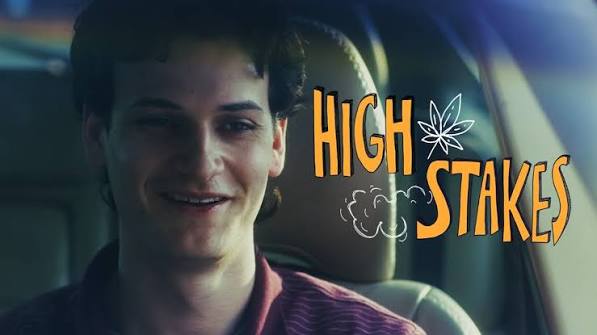

Colin Dowda discusses High Stakes, a 2012-set stoner comedy about a teenage outcast searching for friendship, screening at the River Valley Film Festival.
By Valerie Milano
Palm Springs, CA (The Hollywood Times) 7/14 26 – Writer-director Colin Dowda’s short film High Stakes takes the familiar stoner-comedy formula back to high school, when marijuana still felt mysterious, risky and capable of changing a teenager’s place within the social hierarchy.
Screening at the River Valley Film Festival in Williamsport, Pennsylvania, High Stakes follows Fisher, a lonely high school outcast who decides that selling weed may be his best opportunity to make friends and enter the social circles that have previously excluded him.
“It’s about a high school outcast who decides to sell weed to try to make friends,” Dowda explained during a Zoom interview with The Hollywood Times. “It’s set in 2012, a time before weed was legal, and so he may not understand the full consequences of his actions.”
Click below for our exclusive interview:
Dowda describes the film as a grounded stoner comedy, and that distinction is important. These characters are not experienced marijuana enthusiasts armed with elaborate devices, perfect terminology and the exaggerated confidence commonly found in the genre. They are confused teenagers attempting to look like adults while barely understanding what they have gotten themselves into.
“In every stoner comedy, you’ve got these guys who are the best at smoking weed ever,” Dowda said. “My experience is that most of the time people are not good at it, especially when they’re in high school. They’re figuring it out, just like you are with everything at that age.”
That youthful confusion gives High Stakes its most relatable quality. Fisher does not begin selling drugs because he dreams of becoming a criminal mastermind. He is motivated by a much simpler and more emotionally recognizable need: he wants people to like him.
The film’s 2012 setting allows that premise to work in a way it might not today. Dowda explained that marijuana’s increased accessibility and widespread legalization have changed the social position once occupied by the teenage weed dealer.
 The production team approached 2012 as a genuine period setting, recreating its clothing, cellphones, vocabulary and teenage culture. Dowda was in high school during that period, as were several members of the crew, but accurately reconstructing the recent past proved more complicated than expected.
“It technically is a period piece,” he said. “We got to have a ton of fun with the clothing, the devices, the phones people were using and the language as well. It was trickier than expected to make something period accurate, but it was a really fun game to play rather than just making a modern-day story.”
The film’s pace is rapid and intentionally restless. Scenes, characters and complications arrive quickly as Fisher’s attempt to improve his social life becomes increasingly difficult to manage.
Dowda said the structure was influenced partly by the practical limitations of independent filmmaking. The production’s budget helped determine the film’s possible running time, while the story still needed enough space to provide Fisher with a complete emotional arc.
“We had to move pretty quickly,” Dowda said. “But moving quickly doesn’t work if we don’t take enough breaks, so it was about finding measured points to breathe in the story.”
 That pacing gives High Stakes considerable energy, although the frequent shifts occasionally make the short feel crowded. Some scenes move forward before their dramatic or comedic possibilities have fully settled. The film sometimes plays less like a completely self-contained story and more like the introduction to a larger world.
Dowda acknowledged that High Stakes could serve as a proof of concept or even the opening episode of a longer project. Viewed in that context, its many characters and rapidly developing situations feel like pieces of a story that may be capable of continuing beyond the short’s conclusion.
The film’s comedy was approximately 90 percent scripted and 10 percent improvised. Dowda carefully constructed the dialogue, jokes and rhythm on the page but left selected moments open for the actors to contribute their own ideas.
“We had a lot of moments where only the action was scripted,” he explained. “I made sure the actors knew to feel free to add something if it felt right. Some of the funniest lines in the movie are little moments that came from the actors.”
For Dowda, allowing room for those discoveries was essential.
“You never want to be so strict that you miss out on that magic,” he said.
 Casting began with the search for the actor who would play Fisher. Dowda was looking for someone who could communicate the character’s profound desperation for connection without turning him into a dark or unsympathetic figure.
“We were looking for an actor who could really feel like they were desperate for this friendship and connection, in a way where they’re so desperate they’re disconnected from reality,” Dowda said.
The actor also needed a natural instinct for comedy, but Dowda was less interested in finding someone who could exaggerate the material than in finding a performer capable of showing Fisher’s humanity.
Once the lead was selected, the filmmakers built the ensemble around him. They looked for contrasting personalities and energy levels, pairing more animated characters with performers who brought a quieter or more grounded presence.
Chemistry reads helped Dowda determine which combinations felt like believable friendships.
“It came down to what felt like they could actually be friends,” he said. “What felt like this could actually be a group that I would know in high school?”
 Creating that believable social world became particularly challenging during the film’s basement party sequence. The production placed more than 30 middle-school- and high-school-aged extras inside a single house, with only a limited amount of time to complete the necessary scenes.
Coordinating the background action while protecting time for the principal performers created one of the production’s most demanding days.
The crew encountered another complication while filming a stunt sequence involving an older car. When an actor threw open the vehicle’s door, the door broke, leaving the independent production to solve both a creative problem and an issue involving a rented automobile.
“Definitely the indie spirit on this,” Dowda recalled. “Just trying to make it work the best we could. Wrenches were thrown our way about every day.”
Despite directing a movie centered on marijuana, Dowda said he remained completely sober while working.
“I try to remain stone-cold sober, or else there’s no way I’d be able to do this job,” he joked.
 Dowda does not view High Stakes as a political argument for or against marijuana. His thematic goal is relatability rather than advocacy. The weed is central to the plot, but the deeper subject is the instability of youth, and the questionable choices teenagers make while trying to establish an identity.
“Whether you’re a stoner or not, everyone has been young and everyone has been confused,” he said. “This is more about the struggle and less about coming out on top.”
That approach gives the film a sincerity not always associated with the stoner-comedy genre. Its more exaggerated moments are balanced by Fisher’s recognizable desire to be accepted. Beneath the jokes is the uncomfortable reality that young people may place themselves in increasingly risky situations simply to avoid feeling alone.
Dowda will travel from New York City to Williamsport to attend the River Valley Film Festival screening in person. The trip will mark his first time visiting Pennsylvania.
For Dowda, presenting the film before a live audience carries far more value than simply accumulating views online. He looks forward to hearing where the laughter occurs, observing the response to the film’s quieter scenes and discussing the story with viewers afterward.
“Anytime I get to show anything I’ve made in front of an audience, it is so much more rewarding than any amount of views I could get online,” he said. “Sharing a room with people, hearing the reactions and hearing where the laughs fall is really helpful for me to grow as a filmmaker.”
 He is also interested in discovering which characters, emotions and situations remain with viewers after the screening.
“If the movie leaves any sort of impression on people, inspires them or makes them feel something, that’s great as well,” he said.
Dowda is currently developing his first feature film with a creative partner. The project remains in the script-development stage, and he hopes eventually to bring it to theaters and reach a wider audience.
Distribution and streaming plans for High Stakes following its festival run have not yet been confirmed.
Audiences can follow Dowda’s filmmaking work on Instagram at @ColinDowda and follow the short film at @highstakesmovie.
 High Stakes screens at the River Valley Film Festival in Williamsport, Pennsylvania, with Colin Dowda attending in person.
Credit: Source link