
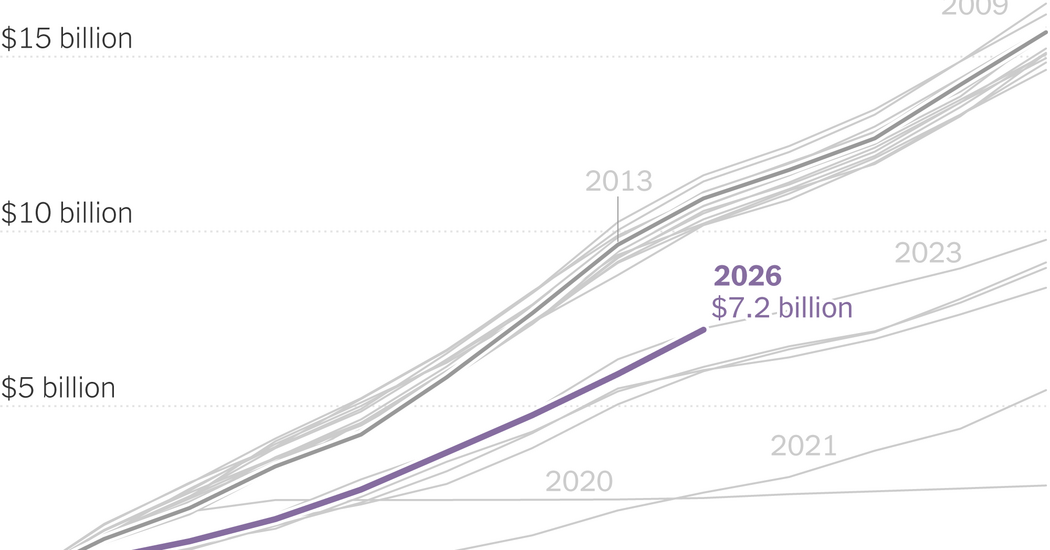
Hollywood’s summer — by its accounting — was a triumph for the ages. Ticket revenue was not only the highest since 2013, but the second highest of all time.
Just don’t look too closely at the math.
The movie industry ranks box office results by the raw dollar total, without adjusting older figures to account for rising ticket prices. It is the simplest method and, not incidentally, the most flattering.
But when you do an apples-to-apples comparison, translating older box office totals into today’s dollars, Hollywood’s summer loses some of its shine.
A good year for movie theaters, but not the best
Cumulative North American cinema box office revenues since 2005, by month
Domestic theaters, which include those in the United States and Canada, collected an estimated $4.76 billion in ticket revenue from May 1 through Labor Day — Hollywood’s definition of summer — according to Rentrak, the leading box office data service.
For an industry struggling to remain relevant amid sweeping changes in technology and consumer behavior, that result was a real achievement. Adjusted for inflation, ticket revenue rose 26 percent from last summer.
“The summer was very strong compared to the past few years, and Hollywood is rightfully celebrating that,” said Wade Holden, a senior research analyst at S&P Global Market Intelligence who focuses on the motion picture and home video businesses.
He noted that, only a few years ago, when the Covid-19 pandemic forced many theaters to close for long periods, it was an open question whether moviegoing would survive at all.
“The catch is when you adjust for inflation,” Mr. Holden said. “That makes the comeback more complicated.”
Summer is a big piece of the pie
North American box office revenues, summer vs. rest of year
Using Hollywood’s publicity-machine-ready math, this summer’s $4.76 billion estimated haul was 9 percent higher than the $4.35 billion collected in 2019, the summer before Covid upended moviegoing.
Adjusted for inflation, the 2019 total rises to $5.7 billion, putting this summer 17 percent below it.
Higher ticket prices disguise a deeper decline in attendance. From Jan. 1 through Aug. 16, domestic theaters sold an estimated 568.4 million tickets, down 30 percent from the same period in 2019, according to S&P Global Market Intelligence. That amounts to roughly 248 million missing admissions.
Fewer cinema tickets are sold per person than in the past
North America box office per-capita admissions
Theater operators and studio executives counter that fewer admissions do not necessarily signal a weaker business. They point to rising demand for premium formats, including IMAX and Dolby Cinema; 4DX screenings in which seats move in sync with the action onscreen; and ScreenX presentations, which extend the projection to a theater’s side walls.
IMAX, in particular, has been white hot. It generated $207 million in domestic ticket sales for “The Odyssey,” about 35 percent of the film’s domestic total, despite accounting for just 11 percent of the screens playing the film.
The average adult IMAX ticket in the United States costs roughly $20, compared with $12.75 for a standard ticket, according to EntTelligence, a film industry research firm.
“Internally, we call it the IMAX awakening,” said Rich Gelfond, chief executive of the large-format cinema company. “We’re capturing more and more of the market.”
Premium movie formats are gaining market share
Percent of the North American box office, by format
Premium screenings were only one of several factors lifting the summer’s total. Hollywood also restored its theatrical supply chain, which was badly disrupted first by the pandemic and then by union strikes.
More than 40 movies opened on at least 2,000 screens this summer, up from 34 last year and roughly matching the 42 released in 2019, according to Rentrak. The count had plunged to one in 2020 and remained as low as 22 in 2022.
The summer also produced an unusually strong crop of original hits. Five nonfranchise movies, “The Odyssey,” “Obsession,” “Michael,” “Backrooms” and “Disclosure Day,” each generated more than $100 million in domestic ticket sales during the season.
Original films with more than $100 million in summer sales
Each poster is sized by North American summer box office revenue
Together, those films collected roughly $1.4 billion this summer, the strongest showing for original movies in five years, even after adjusting for inflation, according to Box Office Mojo data.
Franchises nevertheless remained Hollywood’s heavy hitters.
‘Spider-Man: Brand New Day’ outperformed earlier iterations
Cumulative North American box office revenue at the end of each week
Two sequels, “Spider-Man: Brand New Day” and “Toy Story 5,” nearly matched those five original movies at the domestic box office, together generating $1.38 billion — almost 30 cents of every dollar spent. And “Spider Man” was the summer’s No. 1 movie, collecting roughly $923 million by itself.
The summer’s successes were accompanied by some conspicuous setbacks. Two seemingly surefire franchise movies, for instance, grossed far less than earlier entries.
“Minions & Monsters” took in $183 million, down 56 percent from its 2022 series predecessor, “Minions: The Rise of Gru,” after adjusting for inflation. And the latest “Star Wars” movie, “The Mandalorian and Grogu,” collected $178 million, well below “Solo: A Star Wars Story,” which was itself a flop, collecting roughly $283 million in 2018.
The latest ‘Minions’ and ‘Star Wars’ underperformed earlier iterations
Cumulative North American box office revenue each week
Hollywood would rather you not look too closely at that math, either.
Credit: Source link