On the Sunday night of The Odyssey‘s opening weekend, Paul Dergarabedian managed to get tickets to a 70mm showing at Grauman’s Chinese Theatre—a packed house, the format filmmaker Christopher Nolan had insisted the film be seen in. Before the feature, a title card appeared on screen: Denis Villeneuve, thanking Nolan for letting the audience see four minutes of exclusive footage for the next anticipated blockbuster: December’s Dune: Part Three.
“The audience erupted,” Dergarabedian recalled. “That was mind-blowing.”
He’d already seen The Odyssey on its first showing, the Thursday prior, but saw it again that Sunday. “That’s a lot of hours,” he said, adding that he may yet go to see it again. But the scene at Grauman’s—the 70mm, the Villeneuve card, the crowd’s response—stayed with him as the clearest evidence of something he’d been watching build all summer.
“This is a memory moment,” he said. “A touchstone moment.”
Dergarabedian, a longtime box office analyst and head of marketplace trends at Rentrak, has watched a lot of summers come and go. He’s been at this a while, noting that he covered the milestone releases of both Jurassic Park in 1993 and Avengers: Endgame in 2019.
“I’ve seen it all,” he told Fortune. “And this year—between the unexpected indie surprises and then the blockbuster success—there’s an incredible mix of films.” With Spider-Man: Brand New Day set to open even bigger on July 31, tracking toward $200 million to $250 million domestically, it’s a boom that has room to run.
The purest statistical milestone
For Dergarabedian, the number that mattered most wasn’t The Odyssey‘s opening, even though that was undeniably a blockbuster result, cementing Nolan’s standing as the rare director who can open an R-rated, nearly three-hour original epic on scale. It was what happened the following weekend.
Studio estimates on Sunday morning put the Odyssey‘s second-weekend drop at around 30%, with roughly $87 million in ticket sales. As final numbers came in, that figure crept up to $90 million—tightening the decline to about 27%.
“That’s nothing for a movie that opened that big,” Dergarabedian said, explaining that major tentpoles routinely fall 50% or more in their second frames. This kind of hold puts The Odyssey in the same conversation as Top Gun: Maverick and Obsession when it comes to legs. It’s already near $700 million globally and climbing; by the end of the weekend, Dergarabedian expects it to be pushing $800 million.
“They’re not gonna let that thing leave theaters until it hits $1 billion,” he said.
He traced the hold to “word of mouth doing the heavy lifting” — people reading about the film’s success and not wanting to be left out, “just like appointment television used to be.” The FOMO factor is real for the movies this year, he concluded.
“People were going out on Sunday night [to see this],” he said. “That’s a real thing.”
The observation lands differently in 2026 from it would have a decade ago. For roughly 20 years, prestige migrated steadily away from the multiplex and toward the living room. The Sopranos and Breaking Bad established television as the medium where the cultural water-cooler moments lived; the streaming era that followed doubled down on that logic, until the sheer proliferation of prestige content made appointment viewing nearly impossible. There was too much to keep up with, and all of it was available whenever.
The Odyssey‘s second-weekend hold is a television-era metric applied to a movie—what happens when audiences feel they’ll be left out of a conversation if they don’t show up. Appointment culture has gone back to the future: the multiplex.
Spider-Man as pressure point
If The Odyssey lit the fuse, Spider-Man is the looming detonation. Brand New Day doesn’t open until July 31, but tracking has it in the $230 million to $250 million range domestically, which would make it the biggest opening weekend of 2026. Dergarabedian has seen enough to offer a prediction: “Spider-Man’s gonna blow the doors off.”
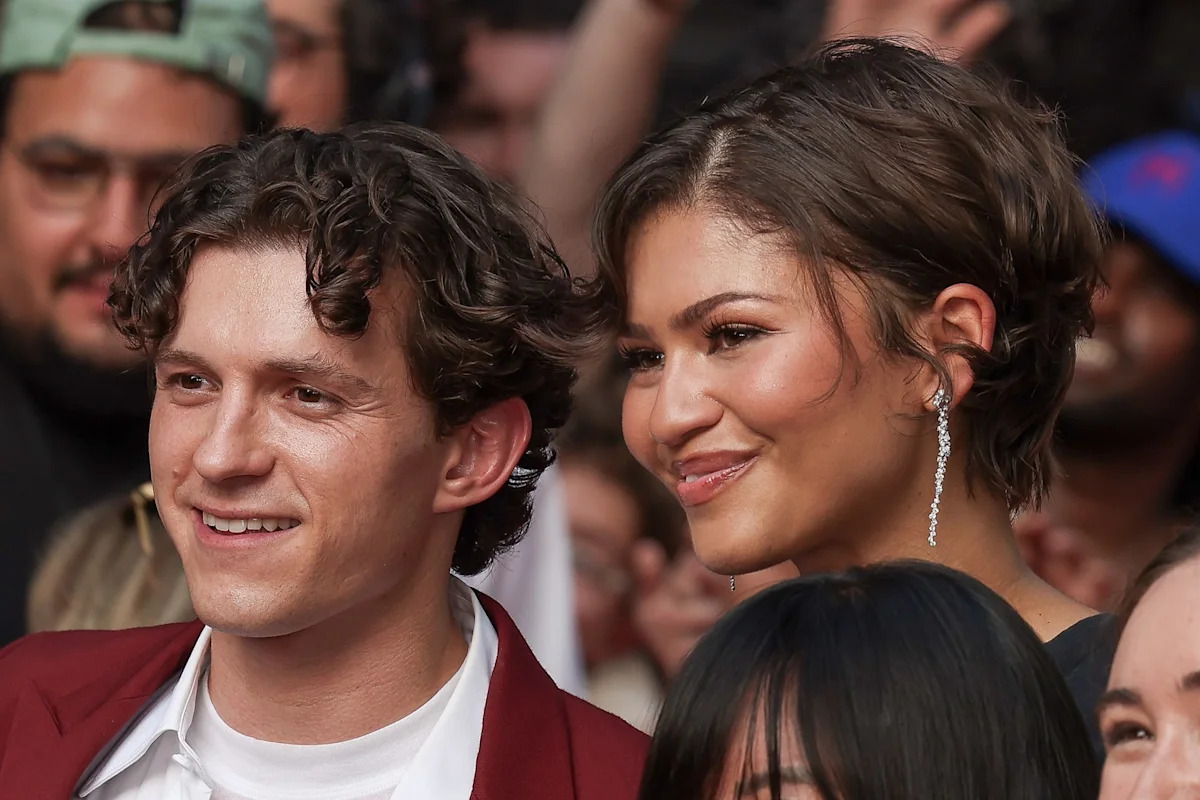
What makes the matchup unusual is its intimacy. Zendaya, Tom Holland, and Jon Bernthal all appear in both The Odyssey and Brand New Day, creating a back-to-back star run that Dergarabedian compared to Humphrey Bogart and Lauren Bacall, or Warren Beatty and Annette Bening. He said he expects fans to embrace the trio of stars.
“I think there’s going to be people bragging about seeing both,” he said. (Zendaya has an outside chance to repeat the trick this December. If she appears in the next Avengers movie, she will open against herself on the same day as Dune: Part Three.)
In fact, instead of a rivalry, he argued for a Barbenheimer-like cultural phenomenon in the making, with The Odyssey being the best thing that happened to Spider-Man. The two films are “complementary and additive,” he said—proof the theatrical market can sustain a superhero tentpole and a Nolan epic simultaneously, rather than cannibalizing each other. He pushed back on the “superhero fatigue” narrative that’s been circulating since the MCU’s post-Endgame stumbles.
“Clearly, if you put all superhero movies into one bucket, that’s a big mistake,” he said. “It’s not superhero fatigue. It’s bad marketing or bad movie fatigue.” He acknowledged Supergirl‘s struggles, but said they don’t predict Spider-Man‘s ceiling.
The eclectic slate
The twin pillars of the Odyssey-Spider-Man showdown are sitting atop a summer that was already outperforming expectations before either of them opened. The Devil Wears Prada 2 kicked off the season by outperforming last year’s Marvel entry, Thunderbolts. Lower-budget genre films—Backrooms, Obsession and Iron Lung, many driven by creators with YouTube and small-screen pedigrees—have broken through with younger viewers. Animated and family titles have filled in around them. Even franchise disappointments like Moana and Supergirl couldn’t drag the aggregate down — and he cited Moana as having long legs in its own right.
“Literally, at the multiplex, if you can’t find a movie for everyone, you’re not looking,” Dergarabedian said. He thinks the eclectic mix is what’s pulling different demographics in at once—families, older moviegoers who remember 70mm roadshows, and Gen Z, who were supposed to be permanently attached to their phones.
The math behind that observation: The 2026 domestic summer box office crossed $3 billion as of late July, leaving roughly a $1 billion gap to reach the seasonal benchmark of $4 billion that used to define a healthy season. Dergarabedian said it could be within reach, especially if Spider-Man opens big and August delivers—a $1 billion August has only happened twice. For the full year, he sees a plausible path to the first $10 billion year since before the pandemic. Pre-COVID, the benchmark was $11 billion domestically, but since 2020, the industry has cleared $9 billion only twice.
Getting to $10 billion for the full year, all the way up from $2.3 billion or “almost zero” in 2020, would be “nothing short of remarkable” to the long-time box office watcher.
Gen Z, ‘macrame’ and the analog appeal
Part of what’s driving those numbers, in his telling, is a demographic surprise. Gen Z now accounts for close to 40% of the moviegoing audience in North America—a cohort that was supposed to be lost to small screens. A 2026 Fandango survey found 87% of Gen Z respondents had seen at least one film in a theater in the past year—outpacing millennials—and they’re averaging around seven annual trips.
“Gen Z are embracing cassettes, handcrafted… macrame,” Dergarabedian said, noting the cohort’s seemingly ever-growing love of analog. The same impulse that drives vinyl and thrift culture shows up in their appreciation for movies that feel materially made, he argued, pointing to Nolan’s refusal to use generative AI, love of shooting on film, and insistence on practical effects. In Dergarabedian’s shorthand, Nolan is making “handcrafted” films that resonate with a generation that grew up algorithmically fed and is increasingly seeking out things that feel like deliberate choices.
He noted the irony of the unexpected hits boosting the box office and their origins in user-generated content.
“Small-screen creators are helping to power a big-screen moment,” he said. Gen Z directors and storytellers who built their followings on YouTube have now shepherded those audiences into multiplexes. The Gen Z demos for Backrooms and Obsession are stronger than for The Odyssey, his data shows, with younger viewers showing up for their discoveries alongside the canon-builders.
A memory moment, in physical form
The Odyssey has given this experience a tangible form, too. The first narrative feature shot entirely on IMAX cameras, its 70mm runs have been marketed as events in themselves. At Grauman’s Chinese Theatre and other IMAX venues, audiences on designated Sundays walk away with physical strips of 70mm film—a giveaway IMAX has marketed as exclusive to those showings. Within days of the promotion’s launch, Odyssey strips were listed on resale sites for dozens of dollars apiece.
“This is a moment where people are keeping their ticket stubs,” Dergarabedian said, not letting the experience dissolve into a streaming queue. He traced that impulse back a long way, recalling the time he saw 2001: A Space Odyssey at Hollywood’s iconic (and soon to reopen) Cinerama Dome in 1968. The echoes for him aren’t about plot but about ritual: The feeling that how and where you see a film becomes part of what it means.
That logic extends to the air conditioning. Much of North America has been under intense heat advisories this summer; attendance in Europe rose 50% in one stretch of extreme heat as audiences sought cool rooms. Dergarabedian is careful not to draw a straight line to the Great Depression, but he sees continuity in how theaters function when the outside world becomes hard to bear. Movie houses were among the first public spaces to install modern air conditioning, and they marketed “refrigerated air” as aggressively as they advertised their films.
“Let’s not forget how important air conditioning is,” he said. “Back in the day, movies would advertise air conditioning.” The dark, cool auditorium is once again, in his phrase, “shelter from the storm.”
“It’s the one place you can go, the movie theater, and leave your troubles at the door,” he said. “If you are appropriately comporting yourself, you are off for two hours.”
Monoculture’s return, and a BMW
Earlier this summer, Dergarabedian noticed attention was being divided between two stories: the FIFA World Cup and The Odyssey‘s rollout. In his mind, that split is significant—evidence a movie can still compete with global sports for top-of-mind status. Fortune asked him: Is the monoculture coming back?
“It is. I actually love it,” he responded.
He illustrated the point with a story about getting into his car. On his BMW’s screen, an ad appeared: a clapper board, then Spider-Man swinging toward a BMW vehicle, animated, the BMW logo materializing at the end. The surround sound in the car, he said, was insane. He posted it to X. People were divided. But the image stuck with him—Spider-Man marketing appearing through his car’s dormant apps while the car was sleeping, waiting for him.
Doug Shapiro, a media innovation guru who writes the media strategy newsletter The Mediator and serves as senior advisor at Boston Consulting Group, would recognize what Dergarabedian saw. He said the monoculture may be coming back, but offered a very different, very 21st-century economic explanation.
“As content proliferates, consumer price sensitivity goes up, willingness-to-pay goes down,” Shapiro told Fortune, “and it becomes necessary to monetize content some other way.” His reading of the box office revival is cooler than Dergarabedian’s.
“It’s a great year in dollars, but not in habits,” he said. Normalized for inflation and population growth, he noted ticket sales per capita are still dramatically down from where they were a decade ago. What’s changed is the bar for when consumers are willing to leave the couch.
In streaming, Shapiro sees the same dynamic playing out on the other side of the economics. In the first quarter of 2026, 60% of premium streaming gross subscriber additions chose ad-supported tiers, according to Antenna. FAST services like Roku Channel and Tubi are growing their share of viewing time. Disney+ is considering a free tier; Paramount+ is putting more content outside the paywall; Netflix has begun publicly entertaining a no-cost ad-supported option in some markets. The recently struck Peacock-YouTube deal—under which Peacock is bundled into YouTube Premium at what Shapiro estimates as a steep wholesale discount—is, in his view, a bet advertising and lower churn will make up for cannibalized subscription revenue.
The mechanism driving both trends is the same: As there is more free content, consumers become more selective about what they’ll pay for, and that has to feel unmissable. Shapiro’s analogy is mobile gaming: AAA console titles cost hundreds of millions and charge you, and mobile games cost orders of magnitude less and are almost entirely free. As AI drives down content production costs, more of what gets made will flood the market at zero marginal price. “Most content will become top-of-funnel for something else,” he has written. When content goes from profit center to cost center, most media companies will struggle to adjust.
Taken together, the two trends describe a flip that is still in rotation. After decades of prestige living on the small screen, that is fragmenting under streaming’s shift toward free and ad-supported models, structurally vacating the premium tier. The unmissable experience—the thing worth showing up for, worth keeping the ticket stub from—migrates back to wherever scarcity lives. In the mid-2020s, that’s the multiplex—with Spider-Man swinging across your BMW screen, too.
This story was originally featured on Fortune.com
Credit: Source link