I think it’s probably pretty easy to see why people in Hollywood are all a little down. Los Angeles is an unaffordable city where jobs are fleeing, studios are consolidating, and the industry is harder to break into than ever.
Agents represent a lot fewer people. Management companies are incredibly selective. And scam websites keep popping up, asking you to pay for access.
From my own experience, it’s taking people months to read spec screenplays, and every bump in the road places the onus on the writer to package it themselves before they can even get a production company on board. Even then, everyone is working for a place of pure fear, terrified they’ll lose their job and never be able to find another.
I know I wake up every day feeling like Sisyphus. I grab my boulder, and I head toward the hill, pushing and pushing because that’s all I know how to do.
I built my entire life and future around the belief that if I work hard in Hollywood and keep putting my best ideas on paper, it will all be okay.
But recently, I went out with a new spec and had the hard conversation with myself that it would probably be the rest of the summer before I had any clarity on how it was received in the marketplace.
My choices were to brush that off and start something new, or to lie in bed.
And for the first time in my nearly 15 years in Hollywood…I chose bed. Now that I have a kid, I can’t stay in bed all day. But emotionally, I never left my old mattress in my 850 sq. ft. apartment.
I thought that would last a day, but weeks later, I still felt creatively drained.
Then, last night, I went to the Academy Museum for a special screening of Alfred Hitchcock’s Notorious. It was hosted by Guillermo Del Toro, and I think it saved my (screenwriting) life.
Let’s dive in.
‘Notorious’ Credit: Criterion
The Myth of Hollywood
In 2013, I was an assistant working 16-hour days at a new production company with a lot of pressure. And then one day, in October, the Black List website chose my script, Shovel Buddies, to be the first-ever script of the week.
The email went out at like 8 AM PST, and by 11 AM, I had agents, managers, and a lawyer. A year after that, I’d have sold that script and seen it go into production.
Suddenly, people were bringing me coffee. And every 16-hour day I spent working was on the set of a movie that I had created from thin air.
Those couple of years of my life are proof of the promise of Hollywood. You can move here with no connections, work really hard, and succeed.
The next decade has been a part of the myth you don’t hear about.
Sustained success is way more of a marathon than a sprint, and even if you get out of the gate fast, the real test is how you deal with the stumbles.
My stumbles are sort of trite and common. Shovel Buddies didn’t open big and make me famous, and the projects I lined up after suffered the same fate. I went from a hit name to just a guy on the periphery. I was getting work, but the contracts were smaller, and the specs I had were getting producers, but not getting made.
Suddenly, instead of leading the pack, you’re just one of the dogs snapping at the bones that get left behind by other people.
I kept writing through the whole thing because I believed that the best way to break in and break out again would be another noisy spec that got passed around and hit like wildfire.
Guess what?
I still believe that.
But the game also changed so much in the last 10 years.
When COVID hit, I started seeing a lot of friends leaving Los Angeles. That didn’t slow down for a while, especially with the 2023 strikes. I’ve seen so many people I love leave, people I think deserved to be here and have a voice or a day in the way Hollywood should function.
Then came the consolidations, and suddenly it felt like everyone in my group threads was unemployed and stayed that way.
These were execs I loved, who came up with me, and who were vital in getting me paid and in developing ideas. They were also human beings with their own hopes and dreams, but they were no longer in Hollywood.
I watched a lot of them leave for tech or for states where it doesn’t cost $2.5 million to get a three-bedroom house.
Suddenly, Hollywood felt a lot leaner than it was when I broke in. That robust sense of love and community had vanished. And after the fires, where I saw friends’ homes burn and never come back…
Los Angeles looked different. It smelled like burnt ash. The Arclight was closed. Both main theaters in Westwood were abandoned. The Landmark Mall lay empty.
My main street in Westwood was full of empty storefronts, of displaced people.
I went all over, Santa Monica, Venice, Los Feliz, Larchmont, The Grove, and it all felt duller. The city had undergone so much, production had left, and no one was sure if it would ever come back.
It kind of felt like Holylwood moved out and left a lot of people here wondering how to move forward.
I wasn’t the only one who wanted to lie in bed. I think this industry as a whole has been collectively suffering from the PTSD of the last few years.
So when I got my ticket ot the Academy Museum, I was going because I knew if there was ever going to be a place that turned this stuff around, it had to be there.
 Credit: The Academy
Enter Guillermo Del Toro
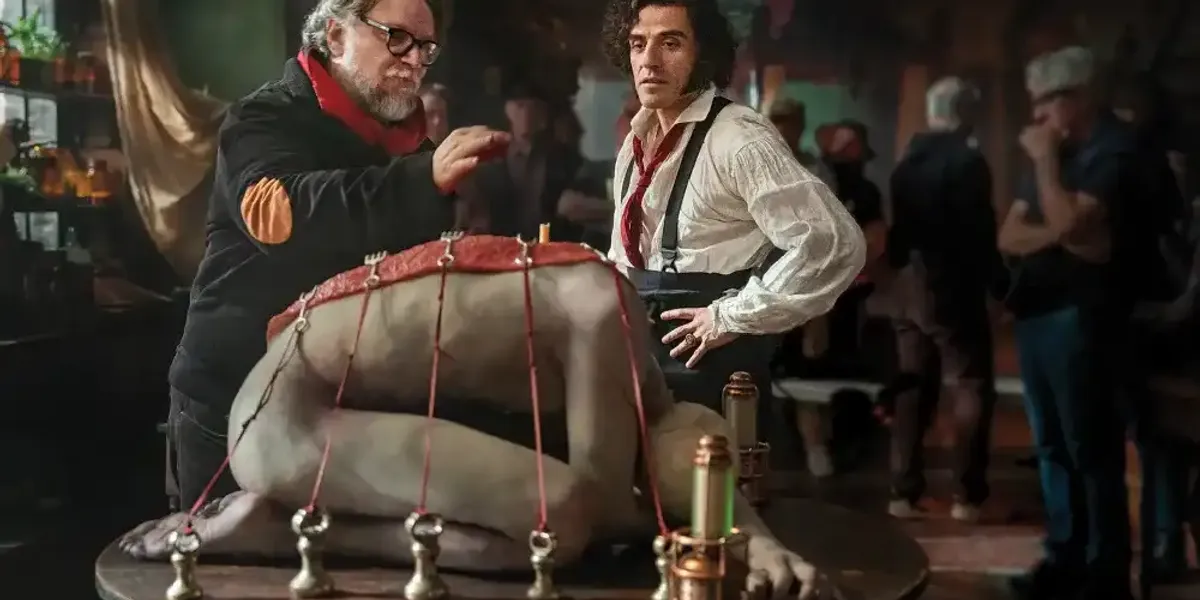
I don’t think I have to introduce Guillermo Del Toro to you; if you’re on this website, you know the maestro behind movies like Frankenstein and Pan’s Labyrinth. He’s also a huge movie nerd, a lover of cinema whose enthusiasm is palpable.
His presentation at The Academy Museum was happening because he wanted to do a talk on pure cinema, and who better to break down than the master of suspense?
Over the next few nights, Del Toro will take audiences on a journey through a few of Hitchcock’s works, and with each movie, he delivers what amounts to a film school lesson on the nuts and bolts of Hitchcock’s filmmaking style.
For Notorious, we studied point of view, learned how they built the crane for the famous key shot, discussed what comedy and horror had in common, and explored anticipation and violence.
We also got to go on a journey with Del Toro into Hollywood’s life, learning how badly he wanted to come to America. When he finally did, making his first American movie at 40, it was like he had to rebrand himself all over again and prove himself to the doubters.
Del Toro juxtaposed that with the hilarity of his own career in cinema and joked that he and Hitchcock had more in common than just their pants size.
Above all else, the night was a reminder that it was okay to love Hollywood, even with her flaws. Like any Hitchcock blonde, Hollywood is beautiful but dangerous. Complicated at its heart. But if you take the time to break her down, you’ll undoubtedly fall in love.
To me, at 39, I needed to hear that it was still okay to be finding my voice. I needed to hear how hard it was for Hitchcock to make the movies he wanted, how much the struggle was worth it because it made his art better, and it was interesting to see pieces of Hitchcock’s life on the screen that I never knew about before.
As Del Toro continued talking, I felt those hot, burning tears dripping down my face. Maybe it was my homage to Ingrid Bergman’s watery eyes in Notorious, but I had fallen in love with what we do and why we did it again.
I was loving Los Angeles as a mecca of filmmaking because I couldn’t imagine being in any other city where a talk like this is possible.
And when I scrambled to try to get tickets for the other nights, I saw they were sold out, and I had faith in a town that was still healing from eveyrthing it had been through, but doing so by experiencing these amazing chats and flocking to the classics that built these streets and put a sheen over this valley that’s enticed so many to chase their dreams by the palm trees and oceans for the past 100 years.
Where Do We Go From Here?
I think that Hollywood has been burnt out over the last few years. We’ve gone through so many things, and I feel like I didn’t touch on half ot it. We had moreal reckonings and resurgences, and so much chaos that it’s been hard to handle.
But out of the ashes, I do see a new Hollywood rising. It’s imperative for the people who are still here to build it better than before and to use our strengths to make it a town that reflects the hopes and dreams that make it magical.
That magic is why I finally got out of bed today, both physically and emotionally.
I didn’t get out thinking it was going to be any easier; I got out because Del Toro reminded me that Hitchcock made the movies he wanted to make despite everyone telling him he couldn’t.
Hitchcock believed. It was that belief that inspired a young Mexican kid in Del Toro to make the movies that had inspired him, the ones people told him would never work or connect with people.
And it was his challenge to the audience to do the same that shook me in a way I needed, that disgusted me, and whispered in my ear to keep going.
If I were wet-eyed Ingrid Bergman, then his words were Cary Grant carrying me down the stairs at the end of Notorious, shaking the poison out of me.
So yeah, my boulder is still here. But I think it always will be. So I might as well push.
Maybe that’s all any of us can do.
Well, that, and remember why we loved the climb.
As always, let me know what you think in the comments.
Credit: Source link