
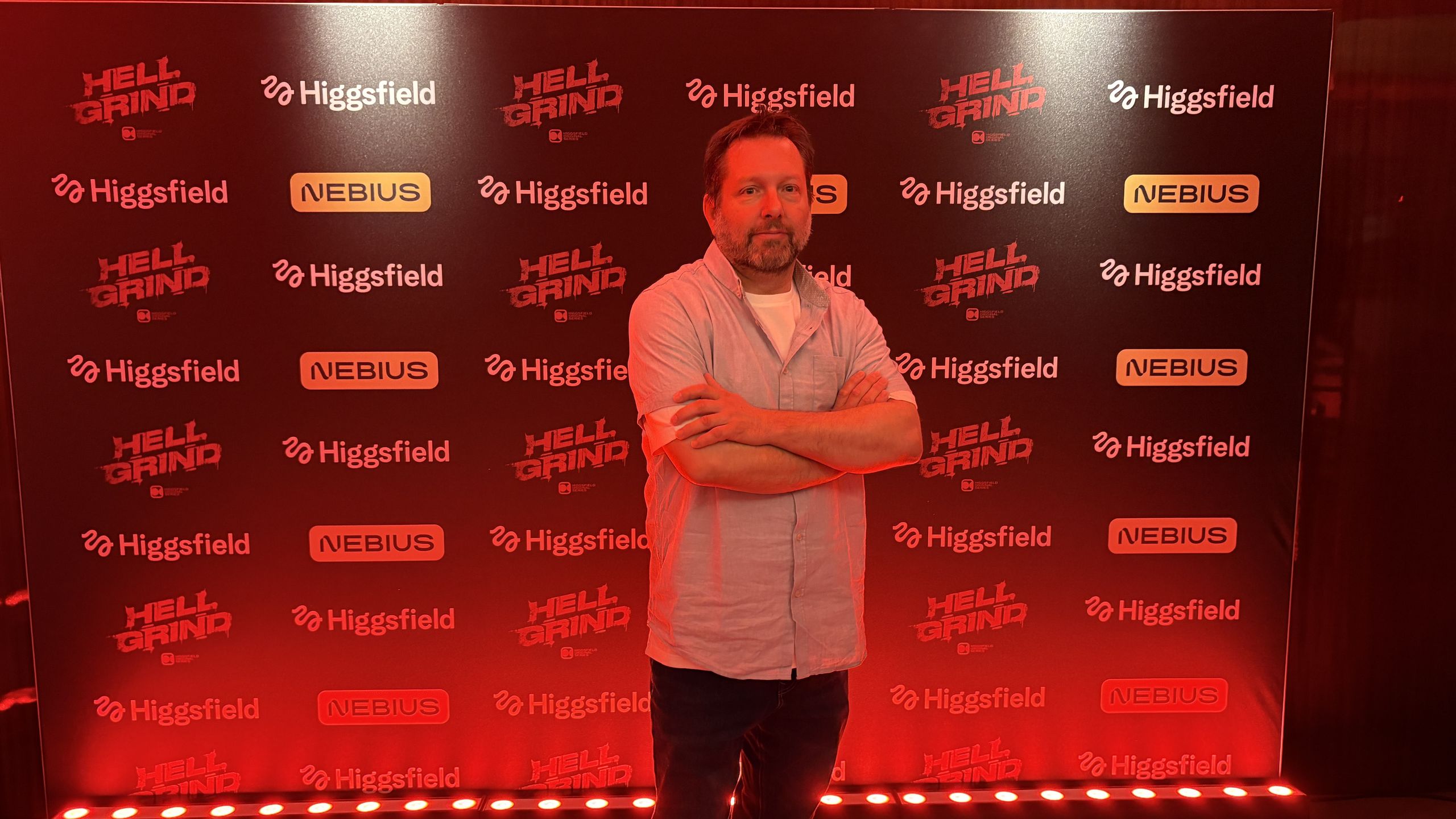
As the Senior AI Editor at TechRadar, it’s not often I get invited to movie premieres. Yet there I was in a private cinema room in a London hotel, about to watch Hell Grind — a 90-minute AI-generated horror movie that took just two weeks to make.
I was there as a guest of Higgsfield, a platform that brings together all the tools needed to make a complete AI movie; and I was about to watch its poster child for the very thing that’s got Hollywood running scared: a purely AI-generated film.
As you’d imagine from the title, Hell Grind isn’t a romantic comedy — as one of the other guests remarked, it sounds more like the name of a WWE event. I don’t want to give the plot away, but it involves ancient artifacts that bestow supernatural abilities on humans when activated, and a Japanese-speaking bad guy covered in spikes, who portals into whichever location he detects the artifacts in and attempts to kill whoever possesses them.

Everything on screen is AI-generated. The human contribution comes in the story, editing, and deciding which AI-generated scenes make the final cut.
If you want a good marker for the speed of AI development in movies, when I attended the AI Film Festival in Venice last year the films were typically around five minutes long. Just a year later, movies like Hell Grind can maintain consistent characters and a coherent story for 90 minutes — and it only took two weeks to make the whole thing.

Watch On
Who’s that guy?
Talking to Higgsfield CEO Alex Mashrabov, I learned that the main character in Hell Grind is actually modeled on a real-life Higgsfield employee, who will presumably be going back to analyzing spreadsheets after his 15 minutes of fame are over.
The rest of the cast all looked like combinations of famous actors and actresses you’ve seen before, but whose identities you can never quite pin down. I found trying to work out who they resembled surprisingly distracting, and I swear that one of the main actors looked a little too much like Naomi Watts at times.
Leaving aside the ethical questions raised by AI models that appear capable of producing characters who resemble real actors, it’s worth evaluating the movie on its own merits.
Surprisingly, the action scenes were often the strongest part of the film. Watching various super-powered heroes and villains duke it out was genuinely entertaining. But at no point did any of it look real.
Hell Grind is a horror fantasy, so it could be argued that realism wasn’t the look it was aiming for. Even so, I got the impression that we’re still a long way from AI-generated dialogue scenes that hold up on a big screen, and make us genuinely unsure whether we’re looking at a real person or not.
Take a deep breath, Hollywood — we’re not there yet.
There were some obvious problems with the dialogue. At points it sounded like an AI chatbot trying to write movie dialogue, and the characters would occasionally blurt out something unintentionally hilarious given their current predicament.
Most memorably, when one character was facing his imminent demise, he let out a baffling “Cool!” Moments like that threw you out of the film and back into the theater, breaking the spell.
The AI boogeyman
AI in movies is a contentious topic. There are obviously people who would rather drink a pint of toxic runoff water from a Mid-west data center than sit down and watch an AI-generated movie of their own free will.
Many people see AI as something that’s going to take their jobs, ruin the planet, and eventually eliminate humanity itself. So Hell Grind simply existing in such a creativity-led industry is a provocative act in itself.
But parts of Hell Grind were fun, and the whole film almost hung together. It felt more like a proof of concept than a piece of art; but if Higgsfield’s goal was to prove that AI can produce long-form content with consistent characters, it largely succeeded.
Hell Grind might not quite be there yet, but it won’t be long before a real filmmaker, frustrated by the endless bureaucracy and gatekeeping of traditional filmmaking, starts using these tools to create something people genuinely want to watch.
The strange thing about Hell Grind is that it left me both impressed and reassured. Impressed because a small team created a feature-length movie in just two weeks. Reassured because, despite all the progress, AI still struggles with the thing that makes films memorable: believable people.
The action scenes worked. The visual effects worked. The story mostly held together. But the moments that should have felt human still felt synthetic.
Hollywood should absolutely pay attention. But after watching Hell Grind, it doesn’t need to panic just yet.

Follow TechRadar on Google News and add us as a preferred source to get our expert news, reviews, and opinion in your feeds.

The best TVs for all budgets
Credit: Source link