
It’s hard to describe all of the feelings provoked by watching a film like Yuval Abraham and Rachel Szor’s NAZA. Outrage for sure. Indignity as well. Most certainly disgust, on a profound level, for the current Israeli regime and its prime minister, Bibi Netanyahu.
Yet this sober and thoroughly documented bombshell of an exposé, in which two dozen IDF intelligence officers detail the systematic targeting and murdering of civilians in Gaza since October 7th — how it was carried out deliberately and with state-of-the-art precision — also leaves one with a deadening feeling, as if humanity may have lost all hope.
NAZA
The Bottom Line
A crucial act of bearing witness.
Venue: Venice Film Festival (Competition)
Directors: Yuval Abraham, Rachel Szor
1 hour 20 minutes
That’s clearly not the purpose of this brave and indispensable movie, which deserves to enter the historical record in the same way as Claude Lanzmann’s Shoah, an excerpt of which we see playing on a screen outside the Tel Aviv Cinematheque. Both works bear witness to acts of genocide — this is the term employed by an IDF officer in the film — and both use a rigorous interview process to get people to speak of the unspeakable, the main difference being that NAZA focuses exclusively on the perpetrators instead of the victims.
The parallels between what happened and is still happening in Gaza right now and what happened during World War II clearly are not lost on some of the Israeli men and women interrogated here, even if the scale and details are certainly different. “We erased history,” one of them confesses, while another looks back on a school trip he took to the concentration camps in Poland and says: “I still see those Nazis as evil, but what does that mean I am?”
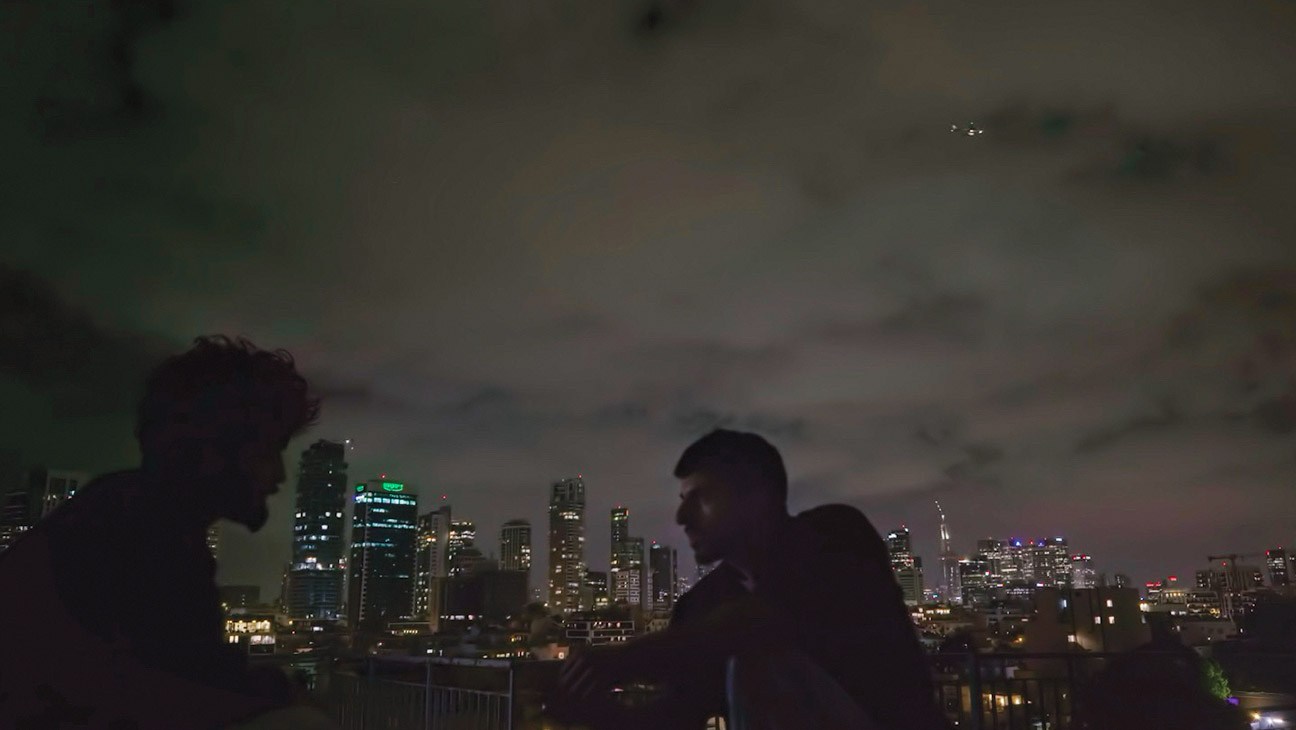
Abraham obtains such statements while sitting on Tel Aviv rooftops to calmly question those members of the IDF who have chosen to come forth, using VFX to alter their voices and faces, as well as to blur their handwriting, so that they can’t be identified. Only the director is clearly visible, with co-director Szor serving as cinematographer along with an unnamed camera crew, capturing 24 difficult conversations in front of nighttime cityscapes that have the icy feel of a Michael Mann movie.
Even those backdrops start to take on meaning beyond the anonymity they provide. As we delve into Israel’s state-sponsored killings in Gaza, which per the film have so far resulted in 73,000 victims, we learn step-by-step how the process was coldly and ruthlessly carried out. Using surveillance technology to hack and track telephones, then drones and AI algorithms to precisely determine the location of targets, the IDF realized that nighttime was usually the best time to kill — it’s when suspected members of Hamas would be sleeping at home with their families, their phones lying next to them.
“A factory of targets” is how one officer describes the process, which displayed zero regard for collateral damage, and, in many cases, seemed to actively encourage it. The film’s title is taken from the acronym used by Israeli intelligence to denote such damage: A Hamas target would be marked in an apartment along with five NAZA, i.e. five innocent women and children, all of whom would be exterminated in an instant. In one case, an interviewee mentions that 500 NAZA were killed to get to one suspected terrorist, while others talk about bombing whole city blocks in acts of total destruction.
The dehumanization of mass murder — “the goal was quantity, not quality,” someone states; another says it was “like a video game” that could, at times, even feel exhilarating — seems to be the m.o. of a regime that has either tried to cover up its war crimes or else to justify them with biblical rhetoric, as witnessed in clips of Netanyahu bellowing about “good and evil, light and darkness.”
Abraham and Szor go on to demonstrate how such destruction is also ingrained in Israel’s past, with archival footage showing the razing of Palestinian neighborhoods in Tel Aviv during the 1940s, as well as the vast intelligence infrastructure implanted in Gaza after the Israeli takeover following the Six-Day War of 1967. “The more we knew, the more we were in control,” one officer states, although he admits they were blindsided when Hamas attacked on Oct. 7th.
While their Oscar-winning No Other Land alternated between scenes of bulldozers tearing down homes in the West Bank and scenes showing the growing camaraderie between Abraham and his Palestinian co-director Badel Adra, there is no such relief here. NAZA is not meant to please, nor to depict some kind of miracle that may have emerged from all the rubble in Gaza. Indeed, the film’s closing images, taken from phone footage shot by Palestinians after IDF bombings, reveal the immense pain and suffering caused by a war machine we’ve come to know intimately.
That machine is operated by “the best of the best” of the Israeli army, as one officer soberly states, and it’s when Abraham tries to coax some kind of mea culpa out of his subjects that he finds himself facing reactions akin to the banality of evil argument, which Hannah Arendt famously used to describe how certain Nazis justified their participation in the Holocaust. “I’m just a small cog,” an officer states, “someone else would have done it.” “That’s the mission” says another, even if such a mission involves using snipers to gun down Palestinian civilians scrambling desperately for food, as we learn during one late interview that chills to the bone.
The stark testimonies of mass killing, of whole neighborhoods being erased from the map, are constantly juxtaposed with images of Tel Aviv’s steel-and-glass towers looming or being constructed in the background, their residents watching Bibi’s speeches on their massive flatscreen TVs. It’s as if one civilization is being fostered by the end of another, which sounds like an overstatement until you hear the officers speaking about “annihilation zones” in Gaza where anything living would be targeted, even a teenage boy who happened to wander in.
NAZA is meant to be intolerable, but it’s also meant to state a truth many still do not wish to acknowledge, especially in our divided and fact-impaired times. Filmmakers like Abraham and Szor, as well as directors such as Dani Rosenberg, Nadav Lapid, Anat Even and Jonathan Glazer (who served as executive producer on this movie) are not only courageously acting as artists bearing witness and challenging official narratives, but as Israelis and Jews refusing to allow such atrocities to be committed in their names, or in mine.
Credit: Source link