
We have thousands of human-written stories, discussions, interviews and reviews from today through the past 20+ years. Find them here:

One of the joys of experiencing art in person is the opportunity to experience something fresh in the seemingly familiar.
This thought came to me on Tuesday night at Hollywood Bowl, as I watched the Canadian violinist James Ehnes create some live magic performing the Tchaikovsky Violin Concerto with the Los Angeles Philharmonic and conductor Elim Chan. And I felt it in the second half, when the orchestra performed Stravinsky’s “The Firebird Suite” from 1919.
As James Ehnes walked onstage, formal in an ivory shawl-collar dinner jacket, I wondered – what would he do with the Tchaikovsky Violin Concerto, one of the most-played, familiar works in the repertoire?
Written in 1878, the concerto also has one of the best stories: its dedicatee Leopold Auer initially refused to play it, pronouncing it “unplayable”; then when it was finally performed (by Adolf Brodsky) the critic Eduard Hanslick called it “music that stinks in the ear.”
In the nearly 150 intervening years we’ve come to love it – and while it is certainly not “unplayable,” it is definitely an athletic feat full of virtuosic stunts.
Ehnes was steady and sure – the first thing I noticed was his phenomenal technique – for example, the off-the-string passage with double stops was admirably elegant (m. 165), and the cadenza was beautiful and logically paced, with some subtle original touches that made perfect sense.
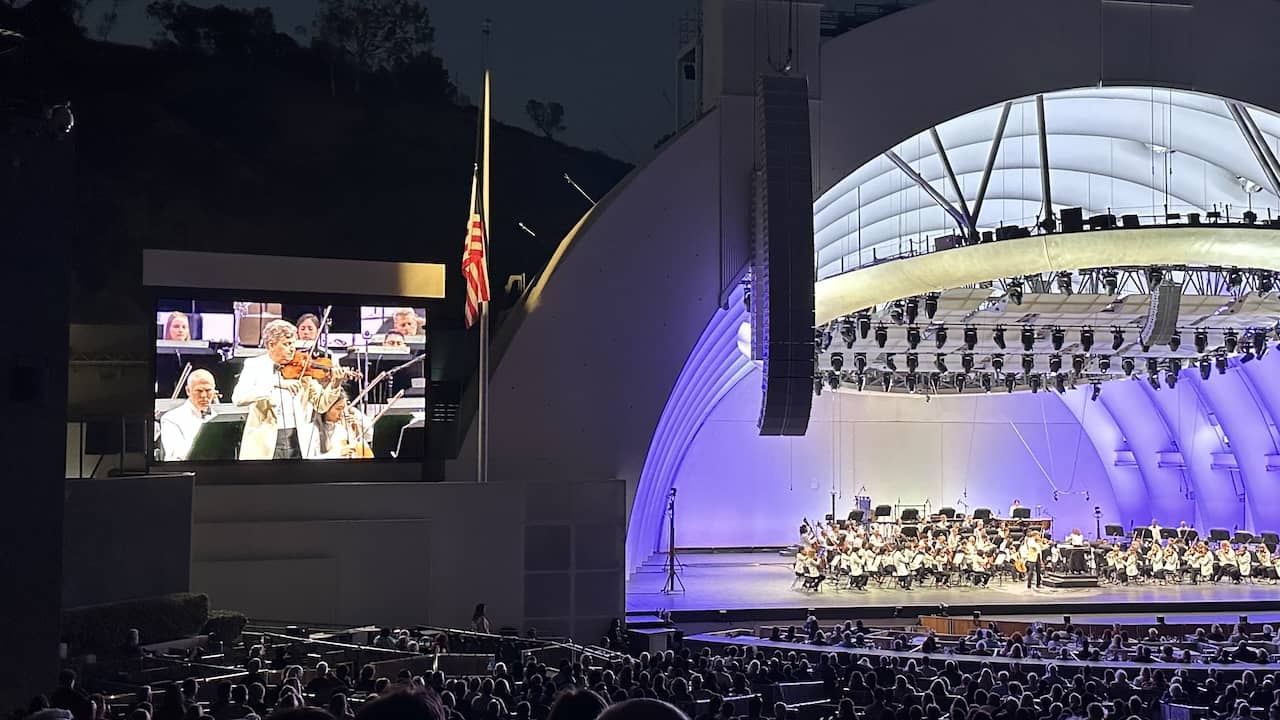
Violinist James Ehnes performs with the Los Angeles Philharmonic at the Hollywood Bowl on Tuesday.
The first movement of “the Tchaik” is one of the longest out there. We can get formal and say it’s in “sonata” form, but for all intents and purposes, as the soloist you play up to the cadenza and then – you basically play it all over again! It wasn’t until this “second time” – after the cadenza – that I noticed what Ehnes the artist was doing. The first time – the exposition – was sure-footed and efficient, not a moment wasted. Tasteful and appealing, but no time to stop and smell the flowers.
But the second time – the development and recap – well, it felt not just like a second time, but like a second chance.
For the second go-around, the musical themes were more sentimental, more nostalgic. He spent more time, put more relish in it. The high-pitched iteration of the theme – a little tightrope walk way up on the E string (before L) was so gorgeous I wanted to cry. And the end – so fast, so accurate, so exciting! Of course everyone applauded, even I did. (These days, I suspect if you don’t wind up with thunderous applause after the first movement, you might not be doing it right!)
But of course, it was not over! The second movement is quite simple – Tchaikovsky actually had written something more complicated (which he later turned into Méditation in “Souvenir d’un Lieu Cher, Op. 42”) but rewrote the second movement as a “Canzonetta” or “little song.” It seemed in keeping with this idea of simplicity that Ehnes opted to start the theme each time on an open D, and to go with Tchaikovsky’s request to play with a mute, rendering the sound softer and more contained.
Soloist and orchestra were well in sync, and with a somewhat brisk tempo, we quickly arrived at the trill that ends the movement in a kind of suspense – a little question mark that becomes a lingering question in the orchestra, drifting off until it is answered with a loud BANG to start the third movement (and to awakens anyone who may have drifted off!).
Ehnes began the third movement with chords that were tidy and clean – and with a sense of the movement’s humor. He performed with great energy in various forms – rhythmic propulsion, intent, and a pacing of his own that worked so very well. He was driving this car – never in the passenger seat. In one spot the music slows to a near-stop, then gets going again – Ehnes was so artful in the revving up.
The conclusion brings a lot of back-and-forth between full orchestra and soloist, and this was done with great synchronicity, a credit to soloist, orchestra and conductor.
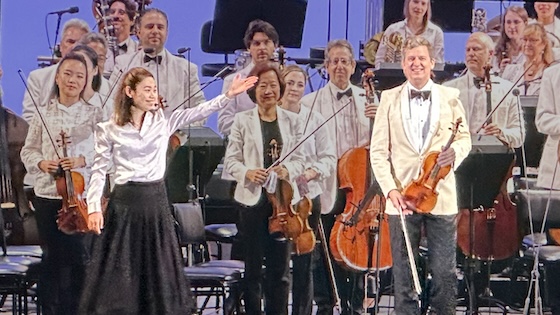
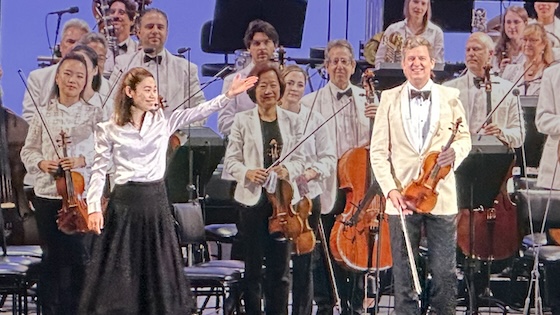
Conductor Elim Chan and violinist James Ehnes with the Los Angeles Philharmonic at the Hollywood Bowl on Tuesday.
Ehnes received a well-deserved standing ovation, and after several bows, he played an encore for us: the Eugene Ysaÿe’s “Ballade” from Sonata No. 3. This was so riveting, I would have come to the concert for the Ysaÿe alone.
A bit of background: during the pandemic, Ehnes found himself marooned without an audience (as did everyone), so he bought some high-quality recording equipment and created a series of concerts in his living room featuring this very music – he recorded all six of Ysaÿe’s Sonatas, as well as the Bach Sonatas and Partitas (you can still watch them here).
None of us likes to think about the pandemic, but it is rather life-affirming to behold Ehnes performing this music for thousands of people, live at the Hollywood Bowl. And did he ever know how! He seemed to revel in the sound of his 1715 “Marsick” Stradivari violin, echoing through this very large space, yearning and dissonant. It felt like time stopping, or going backward – those 100-year-old notes by the great Ysaÿe coming to life. What a performance.
And of course time has not stopped or gone backwards. The second half of the program brought me back to the present time and place. It featured Britten’s “Four Sea Interludes from Peter Grimes” and Stravinsky’s “Firebird Suite.” I’m going to focus on the Firebird, because frankly I just have a lot more to say about it.
First, a bit of a tangent. This summer I helped my daughter move to a small town in Colorado, and while we were there, we visited a local antique store. As she looked for furniture, I walked around idly, spotting an old-fashioned sewing machine, historical memorabilia from the town’s early days as a railroad stop, china, jewelry… and then I saw it on the wall, across the room. “The phoenix!” I rushed over to see it up close.
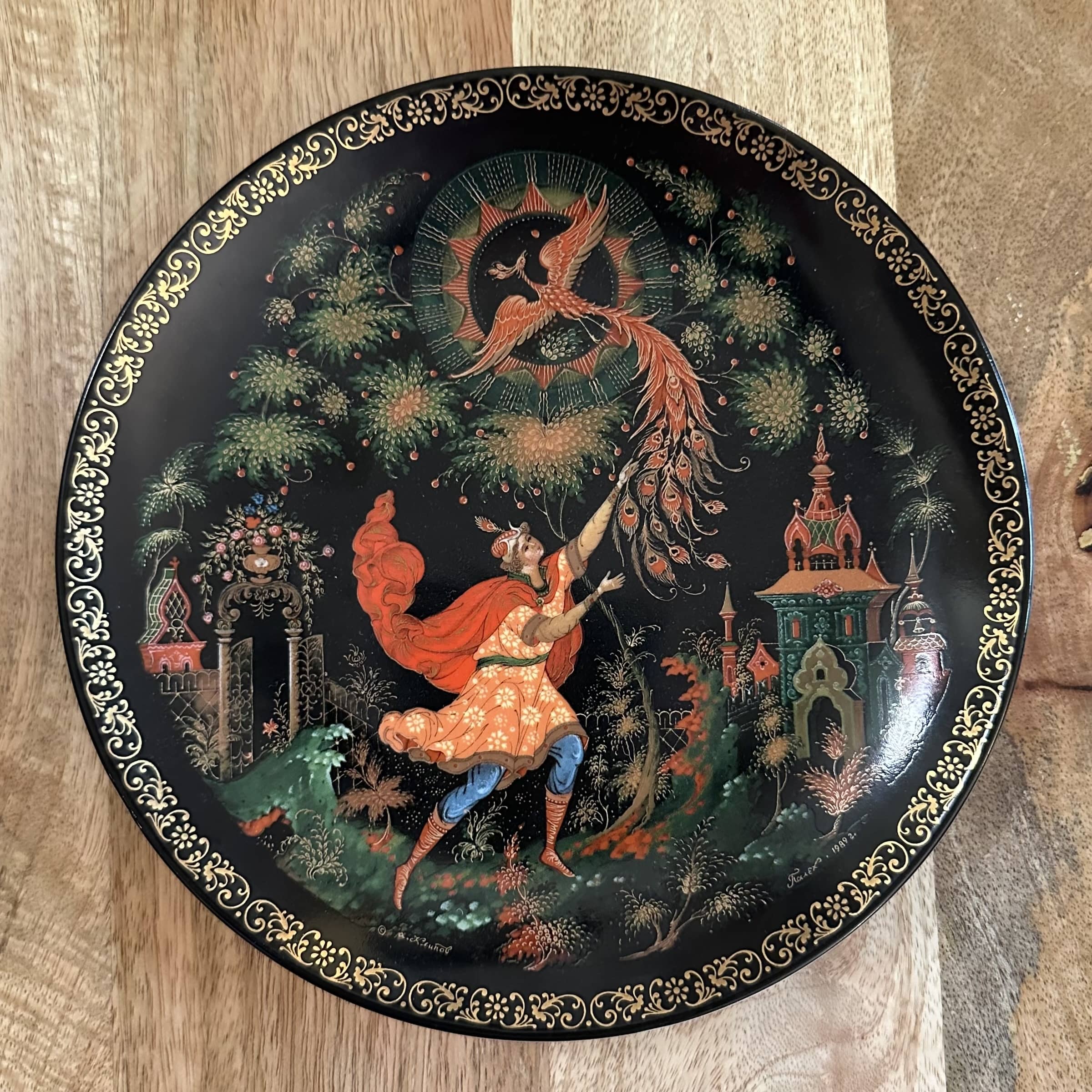
It was a plate, a piece of Russian ceramic art – I have a music box in this style, with scenes from the “Nutcracker.” I might have known this was also a scene from a ballet. But all I saw was the phoenix, the bird that rises from ashes after a fire. For me it was all about Altadena, the community next to mine, where 7,000 homes burnt to the ground last January. I want it to rise from the ashes, too, as beautiful as this bird.
The owner of the store listened kindly as I talked about this. I was going to buy it, whatever the price; she nearly let me have it for free. Once in my possession, I turned over the plate and saw Cyrillic writing on the back. Excited, I went to work with Google Translate.
This was a scene from …. “The Firebird.” Of course! It depicts the young prince, catching a feather from the firebird. And, a firebird is an entirely different thing from a phoenix. Different story, different mythology. But I’ve put this little piece of art on my wall, and to me it is the phoenix rising from the ashes, with beautiful houses also rising around the person in the middle of it.
So just two weeks later, as I listened and watched the LA Phil’s “Firebird” with Elim Chan – I thought of the fires. (To be fair, Disney did it before me – animating Stravinsky’s Firebird as a forest fire and recovery in Fantasia 2000.)
Also, this performance showcased the guest conductor Elim Chan – who just might be a pretty important person to watch. Is she a contender to replace Dudamel, who has just one season left as Music Director of LA Phil before he goes to the NY Phil? It’s anyone’s guess at this point, but it seems quite possible. A native of Hong Kong, her mentors have included Valery Gergiev, Bernard Haitink and Dudamel himself (as a Dudamel Fellow in 2016-17). At age 38, she has conducted top orchestras around the world including the Cleveland Orchestra, New York Philharmonic, Boston Symphony, Royal Scottish National Orchestra, and many more.
Chan is an interesting conductor to witness. At least on Tuesday, she conducted entirely without a baton, creating a kind of three-dimensional beat pattern that involved fingers, hands, arms, head, mouth, and even on occasion – hair (like Dudamel)!
Not that other conductors don’t use their entire bodies to conduct – they certainly do. Once while sitting in the fiddle section, I saw a conductor loose his tooth bridge and, embarrassed, he kept his mouth sealed shut for the rest of the concert. I realized only then, how much I had been watching his facial expression, I was so thrown!
But the baton does provide a focal point for the beat, and without it one still has to find a way to rally the troops with precision and clarity. For Chan, this meant pointing, drawing shapes in the air – a whole lexicon of gestures.
Certainly she was doing something right – the orchestra played cohesively the whole night, and “The Firebird” came off well, with its range of orchestral effects, gestures, meters and moods.
For me the fire metaphors began with the “Infernal Dance of King Kastchei,” which certainly had the frantic energy of a fire. But it was the last two movements that moved me – starting with the “Berceuse” (“Lullaby”) – with the beautiful extended solo by Principal Bassoonist Whitney Crockett, and also with solos from Principal Cellist Dahae Kim. This was a lullaby with pain – smoldering, numbed with shock. Very much like the wordlessness I felt when I saw the colorless ruins of the community to my north, right after the fire.
It’s been seven months of pain for the people who lost everything to fire, and I noted to myself that several of those people were playing in this very orchestra on this night. As I told one of my very young students when she asked “Is it getting better?” – you can’t un-burn-down someone’s house and possessions. They are gone and still gone. But amazingly, in Altadena, some 5,000 lots already have been cleared – the debris removed, soil cleaned. It is beginning now – the possibility of rebuilding. People affected still face a mountain of difficulty, expense and deep grief. But – is there hope?
Stravinsky’s spooky lullaby ended with soft tremolos – traveling through chords, a little confused and lost – then a glimmer of light. A horn solo – played by Principal Horn Andrew Bain – it sounded like a rebirth. In came the harp (beautiful playing all night by Emmanuel Ceysson) – something gently coming back to life. This music is one of the best musical depictions of hope ever written – and in this moment, the people in my community of Los Angeles need hope badly. The music swelled and accelerated, the feeling grew to a point of bursting, a victory march to the end. The audience rose for a long standing ovation for this piece as well.
Can this story end in triumph? It felt good to imagine it.
You might also like:
* * *
Enjoying Violinist.com? Click here to sign up for our free, bi-weekly email newsletter. And if you’ve already signed up, please invite your friends! Thank you.
Replies
This article has been archived and is no longer accepting comments.
Credit: Source link