The title role in the austerely beautiful character study Rose is such a thrilling fit for Sandra Hüller — her flinty manner, her fierce conviction, her steely charisma and her incredible economy of means — that it becomes impossible to imagine any other actor nailing the part. Or at least nailing it with such bold definition. Markus Schleinzer’s expertly crafted film, shot in expressive black and white, tells the haunting tale of an early 17th-century German woman whose gender expression allowed her to pass as a soldier, survive the Thirty Years’ War, take possession of a long-abandoned farm, gain the respect of the Protestant villagers and even become a husband and father.
Opening text describes Rose more colorfully, in the kind of sensationalized language that might have been used by an itinerant bard of the time: “The true and twisted tale of a deceiver of land and folk, who, defying her birth as a woman, comported herself as a man and committed many a wicked deed.”
Rose
The Bottom Line
An eloquent demolition of the gender binary.
Venue: Berlin Film Festival (Competition)
Cast: Sandra Hüller, Caro Braun, Marisa Growaldt, Robert Gwisdek, Godehard Giese, Sven-Eric Bechtolf
Director: Markus Schleinzer
Screenwriters: Markus Schleinzer, Alexander Brom
1 hour 33 minutes
The scandalized tone of that plot précis is a clever ruse on the part of director Schleinzer and his co-writer Alexander Brom. It sets the scene for a scurrilous period romp when in fact Rose is a sober portrait, rich in poignant observation and psychological complexity, of a woman who bravely forged her own path, inventing a life that would never have been available to her without the disguise.
“There’s more freedom in a pair of trousers,” Rose tells the judge (Sven-Eric Bechtolf) hearing her case late in the film. The directness and simplicity of that statement make it clear that, more than an elaborate fraud or a trickster long con, Rose just seized an opportunity for self-realization that eliminated the hurdles for women of that era. Carrying off that deception for as long as she does makes Rose a trailblazing queer hero, even if Hüller rejects any kind of self-glorifying ennoblement in her characterization.
Over the past 10 years, Hüller has built an international reputation as a major talent, most notably in the films Toni Erdmann, The Zone of Interest and Anatomy of a Fall, the latter earning her an Oscar nomination for best actress. Rose is another extraordinary showcase for her gifts and a master class in the art of acting with rigor, honesty, physicality and zero showiness.
It’s almost disappointing to discover that the story is fictional and Rose is not an obscure historical footnote. Rather, she is an amalgamation of hundreds of women from various centuries that Schleinzer encountered in his research, who chose to present as male for any number of reasons — work access, education, avoidance of criminal charges, rape protection, escape from arranged marriages.
Transgender identity and lesbian desire also surfaced, though the writers are interested less in queerness than self-determination. What they have created is a character who may not have existed but nonetheless feels lifted from flesh-and-blood history.
Not much is revealed about Rose’s past outside the fairy tale narration of Marisa Growaldt, who establishes that the stranger approaching through woodlands fought in the war and is in possession of a document certifying that he is the heir to a farm in an isolated rural village. We never learn what male name Rose goes by. The young man, who continues to wear his uniform, is called “the soldier” by the villagers, “the master” by his wife (more about her in a minute) and “the defendant” by the bailiff.
The farm has been so long neglected that its barn and homestead are in complete disrepair, its fields untended and its livestock distributed among the villagers, none of whom volunteer to return the animals. But the outsider has money which they are happy to take in exchange for services. With the help of farmhands, the soldier repairs the buildings and brings the land back to life, rising in the villagers’ estimation — and acquiring another appellation, “the bear-killer” — when he puts a bullet in a beast after it leaves one of them mauled and near death.
His agrarian aptitude makes the man eager to expand. In a drily funny scene with a neighboring farmer (Godehard Giese), he negotiates to buy additional land with a stream running through it. The neighbor declines, but given that he has five daughters at home that he can’t afford to feed, he’s willing to make a deal if the outsider marries one of them. Hüller’s expression is priceless, in just seconds switching from kneejerk rejection of the preposterous idea to “why not?” agreement, figuring that having come so far, what’s one more risky move?
He accepts the farmer’s first choice, eldest daughter Suzanna (Caro Braun), who at first seems a dullard with her forlorn Olive Oyl look, but comes with a decent dowry that includes chickens and her late mother’s embroidered linens. Braun brings a lot of unforced humor into the movie, starting when a hiccup with their cow-drawn wagon on the way home from the wedding leaves them stranded in a downpour. Wearing what’s possibly the most embarrassing bridal headdress in the history of nuptials, Suzanna looks even more helpless and hopeless.
The groom dodges the consummation issue by telling her, “I value your purity and long will I preserve it,” which doesn’t exactly thrill Suzanna. The same goes for her father when there’s no sign of pregnancy and the judgy women at church start clucking disapprovingly.
The way the master gets around that is a temporary fix which will answer any questions you might have had about makeshift 17th-century strap-ons. (Available in two models, we later learn — “the horn” and “the spike.”) Even with her husband’s brusque version of foreplay (“turn around”), this lifts poor Suzanna’s spirits.
Her husband is fixing the roof when Suzanna, so pleased with herself she’s almost bursting, announces she’s expecting a child. Hüller’s double-take is a marvel of less-is-more comic timing. He is not the only one to notice that the baby’s premature birth means the dates don’t quite match up, but at least suspicion of dad’s masculinity is put on hold.
The director and his two lead actors have a light touch with the happy period in the marriage that follows, never pushing the humor so hard that it makes a joke of Rose’s story. The character at all times is treated with the dignity of someone firmly in control of their life. The same goes for Suzanna, who turns out to be a lot smarter and more flexibly open-minded than she appears, when a bunch of bee stings and a severe allergic reaction land her husband in bed and tending to stings on the lower half of his body proves a real eye-opener.
Even here, Schleinzer eludes any farcical turn by focusing on the changes in Suzanna as she finally finds her domain as the lady of the house, shooing the farmhands and maids away to avoid wider discovery. Braun is a delight as Suzanna adapts to her new reality while weighing up the less attractive alternatives.
The film casually reinforces its point here that women of the period had few good options, but the scenes also reveal the almost imperceptible development of mutual fondness between husband and wife. The narrator observes that being able to share the big secret with someone brings unburdening relief.
The spiral of events that follow ups the pathos while quietly commenting on rigid patriarchal rules, male privilege, sanctimonious moral posturing, the denial of women’s bodily autonomy and contempt for otherness, things all still very much with us today. The writers don’t concoct some miraculous escape from judgment that would be untrue to the period. But even as cruel fate comes into view, progressing to blistering tragedy, there’s resilience in the unmasked Rose taking control of her own narrative.
This is a beautifully made film, from Gerald Kerkletz’s striking B&W imagery and descriptive lighting to Olivier Meidinger’s evocatively rough-hewn production design — built from scratch on locations in Germany’s Harz region and Austria. The little church at the bottom of a sprawling valley is especially lovely.
The mix of seasoned actors with nonprofessionals is seamless, with no glaringly contemporary-looking faces or bodies to jar you out of the historical fiction. (Schleinzer’s extensive background in casting, including films for Michael Haneke, Jessica Hausner and Ulrich Seidl, makes the attention to authenticity unsurprising.)
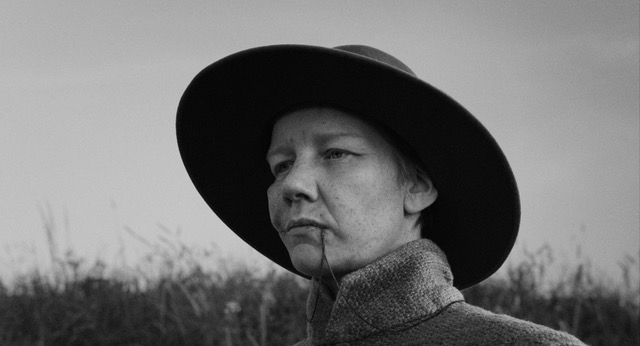
Rose is a terrific story told with confidence and brisk pacing, but also a great vehicle for the astonishing Hüller. Silently observant for much of the time, which makes a moment of raging anger all the more startling, the former soldier has a habit of sucking on a bullet he wears on a string around his neck. (A deep scar shows where it tore through the side of his mouth.) That character tic and the wide-brimmed military hat could almost be the Mittel-European equivalent of a John Ford cowboy chewing on a wheat stalk. The contemplative intelligence in Hüller’s eyes makes her look like someone who would fare quite well in the Old West.
Credit: Source link