
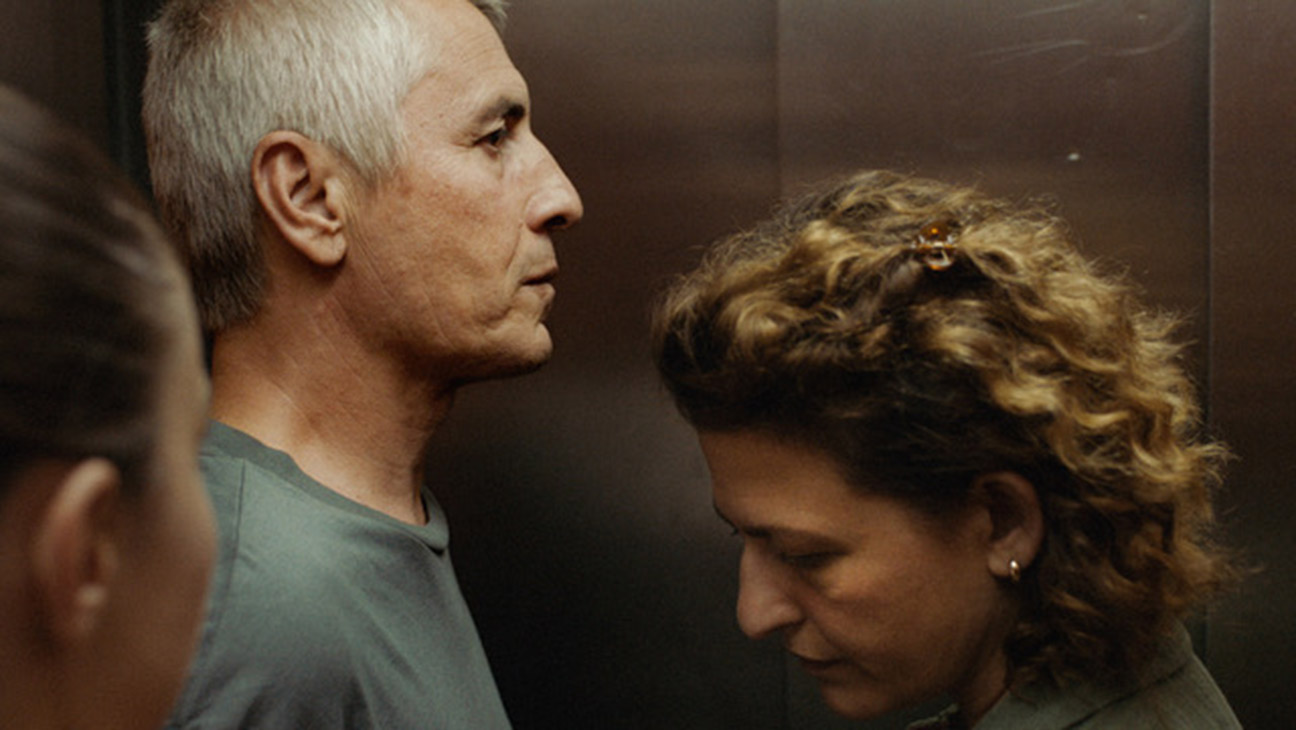
It’s less than 50 miles from Çikatovë e Vjeter, the village in Kosovo where the first section of Shame and Money takes place, to Pristina, the capital city. But for the characters at the center of the feature, the two places might as well be on opposite ends of the earth. In the countryside where Visar Morina’s keenly observed drama begins, life has its dependable rhythms and modest rewards for Shaban and Hatixhe, hardworking dairy farmers raising three daughters. Uprooted from their home and their way of life by an act of treachery, they face the harsh economic realities of urban living and must depend on the double-edged sword of assistance from well-to-do relatives.
Morina’s slow-burning third feature, after Babai and Exil, is attuned to every held breath and hopeful, wary or wounded glance of its two leads, Astrit Kabashi and Flonja Kodheli, who deliver performances of exquisite understatement in a story of dwindling hope and mounting tension.
Shame and Money
The Bottom Line
A slow burner, beautifully played.
Venue: Sundance Film Festival (World Cinema Dramatic Competition)
Cast: Astrit Kabashi, Flonja Kodheli, Kumrije Hoxa, Abdinaser Beka, Fiona Gllavica, Alban Ukaj, Tristan Halilaj
Director: Visar Morina
Screenwriters: Visar Morina, Doruntina Basha
2 hours 10 minutes
On the farm where Shaban (Kabashi) and Hatixhe (Kodheli) live with their extended family, matriarch Nana (a commanding Kumrije Hoxa) sits at the head of the dinner table and also holds the purse strings. She’s the peacekeeper and arbiter when two of her three sons argue or her granddaughters bicker. Whether or not Shaban is literally her middle son, he’s the centrist in temperament — a character trait that will reach its breaking point when he’s struggling to survive in the city.
The family’s grown-up problem child, youngest brother Liridon (Tristan Halilaj), has an aversion to work and an unearned sense of entitlement. As the story opens, he’s in desperate need of a significant sum of money, and has asked his mother to come to his rescue. His brother Agim (Abdinaser Beka), a teacher and married father, has nothing but contempt for him, while brother Shaban and even Nana are willing, if guardedly, to give him another chance. Wasting no time, Liridon double-crosses them in dramatic fashion, sending Shaban and Hatixhe, along with Nana and their young daughters (Aria Shala, Riga Morina, Melika Gashi), to Pristina, where Hatixhe’s married sister lives.
Adelina (Fiona Gllavica) shares a huge white slab of a modernist house with her businessman husband, Alban (Alban Ukaj), and his parents. In stark contrast to Hatixhe’s unadorned sensibility, Adelina comes across as Western European, from her elegant clothing to her fertility treatments. Yet she’s also, in a sense, a tiptoeing interloper. She’s paid a pittance to help her mother-in-law (Teuta Ajdini) take care of her chronically ill, noncommunicative and barely cognizant husband (Selman Lokaj). For a member of the immediate family, it’s a strange setup. Adeline enlists Hatixhe’s help on the caregiving front, a turn of events that Nana observes with disapproval.
Going along to get along, Shaban is so averse to being impolite that he doesn’t ask how much they’ll be paid when Alban hires him and Hatixhe as part-time cleaners at his nightclub. But he does eventually inquire about other work opportunities. “Bring me your CV,” Alban tells the farmer, and later admonishes him for joining the day laborers who congregate on a city street seeking work for cash: “Our neighbor has seen you.” Shaban’s chief response to this and other affronts is silence. It’s his wife who provides a rebuttal, however indirect, when her sister presses the point about how shameful such work is. “Shame is a luxury,” she tells Adelina.
The strained awkwardness of Adelina and Alban’s gestures of generosity underscores the class disparity between the city dwellers and their relatives. A gift from Adelina to her sister (purchased after receiving permission from her husband) has an uneasy, transactional vibe for Hatixhe. With its family friction and its outsiders’ view of a fast-growing city in a young, postwar country, Shame and Money casts a piercing, sorrowful gaze at the ground-level effects of globalization.
The clashes at the core of the superb screenplay, by the helmer and Doruntina Basha, receive trenchant reinforcement in the score. In addition to occasional bursts of folk songs, there are outstanding new compositions by Mario Batkovic that move from a quick, nerve-jangling pulse to a full surge of mournful chords in a late sequence. In that section, set in the streets of Pristina, Morina and DP Janis Mazuch break away from the straightforward intimacy that characterizes much of the film: The camera whirls around a wedding celebration, not far from the statue of Bill Clinton that dominates the area.
As parents determined to maintain a strong front while grappling with mounting pressures, Kabashi and Kodheli are extraordinary. The partnership between Shaban and Hatixhe is fully evident in the way they talk in bed, or when, side by side, they walk past city dwellers at their leisure on restaurant patios to ask for cleaning jobs. Together and separately, they navigate the shocking material requirements of their new home, trying to understand the difference between rent and a security deposit, or the reason for a bank service charge. She grounds him, but the worry on her face intensifies as she feels him slipping into dangerous territory, overcome by a sense of failure as he searches for an honest day’s work. “Things are circling in my head,” Shaban tells his wife. On his farm, he knew that he was where he belonged. In the city, by contrast, he comes to learn his place.
Credit: Source link