
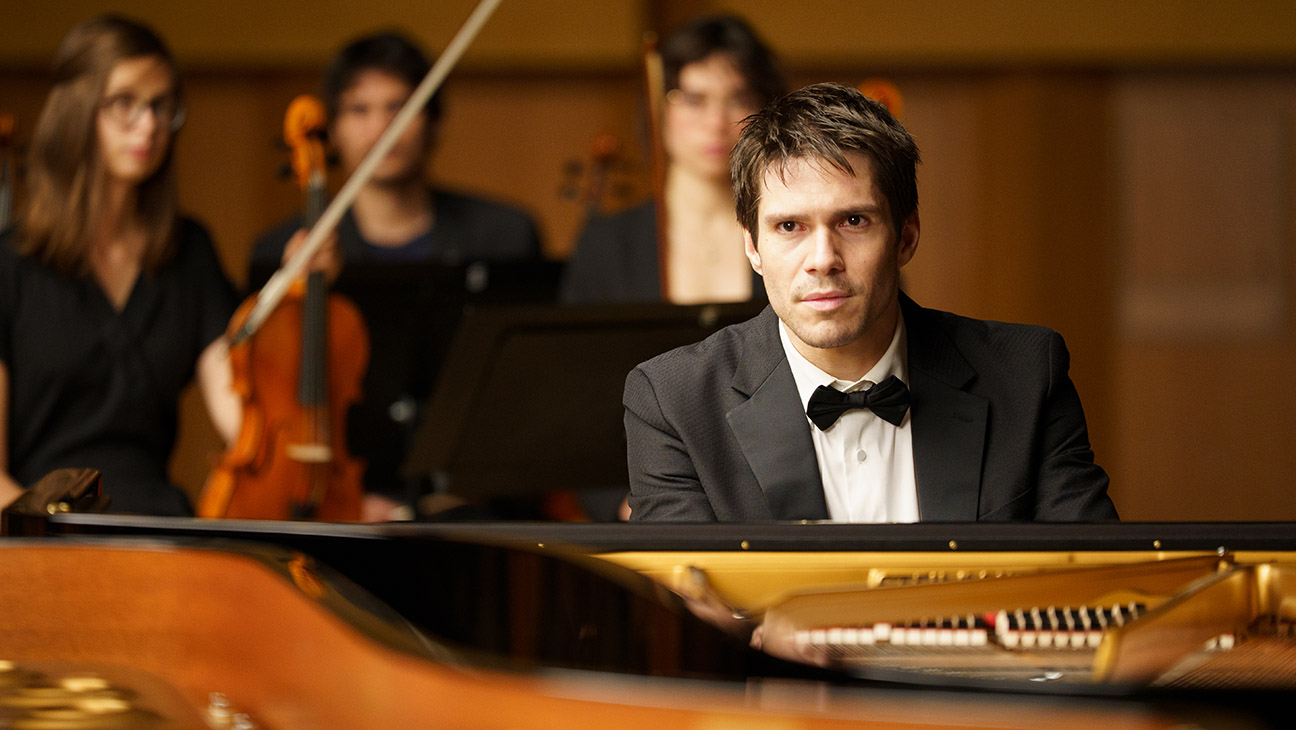
Musical duets are just the tip of the iceberg in Two Pianos, the story of a lapsed musical prodigy’s gradual reawakening. The main show belongs to a constellation of paired characters, their overlaps and interactions ever redoubling: lovers, mentor and disciple, husband and wife, parent and child. Each duo might be destined or mismatched; the question is how to discern the difference. Arnaud Desplechin, no stranger to contentious pairings (Brother and Sister, Kings & Queen), revisits familiar themes here, but there’s something fresh, too, in the story’s structure and his approach.
A portrait of the artist as a young man with an old, battered soul, Two Pianos is a strange compound, an elegant mélange. Its tête-à-têtes give way to full-throated melodrama, the narrative punctuated by haunting Hitchcockian flashes, complete with Bernard Herrmann-esque swells of yearning melody in Grégoire Hetzel’s stellar score. If at times the dramatic balance feels off, or the passion exasperating in particularly Gallic ways (l’amour!), Desplechin and his superb cast convincingly bring the angsty emotions to a place of unexpected brightness and clarity.
Two Pianos
The Bottom Line
A well-played mix of dissonance and harmony.
Venue: Toronto International Film Festival (Gala Presentations)
Cast: François Civil, Charlotte Rampling, Nadia Tereszkiewicz, Hippolyte Girardot, Valentin Picard, Jeremy Lewin, Anne Kessler, Alba Gaïa Bellugi, Marianne Pommier
Director: Arnaud Desplechin
Screenwriters: Arnaud Desplechin, Kamen Velkovsky
1 hour 55 minutes
The idea of doubles in Two Pianos begins with the very shape of the story: Desplechin and Kamen Velkovsky have written a screenplay that knits together two main narrative threads around pianist Mathias (François Civil, of Beating Hearts) — one on the career/artistic front, one involving a mess of unresolved romantic ties.
After a night flight delivers Mathias to Lyon, the hometown he hasn’t seen in eight years, he heads straight from the airport to a party, the magnetic pull being the woman who summoned him home. A butler lends him the requisite necktie — it’s that kind of party — and Mathias makes his way across well-appointed rooms full of highbrow chatter until he reaches Elena, a grande dame played to imperious, unsmiling perfection by Charlotte Rampling. Elena’s sugar-free allure is as unmistakable as the famously down-turned eyes and mouth of the formidable actor portraying her.
Mathias has gladly stepped out of his self-imposed exile to join Elena in a few local concerts. He was once her star pupil, her discovery, and had begun a promising solo career before fleeing to Japan, where he’s been teaching music for eight years — or “hiding in a rut,” as Elena sees it. A self-described “monster” who unapologetically chose her art over marriage or parenthood, she insists that Mathias go back on tour. “I always get my way,” she says, words that prove not just accurate but prophetic.
Leaving the party, Mathias finds himself face-to-face in the building’s lobby with an arriving guest, a key figure from his past. After a moment of mutual discombobulation freezes them both in horror, she flees and he faints. Then he hits the bars, proceeds to get blotto and winds up in jail.
The young woman who knocked Mathias unconscious without laying a hand on him is Claude (Nadia Tereszkiewicz, of The Crime Is Mine), who came to the party reluctantly, the plus-one of her gallerist husband, Pierre (Jeremy Lewin). In the movie’s collection of well-drawn characters, Tereszkiewicz’s is the least easy to embrace. For a while she comes off as almost childishly self-absorbed. In our first glimpse of her, she’s looking in a mirror, and then demands a story from Pierre, who complies with a made-up Jewish fable about a long-separated couple brought back together.
Whether Mathias and Claude should reignite a long-extinguished flame becomes more of a question after the story takes a startling turn and Claude finds herself single again. Claude can’t disentangle her years-ago affair with Mathias from feelings of self-recrimination and guilt, and seesaws between anger and seduction. Mathias, who seemingly has denied himself not just his place on the concert stage but also, over the years, a chance at a committed relationship, finds himself desperately in love with her. He’s either oblivious or indifferent to the fact that she has no apparent feel for the emotional or spiritual power of music, her academic degree as a visual arts “specialist” notwithstanding. “I split my life in two,” Mathias tells his musician mother (Anne Kessler).
That split takes an unsettling literal slant when Mathias, ambling through the park, notices a young boy (Valentin Picard) who looks just like he did at that age, and who carries a violin, just like he did. The score surges and splinters, and the world is askew. Mathias’ obsession with the child threatens to bring disaster upon him, until it leads to something far more complicated.
To Mathias’ rescue, again and again, is his down-to-earth yet wizardly agent, Max (frequent Desplechin collaborator Hippolyte Girardot, in ace form). A no-nonsense dispenser of practical help and hangover remedies, Max is hardly the only one who believes in Mathias’ talent, but he is, crucially, the one who can set him back in action as a concert pianist — if Mathias is ready to take the leap. That’s a big “if” for a man who’s so good at being his own worst critic that he has in many ways shut down.
He and Claude, meanwhile, thrash and sulk and steam up her building’s foyer. Their friend Judith (Alba Gaïa Bellugi), who knows Claude’s secrets and senses Mathias’ gloom, tries to lift his spirits, or at least distract him. But it’s his eventual friendship with that boy in the park that shifts the story to another plane, deftly avoiding the kind of sentimental mush it could so easily have slipped into.
In his scenes with impressive first-timer Picard, Civil convincingly channels the worldly but boyish Mathias’ understated charm and reveals a soul-deep generosity, all the more affecting after he’s established the character’s confused, self-punishing depths. Civil contributes his own piano playing too — notably a Bach hymn that serves as the story’s crowning moment of failure as triumph.
Claude moves toward her own epiphanies in ways that are exhausting to witness, probably more so for the viewer than for Mathias. But when, in a scene of memorable awkwardness, she delivers a (bad) joke at a Jewish funeral, the façade she’s otherwise working so hard to maintain crumbles with endearing vulnerability. In a way this parallels a breaking point in the story’s first half, when taskmaster Elena lets down her steely guard to confide in Mathias why the hope she attaches to him has taken on extra significance for her.
Working with cinematographer Paul Guilhaume (Emilia Pérez), whose assured handheld work is exceptionally expressive without calling attention to itself, Desplechin draws something liminal from a specific sense of place. Two Pianos begins in the thick of night, saturated in the sepia shadows of the Vieux Lyon quarter’s historic architecture and cobblestone streets, and moves gradually toward a crisp autumn light. A long-held heaviness lifts and, not without cost, a couple of young grown-ups embrace the sometimes terrifying adventure of figuring themselves out.
Credit: Source link