Dolly Parton was 21 years old when she joined the most popular program on syndicated television, “The Porter Wagoner Show.” She’d been singing on local radio and TV shows in East Tennessee since she was 10, so she understood her role. While she presented herself as pointedly demure and deferential, as “girl singers” were expected to be in 1967, it didn’t take long before she gained enough confidence to let her personality blossom.
She and Wagoner recorded a string of hit duets, and Parton also became a solo star, with four consecutive No. 1 singles from 1973 to 1975, including the signature songs “Jolene” and “I Will Always Love You.” By 1976, she was widely regarded as “the most original and evocative” country singer of any gender, the critic John Rockwell wrote in The New York Times. That year she began hosting a syndicated variety show, “Dolly.” Soon, she was being offered starring roles in Hollywood films.
Despite being ambitious, Parton wasn’t sure she could pull it off. “I didn’t consider myself an actress (and still don’t),” she wrote in “Dolly: My Life and Other Unfinished Business,” a 1994 memoir. Her manager, Sandy Gallin, had an answer for her: “Don’t be an actress. Be yourself.”
Regardless of the medium, Parton was magnificently comfortable at being herself. She made it look easy, as if she was always playing Dolly Parton onscreen. And if she turned Hollywood films into Dollywood films with her big personality and positive disposition, it was partly a trick drawn from decades of performing experience. She acknowledged that her signature wigs and waist-cinching costumes made for an outsized persona. Yes, her film work is a performance, but it’s also an expression of her genuine genuineness.
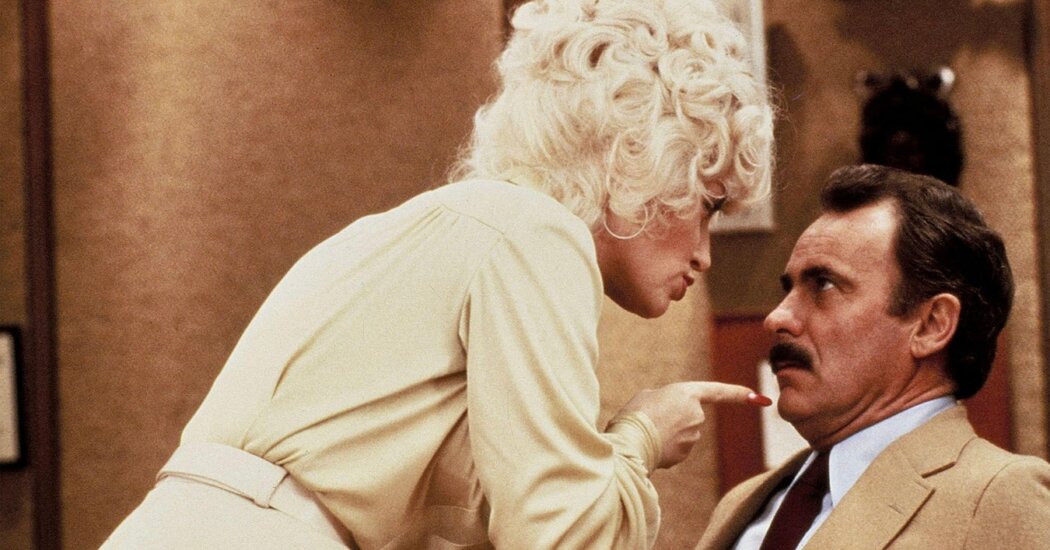
When Jane Fonda, who had signed up for one of the lead roles, asked Parton to play the chipper secretary Doralee Rhodes, she was honest about the reason: She believed Parton’s name would help sell lots of tickets in the South. As Doralee, Parton sprays kindness all around the office, until she threatens to use a gun on her oily, lecherous boss, played by Dabney Coleman: “I’m gonna change you from a rooster to a hen with one shot.” Parton also wrote and sang the film’s title song, which went to No. 1 on the pop chart as well as the country chart, won two Grammy Awards and received an Oscar nomination. This helped sell more tickets than even Fonda could have anticipated; “9 to 5” was the second-highest-grossing film of the year, behind only “The Empire Strikes Back.”
Stream it on Philo. Buy it or rent it on YouTube, Apple TV, Prime Video, Fandango and Google Play.
‘The Best Little Whorehouse in Texas’ (1982)
A musical comedy set in the South seemed like a great fit for Parton, even if some of her fans blanched at seeing her play a brothel madam in this adaptation of a 1978 Broadway musical. Parton didn’t get along with her co-star Burt Reynolds, whom she described as surly, and the movie was “a miserable, spirit-numbing ordeal,” she wrote in her 1994 memoir.
Still, Parton was “phenomenally likable” as Miss Mona Stangley, The New Yorker critic Pauline Kael wrote, with a manner that was “natural and easy.” She was now two-for-two in the plaudits category: Parton was nominated for a Golden Globe and a Grammy for a rerecording of her 1973 hit “I Will Always Love You.” (That song’s biggest cinematic fame had to wait for the 1992 film “The Bodyguard,” where Whitney Houston sang it.) “Whorehouse,” she wrote, “elevated me, at least temporarily, to the status of a full-fledged movie star.”
Buy it or rent it on YouTube, Apple TV, Prime Video, Fandango and Google Play.
Why was Parton’s film stardom temporary? In a word, “Rhinestone.” It’s a convoluted comedy in which Parton plays a struggling country singer who vows she can turn a coarse New York City cabby (Sylvester Stallone) into a country star. Most of the laughs are inadvertent, and “Rhinestone” regularly appears on lists of Hollywood’s worst films. (“Sly drags national treasure Dolly Parton down with him,” the A.V. Club wrote in a 2023 article.) Forty years later, Stallone said he appreciated “the audacity” of his performance, which included putting on a Nudie-style cowboy outfit and warbling “Old MacDonald Had a Farm.” Parton wrote or co-wrote nine songs on the soundtrack and called them “some of the best country songs nobody ever heard.”
Stream it on the Roku Channel.
‘Steel Magnolias’ (1989)
As she did in “9 to 5,” Parton excelled again as part of a female ensemble, alongside Sally Field, Shirley MacLaine, Daryl Hannah, Olympia Dukakis, and, in her breakout role, Julia Roberts. Parton plays Truvy Jones, the empathetic owner of a small-town Louisiana beauty shop that serves as a social center and group therapy class for women who’ve learned they can’t rely on their handsome, feckless men. “I especially love the portrayal of female friendship,” the actress Dakota Fanning said when introducing the movie at the American Film Institute’s “Movie Club.” To skeptics, it’s a weepy soap opera, but to fans, it’s a rare feature-film celebration of female ingenuity and independence, not to mention sisterhood.
Stream it on Paramount+ and Pluto TV.
‘Joyful Noise’ (2012)
Parton grew up poor, with no radio or television in the house. The only music she knew was folk and bluegrass, which her family played and sang on the porch, and gospel music, courtesy of her grandfather, a preacher who played fiddle and guitar. In “Joyful Noise,” she’s G.G. Sparrow, a widow who sings in her small-town, Georgia choir. G.G. wants to modernize the choir’s music, which brings her into conflict with the stern, tradition-bound choirmaster Vi Rose Hill, played by Queen Latifah. Vi mocks G.G. for her multiple plastic surgeries and her age (“You read the Bible to reminisce”), and G.G. pelts Vi with biscuits. The two find mutual ground, of course, and “Joyful Noise” ends with a jubilant choir performance of “He’s Everything,” a gospel hymn written by Parton. Her final film brings her full circle, back to her roots in Appalachia.
Stream it on the Roku Channel.
Credit: Source link