I often feel like a journalistic Gretel.
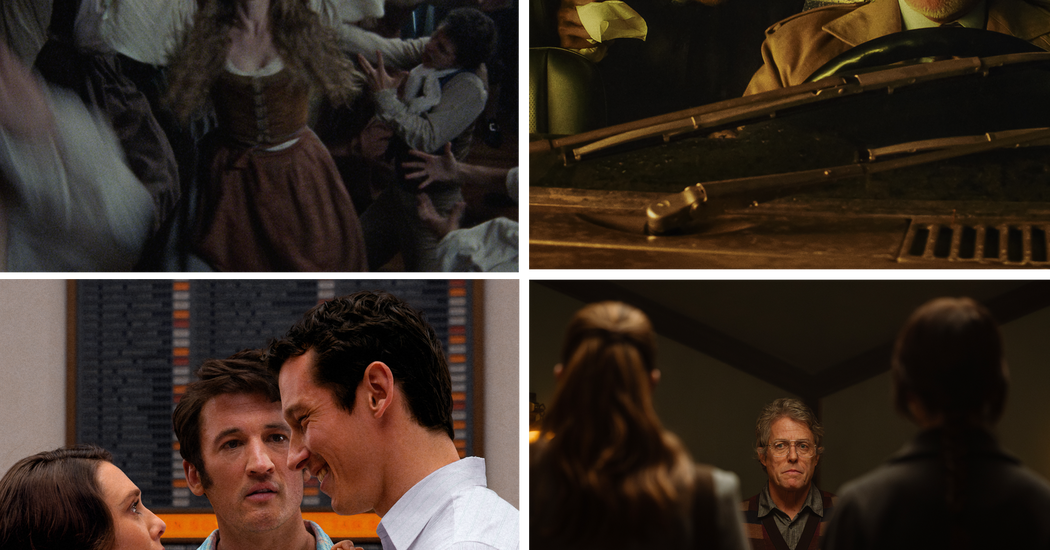
I’m constantly picking up breadcrumbs of American spirituality and saving them in a note on my computer. Dua Lipa and Stephen Colbert discussing faith, LeBron doing guided meditations, Lil Jon selling chakra T-shirts. And this year, many artists (Justin Bieber, Rosalía, Dijon), movies (“Heretic,” the latest “Knives Out,” “The Testament of Ann Lee” and “Eternity”) and TV shows (“The Secret Lives of Mormon Wives” and “Nobody Wants This”) have wrestled with religion and spirituality.
But crumbs don’t make a meal, to torture the metaphor. I’ve been wondering whether these examples amount to a meaningful cultural shift.
So this past week, I spoke to two people at The Times whose job it is to explain pop culture: Alissa Wilkinson, one of our film critics, and Joe Coscarelli, a reporter and co-host of our podcast “Popcast.” They both said that yes, something was changing. Americans seem to be getting more conversant with religiosity. Movies about the Bible are having a moment in Hollywood. Rappers and singers are earnestly, not ironically, engaging with faith.
“It tells you something about what people are interested in right now,” Alissa told me. “You can see what we’re worried about or what we’re thinking about.”
When did this start?
If Hollywood has had a spiritual reawakening, you could date it to 2018.
That’s when “First Reformed,” a thriller about a despairing minister, came out. Ethan Hawke is the star, and Paul Schrader directs. It got rave reviews, including from our critic A.O. Scott. He described it as an epiphany.
A number of studios had passed on the film. The reviews made them think they might be missing an opportunity, Alissa said, and created a “trickle-down effect.” Over the next few years, studios produced “Soul,” the latest “Knives Out” and the Oscar-winning “Conclave.”
There had been a similar spike in religious-themed movies after Sept. 11, when “The Chronicles of Narnia” and Mel Gibson’s “The Passion of the Christ” topped box offices.
“It comes in waves,” Alissa said.
What has changed?
A few broader world events have fueled the latest embrace of religion in pop culture.
The first was the pandemic, which prompted a collective reckoning with existential questions. “In a time of uncertainty, there were more people looking to whatever God was to them,” Joe said.
This coincided with some major pop stars — including Bieber, Dijon and Rosalía — entering their 30s. They started to wrestle with more mature themes, including questions of family and partnership.
The second was the ascendance of a social conservatism during the Trump era. “Mainstream studios are trying to capture what they perceive of as the right-wing audience,” Alissa said.
How is this shaping us?
This has all been well documented, including in Believing. But what I really wanted to understand was whether this moment felt distinct, and if my colleagues felt that even elite secular culture was changing.
“The difference is the earnestness,” Joe said of the religious sentiment appearing in art now. For decades, artists have played with religious iconography by subverting it. Madonna wore crosses and nodded lyrically to the “Madonna/whore complex.” Rappers have played with upside-down crosses, borrowing from metal and punk. “The current moment is engaging with it in a much more head-on, straightforward, earnest, and irony-free way,” Joe said.
This is shaping how people discuss religiosity in public. “If there’s anything that the Trump years have done, it’s made people more fluent in what used to be a subculture,” Alissa said. “Your average person who may not have grown up in church now has some familiarity with that world again because it has become mainstream.”
This doesn’t mean that it’s common at many Brooklyn or Los Angeles dinner parties, where America’s artists congregate, to talk about church. “You’d still get a sideways look,” Joe said.
But the stigma does seem to be relaxing, he added. Liberal Jews are openly wrestling with their faith and identity in a particularly fraught political moment. People seem to be obsessed with watching Mormon women onscreen. Wellness culture is blending with spirituality: The girlies are manifesting unironically, and they’re posting about meditating in saunas.
All of it points to more social openness and a greater cultural fluency with belief.
Choose Your Own Eternity
One of the latest movies to take on religion? “Eternity,” from the production company A24 (“Babygirl,” “Aftersun”).
It imagines the afterlife as a transit hub where people decide where to go next. The choice is especially difficult for one woman, played by Elizabeth Olsen, who finds the two loves of her life waiting for her there.
The movie recasts the notion of the afterlife not as a site of judgment or deliverance, but as the ultimate expression of our hyperindividualistic culture, where personal choice reigns. I wanted to understand why, so I called the director, David Freyne.
This conversation has been edited for brevity.
We’re seeing religious themes appear more in film. Why did you choose to pursue a movie about the afterlife?
I’ve always wanted to create my own afterlife. It’s something I’ve been obsessed with since I was a kid. I grew up gay in Ireland when it was very Catholic, and I spent my childhood kind of petrified of my own damnation.
I found it really fun and cathartic to make a world where you get to decide what your eternity will look like. I think many religions have a very prescriptive view of what that is. It’s a comforting idea that actually it’s up to me.
And it weirdly made me a spiritual person by the end of it, even though I wasn’t spiritual going into it.
Fascinating. What do you mean by that?
I was always scared of death, and making this film has made me approach death with a lot more curiosity than I used to. It goes to that old Tom Stoppard quote that every ending is an entrance.
I love that quote so much. Rosencrantz!
I know. I obviously do not know what’s next. I’m very much on the atheist-slash-hedging-your-bets side of things. But I think there’s an excitement in the unknown that I had to make this film to really appreciate.
But the afterlife you created is one that extends our postmodern existence, built on seemingly infinite choice and individual responsibility. In it, one woman has to choose not only where to go, but also which man she loved to spend forever with. That’s truly my personal form of hell. Is that really your idea of heaven?
So many people have said that. Even Lizzie [Olsen] said that “this is a capitalistic nightmare, it’s just a microcosm of where we live.” Which it is. But I believe that wherever our consciousness goes, all of our insecurities and anxieties are going to go too. We’ll bring our relationships, our baggage. It’s a hell of our own making.
That’s a fundamental tension in theology, which questions, if there is an afterlife, will it be one that frees us into a paradisiacal space apart from the foibles and the suffering of this life? You seem to think no.
If there is some sort of kind of ethereal afterlife where we’re just contented and happy, then it’s not us. It’s not who we are. Your soul is just you. the good, the bad and the ugly.
You’re implicitly making a statement that you think perfection is somewhat boring.
It’s both that I think perfection is boring and I also think perfection doesn’t exist. Even in the afterlife.
Religion in the News
Catholicism
One Last Thing
The singer Rozzi is releasing a new album called “Fig Tree,” inspired by the famous quote from Sylvia Plath’s “The Bell Jar.” Rozzi spoke about it in Byline. And here’s the quote. I’ve always loved how it captures the earnestness of longing. I also find it morally instructive:
I saw my life branching out before me like the green fig tree in the story. From the tip of every branch, like a fat purple fig, a wonderful future beckoned and winked. One fig was a husband and a happy home and children, and another fig was a famous poet and another fig was a brilliant professor, and another fig was Ee Gee, the amazing editor, and another fig was Europe and Africa and South America, and another fig was Constantin and Socrates and Attila and a pack of other lovers with queer names and offbeat professions, and another fig was an Olympic lady crew champion, and beyond and above these figs were many more figs I couldn’t quite make out. I saw myself sitting in the crotch of this fig tree, starving to death, just because I couldn’t make up my mind which of the figs I would choose. I wanted each and every one of them, but choosing one meant losing all the rest, and, as I sat there, unable to decide, the figs began to wrinkle and go black, and, one by one, they plopped to the ground at my feet.
As Sarah in St. Paul wrote to me, I hope you keep asking hard, big questions. See you next week!
Sign up here to get this newsletter in your inbox. And if you like it, share it with your family, friends or congregation. You can follow my reporting on Instagram.
Feedback, feelings? Tell us at [email protected].
Credit: Source link