
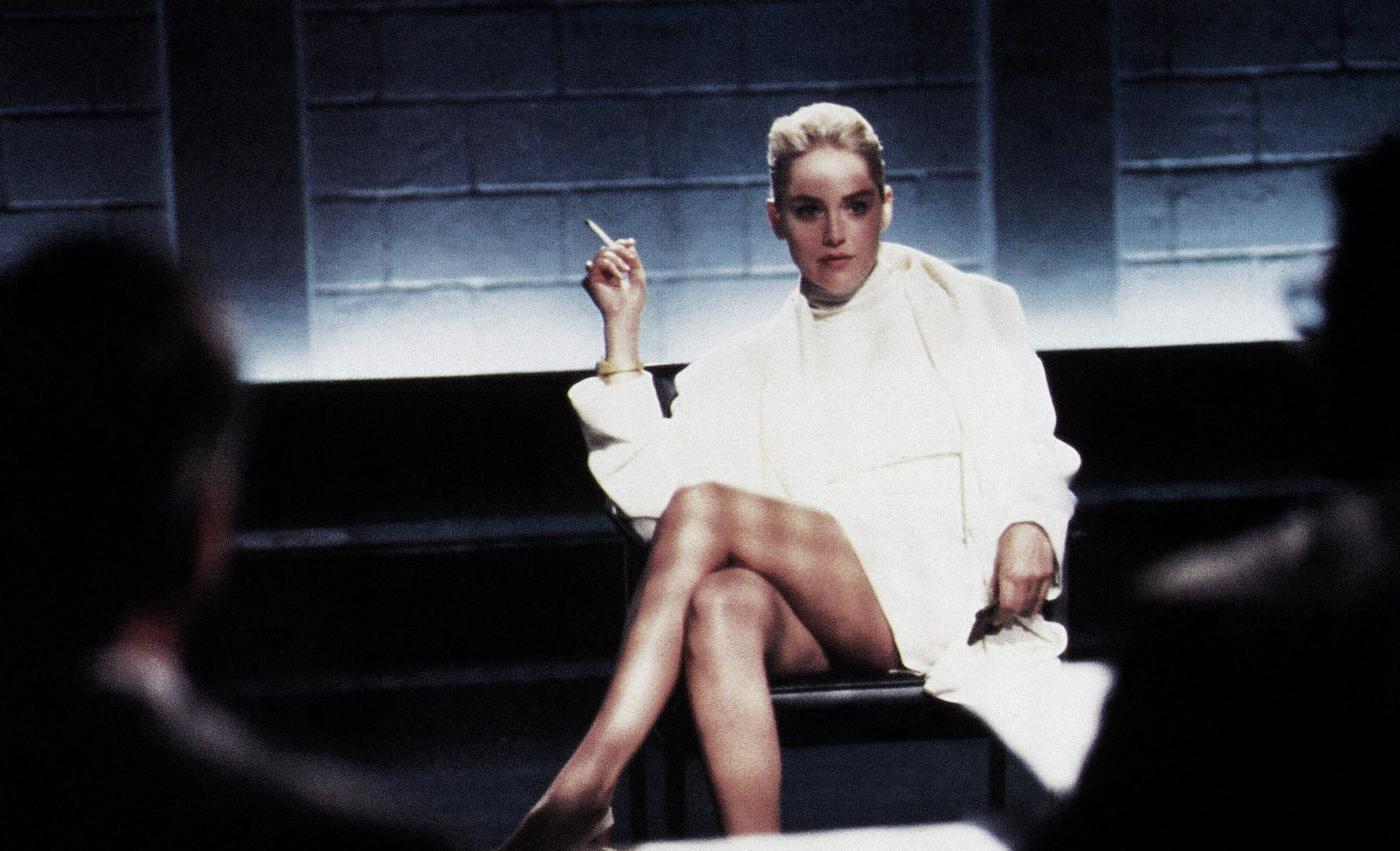
Basic Instict. Sharon Stone, 1992. ©TriStar. Courtesy of Everett Collection.
Joe Eszterhas’s films have grossed over a billion dollars globally, and he’s raked in millions writing them. Joe’s known as one of the only writers in Hollywood history to get paid more for writing scripts than the directors were paid to film them. He’s also the first writer ever to bank first-dollar film grosses. At his peak, the Hungarian-born voice behind such gonzo classics as Flashdance, Basic Instinct, Jagged Edge, Sliver, and Showgirls was labeled a living legend by ABC News, compared to William Shakespeare by Time magazine, and hailed by Variety as “the Che Guevara of screenwriting.” Starting in the early ’70s as a journalist alongside Hunter S. Thompson at Rolling Stone, Eszterhas imbued his films with the grittiness of our country’s criminal underbelly and an erotic, tabloid voyeurism. Every movie was an event. And to those who think that era is over, think again: Joe’s hot off a sale to Amazon MGM worth up to $4 million for a long-awaited Basic Instinct reboot. As he puts the finishing touches on it, we sit down to talk taking the cash, cashing the check, and showing ’em what they wanna see.
FRIDAY 3PM, APR 24, 2026, CLEVELAND
———
PATRIK SANDBERG: It’s so nice to meet you. I feel like I’ve been a fan of yours my whole life.
JOE ESZTERHAS: I thank you for that. I think we’re going to have a fun time with our interview, and I don’t say that to all the girls.
SANDBERG: We have some weird things in common. I’m from Marin [California], a town called Petaluma, and you lived there, too.
ESZTERHAS: I lived up there for along time, from ’71 through maybe ’89 and ’90. First in Mill Valley, then I started selling spirits in Tiburon. I had fun there. My grown son lives in Petaluma right now.
SANDBERG: I’ve been reading Hollywood Animal [Eszterhas’s memoir]. It makes so much sense why you set Basic Instinct in San Francisco, knowing you spent so much time there. San Francisco to me is the most cinematic city, but not many films are shot there anymore. Nothing like the ’70s, ’80s, and ’90s, when so many thrillers were shot there. I’m curious about your time working at Rolling Stone, back when its offices were in San Francisco. You interviewed Charles Manson and spent time with Dr. Martin Luther King Jr. and Jimi Hendrix. How did your work as a journalist factor into your work as a screenwriter?
ESZTERHAS: I was at Rolling Stone from ’71 to ’76, when it was exploding. We were right in the middle of the cultural revolution, and in someways we were the vortex. I went there because Hunter S. Thompson read one of my stories in the Cleveland Plain Dealer, which was syndicated on the AP wire. He loved it so much he sent me a note that said, “Big fucker, now there are two of us in the world who can write about cycle gangs.” Then I got fired from the Plain Dealer for writing a story about the My Lai Massacre in the Evergreen Review. Rolling Stone just happened to call me days later and said, “Could you come out here? We’d like you to do a piece on narcotics agents.” I went out, understanding I’m a guy from Cleveland and I’m heading into the hip center of the universe. I’ve always loved music. Besides baseball, rock n’ roll was one of my bridges to America. I’d read Rolling Stone in Cleveland because one little store sold it. So I went out and found myself in this wild, amazing place. A couple of days after I arrived, Rolling Stone threw a party, and in the center of the room was a kind of tub. In the tub was Hunter Thompson, and he’s got a needle in his hand, and he’s shooting it into his navel.
SANDBERG: Whoa.
ESZTERHAS: He looked up at me with the needle stuck in his bellybutton and went, “Are you Joe?” I said, “Yes, I am.” He said, “Oh, well, do you want some of this shit?” And I said, “No, thank you.” It was a mind-boggling place, coming out of Cleveland and being a refugee Hungarian kid. I had a thick accent until I was 18. On my third or fourth day there, I see this little guy on a corner with granny glasses and his head down, reading. I suddenly think, “Oh my god, that’s Mick Jagger.” Mick Jagger was the English publisher of Rolling Stone at the time. I went up to him and said it was a pleasure to meet him. I asked if he’d read any of my things and he said he had. And I said, “Are you interested in them for England?” He shook his head and said, “No, I’m sorry. It doesn’t quite measure up.” Everybody in the world came through there. Yevgeny Yevtushenko, the Russian poet, Timothy Leary, Allen Ginsberg. I had more fun at Rolling Stone in those five years than I’ve ever had in any kind of job. You never knew what was going to happen. I was married but cheating on my wife as much as I could. At Rolling Stone, it was not uncommon for a beautiful young woman to walk up and say, “You’re Joe, aren’t you?” And I’d say, “Yes, I am.” And the next sentence she said was, “I’d really love to ball you.” That’s the kind of revolutionary time it was.
SANDBERG: Did you ever encounter Anton LaVey [founder of the Church of Satan]?
ESZTERHAS: No. The whole Satanic thing was really raging in San Francisco, but I never encountered him. I did, however, spend a weekend with the representatives of a Satanic group called The Process [Church of the Final Judgment] in Arizona. They were Satanic missionaries, dressed all in black, and actually very nice people who simply believed in the devil.
SANDBERG: Your first film project was 1978’s F.I.S.T., which ended up starring Sylvester Stallone. Did it feel like a lucky break to you at the time?
ESZTERHAS: I’ll tell you exactly what happened. I wrote a book called Charlie Simpson’s Apocalypse, which was based on a Rolling Stone cover story, I think. It was about a kid in a small town in Missouri, essentially going to war with the cops on a cultural level. That book ended up becoming a finalist for the National Book Award. I got a call out of the blue from Marcia Nasatir, an executive at United Artists, who read my book and asked if I’d be interested in doing a screenplay. I always loved movies, but the dream was writing novels. I hadn’t thought of screenplays. When she called me, Jann [Wenner] didn’t pay much and I had a side job bartending. I had two newly born kids, so this was miraculous. I went down to speak to Marcia and United Artists head Mike Medavoy, and they said, “If you can come up with an idea, we’d like you to do a script.” I spent six months researching the story of labor activists going to war with cops, and then I did what is known as a treatment.
SANDBERG: Like a pitch.
ESZTERHAS: Yeah, essentially. A fancy outline. And they sent it to the director Norman Jewison, who liked it a lot. Norman had a terrific kind of working-class spirit. He was very liberal in his politics, to the point that he had been doing films for the Bobby Kennedy campaign. When Bobby was assassinated, he left the country for two years because he just couldn’t stand being here. He had a great conscience. We worked together on the script. I didn’t know what the fuck I was doing. The first draft I turned in was 450 pages.
SANDBERG: My first script was around 240 pages. My thought was,“I’m going to work with no outline and see what happens.” And then I was like, “Well, I just wrote a mini series instead of a movie.”
ESZTERHAS: Exactly. Marin County obviously fucked both of us. [Laughs] Norman said, “This isn’t a script, there’s a speech in here that goes on for 12 pages.” I had the absolute absurd balls to say, “If the words are good, what does it matter?” Norman picked the thing up and hurled it at me. We worked and worked on it. I got a master class in screenwriting, but also in Hollywood, because he took me to all the meetings with the studio heads and producers. I stayed at his house in Malibu when we worked, and one night I came in from dinner and there was a big brown envelope that said, “Personal and confidential, Mr. Jewison.” I couldn’t resist. I opened the goddamn thing, and it was a memo from his accountant that said he earned $8 million the previous year. The next morning we’re working and suddenly he turns to me and says, “You opened it, didn’t you?” He had this big smile on his face. I said, “Yeah.” He said, “You see? If you learn something, you can earn $8 million one day.” Years later, after Basic Instinct came out, I was getting a lot of publicity. I was going back to my room at the Wilshire and the limo dropped me off. And there, standing at the top of the steps, is Jewison. He says, “I told you it could happen.”
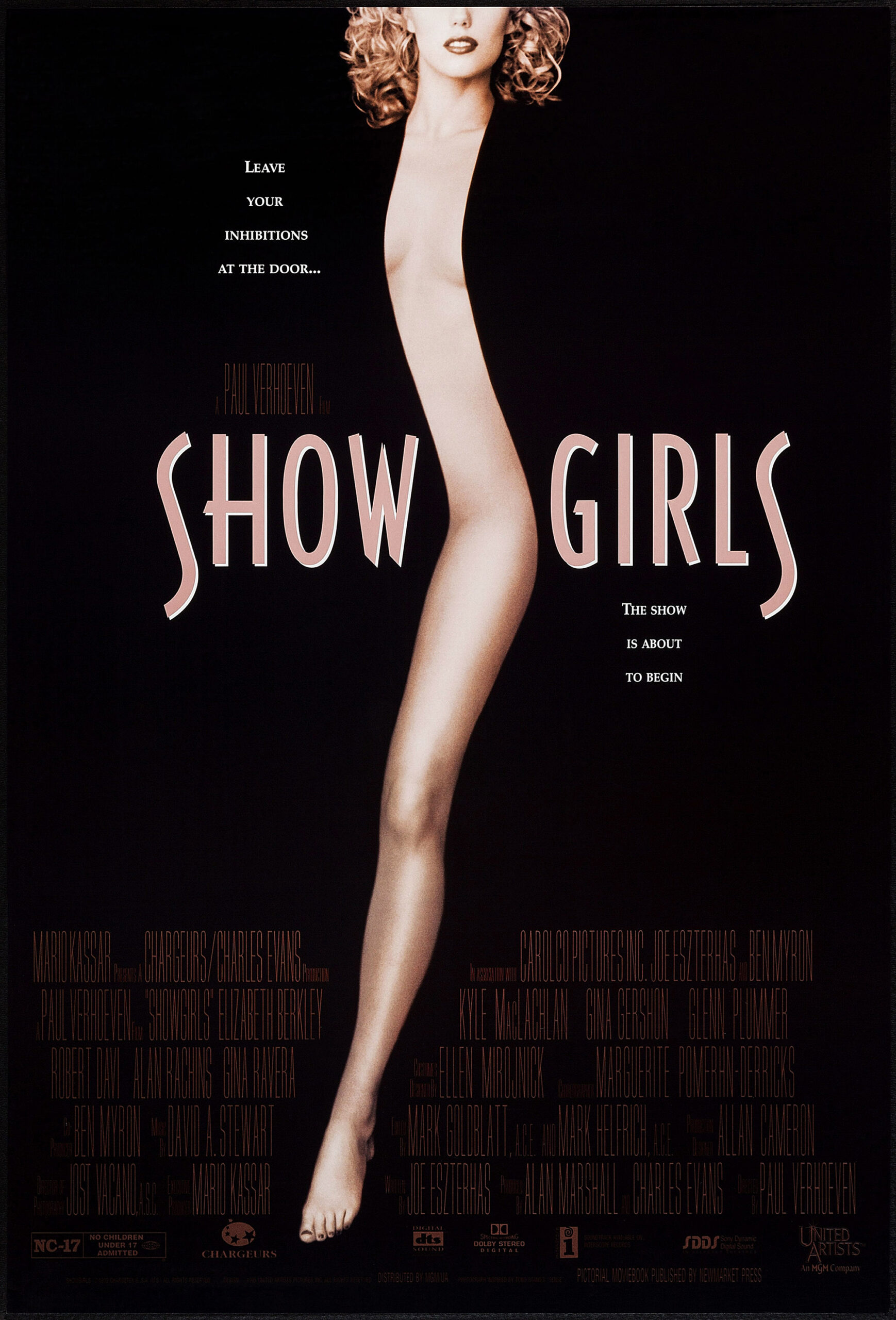
Showgirls. US poster art, Elizabeth Berkley, 1995. © United Artists. Courtesy of Everett Collection.
SANDBERG: Where is he now? Can I get his number?
ESZTERHAS: He’s in a different world. He was a wonderful man.
SANDBERG: Do you keep up with the ups and downs of Hollywood?
ESZTERHAS: I’ll tell you the truth. One of the reasons we moved to Cleveland in 2001 was I had a really good friend who was a producing partner. Our day began with him calling me and telling me what was going on in town. He’d already read that morning’s Variety and other industry papers, so he’s telling me what’s up. We did this routinely for a year or two, and then I suddenly thought, I don’t want to start my days this way. I want to read my New York Times. I want to ponder what the hell is going on in the world and I want to put my morning energies into my wife and my kids. Hollywood overtakes you and I didn’t want that to happen. And my commitment from the very beginning was to write, which I could do anywhere. I’ve always written original screenplays without doing pitches, without going in and selling it—just write the fucking thing and put it out there. Now, the big risk is that it won’t sell. And god knows that’s happened a lot in my case. Over the years, I’ve probably written 33 scripts. Eighteen have been made. The only screenwriter I’ve ever admired in my career was Paddy Chayefsky. He wrote Network and The Hospital and Altered States and a couple of others. His theory was, if you make a pizza, deliver the whole pizza. Don’t let it be half-baked because then someone can come along and piss on it. He said, “And I don’t want that to happen to my baby, ’cause I created it.”
SANDBERG: I understand why people pitch, because it’s nice to get paid to write something, but—
ESZTERHAS: Of course. And you run the great risk of it not selling. Bob Towne, I didn’t know him well, but he and I spoke a couple of times. Bob said, “The biggest mistake I’ve made in my career is I talk too much about what I’m writing. By the time I sit down to write, it’s almost gone because I talk about it so fucking much.” I think the whole pitch process does that.
SANDBERG: You’re a screenwriter because you want to write.
ESZTERHAS: What I love about doing originals and specs is it’s fun. It turns me on. My characters tell me what they want me to do. Sometimes I wake up at night and take notes because there’s a twisted little man inside me who’s my co-writer. I swear to you, sometimes I get up in the morning and subconsciously the work has been done. I know where they want to go. And you know, raising four boys in Malibu, they were being invited to parties where Will Smith brought in fake snow for the holidays or somebody brought in zoo animals and other kids brought their parents’ Oscars. It pissed me off because I didn’t fucking have one to start with! I didn’t want anybody flashing Oscars to my kids. I had and miss many friendships there, but I didn’t want to feel like I was a Hollywood person.
SANDBERG: I have to ask you about the Basic Instinct reboot. Did you sell MGM a pitch or a finished script?
ESZTERHAS: Neither. They came to me and asked, “Do you have any ideas for this?” And I said, “I do.” I really talked about bare bones. As you know, after Basic, there was a so-called sequel.
SANDBERG: Which I’ve never seen, actually.
ESZTERHAS: Yeah, it’s really bad.
SANDBERG: Did you have anything to do with that?
ESZTERHAS: No, no. They paid me a million five to have nothing to do with it.
SANDBERG: Nice work if you can get it.
ESZTERHAS: Absolutely. It’s easy money. Nobody said this to me, but I didn’t think they wanted to take the kind of creative chances the original did. They didn’t want controversy. What they did was turn it into a bland police procedural. They set it in London and the whole piece was really boring. It didn’t have any humor. It didn’t have the spice and earth and wit of the original. In the 30 years since it came out, I went through a lot of Basic Instinct revivals and saw audiences who just adored the fucking movie.
SANDBERG: Yeah. It’s still huge.
ESZTERHAS: I told MGM/UA that if I did this, I’d want it to be fun and enjoyable. I just finished the script and we’ll see.
SANDBERG: Is Catherine Tramell still at the center of it?
ESZTERHAS: Catherine Tramell [Sharon Stone’s character] is in this one, and so is a new character, her daughter, Jezebel. I can’t say too much about it.
SANDBERG: I’m curious how you update a film like that now, because of the ways society has changed. On one hand, everyone is way more open and understanding about mental illness, sexuality, and addiction, but there can be way less forgiveness when it comes to speech or humor or something shocking. Is that something you can talk about?
ESZTERHAS: I can answer it generally, but it’s politically incorrect. Some people will laugh at some of the dialogue. Others will be pissed off by it. But even those who are pissed off will secretly enjoy it, even if they don’t publicly. It will be controversial. With the original, people forget that one of the things that made it so successful when it opened commercially, right off the top, was that there had been controversy for months before its release. There were protests in New York and L.A. I’m not afraid of controversy. One of the things happening in filmmaking today is films have become more tepid and whitened. My script for the sequel is anything but that.
SANDBERG: Making it tepid has actually created a lower bar to offend people. The things people get worked up about now are the littlest things.
ESZTERHAS: My new script has quite a few moments where the audience will be really startled and ask themselves, “Holy shit, did I hear that right?”
SANDBERG: Would Paul Verhoeven come back to direct?

Sliver. William Baldwin, Sharon Stone, 1993. © Paramount Pictures. Courtesy of Everett Collection.
ESZTERHAS: No, I don’t think so. I would certainly welcome him back, let me say that. But I think the resistance from some quarters would be that you’re talking about an 81-to 82-year-old screenwriter. Then you add a director who’s even older. One of the reasons Paul should come back is his sensibility. I went to see the opening of the original Basic with my 16-year-old son, Steve, in Marin County. There was a line of reporters and photographers outside waiting to see what my reaction would be to the film. I came out and told them how much I liked it. Then as we were walking away, my son said, “God, dad, that interrogation scene [where Sharon Stone’s character uncrosses her legs], how did you come up with that?” I had to tell him, “Sorry, it wasn’t my idea. That’s the director’s.” Paul was a provocateur, and he did a Dutch film, which I saw before he came out to direct Basic. The opening of the film is an erect penis rising. He just loves to push the button. He wanted to make Basic NC-17 and I convinced him not to. He won the argument with Showgirls, and I think it ultimately hurt the movie. Whoever directs this sequel, I hope has some sense of provocation.
SANDBERG: The way his films are photographed is amazing.
ESZTERHAS: One of the most amazing experiences I had watching one of my own things was in Greenwich Village, sometime around 2007. There was a gigantic Showgirls revival in a big theater. It was a primarily gay audience, and Michael Musto was the MC. My wife and I sat in the back of the theater. They called me up to the stage and as I walked up this long aisle, I heard laughs and hoots and shoutouts. I didn’t quite understand it. Once I got up there, Michael greets me and says, “Joe, turn around a sec.” So I turned around. Our seats were in the back of the theater and had signs that said “Reserved.” My sign affixed to my back, so I’m walking down this long aisle with a sign that says “Reserved,” and the audience just went fucking nuts. But one of the unforgettable things about watching the film that night was that the audience knew every single line of dialogue. One woman told me, “You’ve ruined my life,” because her husband walks around the house reciting the damn dialogue from Showgirls. The enjoyment I saw on those audience faces would inspire me to write forever, if I could.
SANDBERG: Showgirls is one of my favorite movies of all time. Obviously when the movie came out, it was received one way. I’m really curious to talk to you about the way it’s been reappraised in recent years. I always call it the gay crystal ball. Often gay guys see first how amazing something is in a way everyone else doesn’t, and then the world catches on later. So the gay community loved the movie and it became a huge cult classic, but now I feel like the reappraisal has gotten even bigger. Even within film scholarship, people talk about it in a different way. Is that rewarding?
ESZTERHAS: Absolutely. The same thing’s happened with Basic. Not on as broad a scale, but the same process. Camille Paglia called Basic a post-feminist classic, and the same kind of praise has been given to Showgirls. It feels wonderful. I felt from the beginning that people misperceived the movie. Everyone seems to have forgotten the fact that at the end she turns her back on the whole pile of shit.
SANDBERG: With her billboard behind her and everything.
ESZTERHAS: It’s such a ballsy, heroic thing to do in my mind, and makes for such a wonderful character. It’s meant a great deal to me personally.
SANDBERG: You mean you did the same thing, turning your back on Hollywood and going back to Cleveland?
ESZTERHAS: Patrik, you are the only person who has pointed that out to me, and you’re absolutely right. There was a choice to be made about whether or not Hollywood was going to overwhelm me, if it was going to overwhelm my gut, my heart, and everything else.
SANDBERG: You loom large in culture as this legendary screenwriter from a time of Hollywood excess. This bad-boy image has followed you, but looking more deeply, you’re this nice Midwestern dad. Do you think there are misconceptions about you?
ESZTERHAS: Well, that image at times has been a great help to me, because post-early-’90s, one of the reasons they’re not fucking with my scripts is because they’re afraid to. I did two movies with Irwin Winkler, the best producer I ever worked with. We had a long meeting with the heads of UA on Betrayed. They handed us a 12-page memo detailing the script changes they wanted, and my blood pressure was raging. When we left the meeting I said, “Irwin, what the fuck are we going to do now with this shit they handed us?” Irwin Winkler took the pages, ripped them into tiny little pieces, and dropped them on the ground.
SANDBERG: Love that.
ESZTERHAS: He said, “You’re Joe Eszterhas. Everyone’s scared to death of you. Don’t worry about it.”
SANDBERG: You’ve had your share of arguments. With Stallone, although you’re still friends. With Mel Gibson. You never compromised your vision, even if it risked a project. Do you have any regrets?
ESZTERHAS: On occasion I did listen and compromise, especially to directors when they had an idea, like Costa-Gavras, who I did two films with. But in most cases, studio people aren’t writers and they approach material from an entirely different, non-writerly point of view. But they pretend to be writers. Directors aren’t writers either. I have a great deal of respect for directors, but they’re not writers. Steven Spielberg really wanted me to direct a script he had kicking around. I said to him, “I don’t have that talent. It’s a general’s talent.” You’re putting everything together. You’re dealing with cinematographers and producers and all kinds of people. The only talent I have is to go into a little room, become antisocial, conjure up a mystical process from some secret part of the body, and then something comes out as a story. That’s it. It’s a sacred process. What you create is your child, and you can’t betray that child.
SANDBERG: Who would you want to write a movie for in today’s new generation of directors?
ESZTERHAS: I admire Paul Thomas Anderson’s work. I like One Battle After Another very much. I liked Anora and the other films Sean Baker did. Interestingly, he works in a way I should loathe. He does this brief outline and lets the actors ad-lib scenes, which is an interesting way of avoiding a screenwriter. But I think he makes good films.
SANDBERG: I think we’re about to get cut off.
ESZTERHAS: I really enjoyed this. Good luck on your projects. My family motto is kick ass and don’t take any shit from anybody. Pass it on.
Credit: Source link