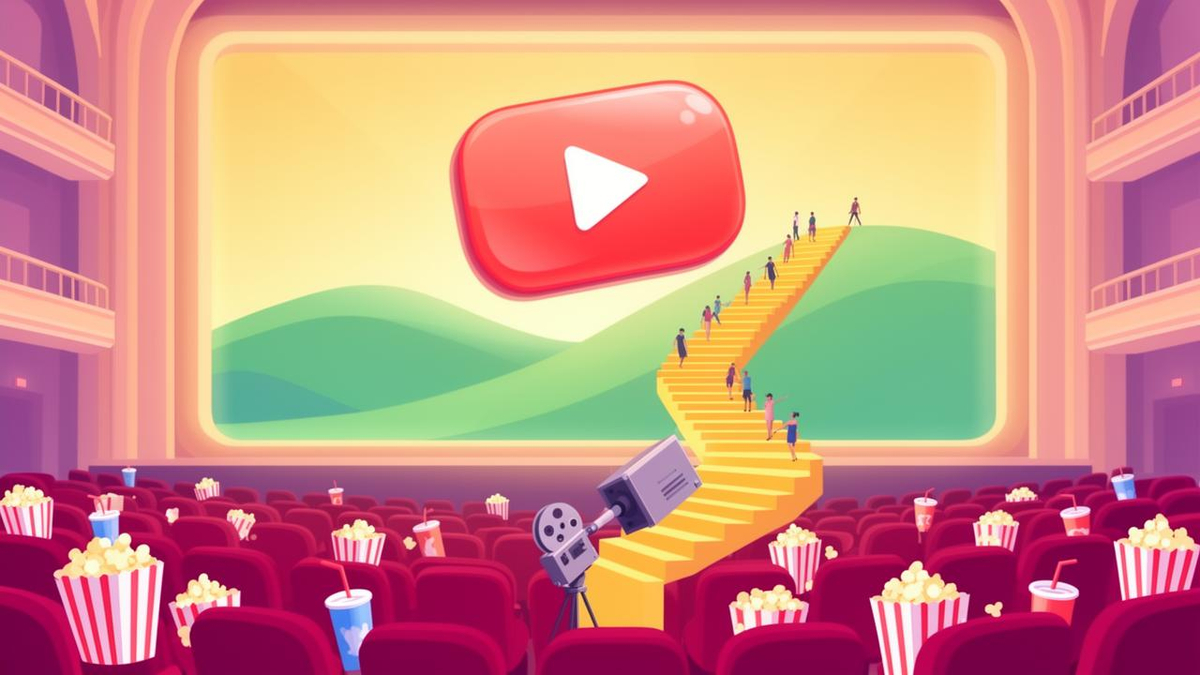
The summer of 2026 will be remembered as the season the movies roared back — and as a warning to every executive who spent the past decade betting that audiences would keep paying for interconnected sequels. Three films made by YouTube-native filmmakers — Iron Lung, Backrooms, and Obsession — landed in theaters back to back and actually worked, while the franchises Hollywood leaned on, Star Wars and DC among them, underperformed. That inversion is the story Lucas Shaw untangles on Bloomberg’s Screentime podcast. His read: the recovery is real, but it rests on a lesson the industry keeps refusing to learn — and it is one wrong decision away from becoming just another glut.
What actually got audiences back into theaters
The rebound began with supply: the summer of 2026 offered probably the highest volume of high-caliber blockbusters in a long time, as the Bloomberg Businessweek essay on the recovery puts it. The essay boils the rest down to two lessons the industry has had to relearn before.
First, Hollywood spent more than a decade building cinematic universes — the Marvel-style bet that audiences would keep showing up for interconnected sequels. What clicked this summer was either genuinely new or had been off screens for five or six years. Second, the window between a film opening in theaters and becoming available at home still matters.
The recovery is real but incomplete: revenue is running roughly 10 to 15 percent below pre-pandemic levels, and actual ticket sales are down far more. Higher ticket prices and the pull of IMAX explain why the revenue gap is the smaller of the two.
| Factor | Summer 2026 reading |
|---|---|
| Fresh ideas, or properties absent five to six years | Drove the season’s hits |
| Cinematic universes — the decade-long default (Star Wars, DC) | Underperformed expectations |
| Premium formats (IMAX, 70mm) | Pulled in cinephiles and propped up revenue |
| Theatrical-to-home release window | Cited again as a make-or-break lesson |
| Young-audience properties (Minecraft) | Proved younger viewers still buy tickets |
Cinephilia is now a measurable part of the business. As the Businessweek piece put it, “being a film nerd is cool again.” Christopher Nolan’s Odyssey is the clearest test: Shaw saw it in 70mm — not, he admits, “what Christopher Nolan would want” — and a true 70mm IMAX viewing requires one of only about 40 screens in the entire country. That scarcity is itself the draw. Ryan Coogler’s IMAX release rides the same current.
Then there’s the myth that younger viewers had walked away for good. The pandemic-era claim that young people had moved on to video games and streaming is, Shaw says, wrong.
“I think the notion that young people are just not interested in movies was clearly false. They just are interested in particular types of movies.”
The Minecraft movie made the point — it is a property those audiences love. Shaw draws a parallel to another collapsed generational prediction: the same confident talk that young people would never buy houses has quietly turned into “they’ll buy if they can afford them.” Moviegoing may be slightly less central to young audiences than it once was, but the idea that they are uninterested is plainly false. Selectivity, not abandonment, is the story.
Three internet-born hits and a new talent pipeline
The most consequential development of the summer may be three films that arrived in succession, all made by YouTube-native filmmakers. Iron Lung, from the massively popular YouTuber Markiplier, was mostly self-distributed and “did really well” for its kind of property. Backrooms and Obsession followed, completing a cluster that landed while the legacy franchises sagged.
| Film | Creator | Distribution | Result described |
|---|---|---|---|
| Iron Lung | Markiplier | Mostly self-distributed | “Did really well” for its type |
| Backrooms | A YouTuber director | Not detailed | One of the three-film breakout cluster |
| Obsession | A 26-year-old YouTuber | Not detailed | One of the three-film breakout cluster |
Obsession is the telling detail: its director is 26, which is how young online-native filmmakers are now landing theatrical releases from major studios.
Shaw dismisses the idea that this is a one-off with a rule of thumb from his trade:
“There’s a saying in journalism: three is a trend.”
The caveat matters. YouTube has been a farm system for filmmakers for a decade or more, so creator crossover is not new. What changed is timing: three of these films landed while Star Wars and DC underperformed, and that coincidence has forced Hollywood to pay attention. Producers are now hunting for the next internet meme or YouTube star.
But Shaw is careful not to flatten the three films into one story — each succeeded for distinct reasons. The actual lesson is the combination: take talent and material that have already proven they can speak to an audience online, plug them into the studio system with the freedom to stay true to their vision, and give them “all the intelligence and bells and whistles of a proper Hollywood release.” That pairing — not the YouTube pedigree alone — is what worked.
The fork: filmmaker-plus-infrastructure, or meme-IP glut
The entire comeback now hangs on one question, which Shaw frames as a fork in the road:
“Are they going to see obsession and instead just make a million different deals with other YouTube filmmakers, or are they going to find the right filmmaker and put the right infrastructure around them?”
His answer is that it “just depends on whether Hollywood learns the right lessons from this.”
In the wrong-lesson world, studios recreate the exact failure they just escaped — the cinematic-universe glut — with a different flavor: meme IP and influencer deals at scale. In the right-lesson world, the summer becomes a template for a durable movie economy. Shaw’s warning is explicit: the rebound will not hold if Hollywood settles for a string of one-off creator deals rather than building institutions around the right people.
The tonal pendulum: audiences want to leave the theater lighter
Shaw states his own preference plainly:
“I feel like there’s enough stuff in this world that kind of stresses me out that when I go home, I want a happy ending.”
That turns out to be a business story. Hollywood talked itself out of uplift, starting with the anti-hero era of television — particularly after House of Cards arrived on Netflix — when the industry embraced the idea that no character needed to be likable. The canonical figures were Tony Soprano, Don Draper, and Walter White: deeply flawed, often despicable, and yet viewers kept rooting for them because the writing made you care. You “almost felt bad, but couldn’t help but want to see them succeed.”
The overcorrection came later, with projects that were “very dark and bleak and depressing,” full of irredeemable characters and nothing to root for. That, Shaw says, “ultimately is going to turn people off.”
“We tilted too far away from that, where there were projects that were just very dark and bleak and depressing and where nobody was redeemable, and that ultimately is going to turn people off.”
His position is not saccharine. Stories should still reflect real problems — audiences are craving stories that do — but the emotional contract has changed.
“People are craving stories that reflect some of those problems, but they don’t want to walk out of the theater constantly feeling depressed.”
That carries a financial consequence: keep making grim, redemption-free projects, and audiences will quietly drift back out of theaters.
A $12 billion Lakers flip that smells like distress
The week’s second surprise was Josh Kushner and Bob Iger buying the Los Angeles Lakers for more than $12 billion — the second time the franchise changed hands in a startlingly short span.
Shaw’s first reaction, by his own account, was an expletive. The shock cut two ways. Mark Walter had bought the Lakers barely a year earlier, and fans — Shaw among them — had hoped the Guggenheim group that reinvented the Dodgers, “one of the best brand franchises in all of professional sports,” would apply the same “fairy dust” to a Lakers team that has struggled. Shaw also sees a structural reason for those struggles: a family whose entire net worth sits inside one team cannot match the resources of the massive new ownership groups now rising across pro sports.
But the reporter’s instinct overrode the fan’s excitement.
“My main takeaway was, man, Mark Walter must be in trouble.”
Bloomberg and other outlets have reported on investigations into Walter’s insurance business and how he was moving money, with subsequent reporting describing a need for cash. Selling a marquee franchise back so quickly is not a normal ownership act — something, Shaw says, was forcing it.
On the buying side, Kushner and Iger are close — Iger has been an adviser to Kushner’s venture firm Thrive — and the pair had been trying to acquire an NBA team. The personal oddity is that Iger was for years “one of the most prominent Clipper fans in Los Angeles.” Becoming the face of the Lakers reads as a next act for a former Disney chief executive determined to stay in public view.
The background sharpens the picture. The deal values the club at a reported $12.5 billion, barely more than a year after Walter paid about $10 billion — back-to-back records in a market that now prices marquee teams as global media assets rather than sports businesses. Jeanie Buss is expected to remain as the team’s governor, and the Buss family’s retained stake keeps the league’s ownership threshold intact. Magic Johnson, who says he has known Iger for more than four decades, told fans they “couldn’t have two better owners,” while LeBron James has already left for Philadelphia, leaving the new owners without the franchise’s defining superstar.
The Screentime lineup maps the next battles
Shaw closes by previewing Bloomberg’s own live event, Screentime, running Sept. 30 to Oct. 1 in Los Angeles and kicking off the evening of Sept. 30 — a lineup he calls one of the best yet.
| Guest | Affiliation | Status |
|---|---|---|
| Ted Sarandos | Netflix co-CEO | Returning |
| Donna Langley | NBCUniversal | Returning |
| Dana Walden | Disney | New |
| Casey Bloys | Head of HBO | New |
| Gerry Cardinale | RedBird Capital, major Paramount shareholder | New |
The agenda is a map of where the tension sits. With Cardinale in the room, the Paramount and Warner Bros. situations are guaranteed topics — Paramount is trying to close its roughly $110 billion acquisition of Warner Bros. Discovery by offering theater chains a written 30-films-a-year commitment as a shield against an antitrust challenge from a dozen states. Also on the bill: the Los Angeles mayoral race and the flight of production out of the city, with a leading candidate scheduled, and AI music, with Suno CEO Mikey Shulman following a recent Bloomberg profile.
The connective tissue: money is flowing toward the most valuable pieces of culture — an NBA franchise here, an AI music company there, a studio merger that could reset theatrical output — while the physical production base that built Hollywood keeps leaking away.
If there is a single thesis across both halves of the week, it is selectivity. Audiences did not stop wanting movies; they stopped wanting everything. They want a story they haven’t been fed for years or a world that feels new, an experience worth leaving the house for — 70mm film, a room-sized screen — and an ending that doesn’t send them home hollow. Capital is behaving the same way: consolidating around scarcity, from a one-of-one sports brand to the studio assets that can still command a theatrical window.
The investment questions follow directly. Can studios convert a YouTuber pipeline into durable franchises without strangling the creators who made the films interesting? Will the Paramount–Warner Bros. merger, now carrying a 30-film-a-year pledge and a mounting legal bill, reset theatrical economics or merely compress output the way Disney’s Fox deal did? Will Los Angeles find a reason for productions to stay? And can the Lakers turn a $12 billion-plus price tag into a winning franchise with a former Disney dealmaker and a venture capitalist at the helm, and LeBron James finishing his career in Philadelphia?
Shaw’s own forecast sets the test: the rebound survives only if Hollywood learns the right lesson. For investors, that means watching whether the next wave of creator-driven films gets infrastructure or just gets signed. The early tell is already visible in markets — film shares were among the strongest sectors in China’s A-share index in early August as the same optimism traveled — but the real proof comes in the next wave of greenlights. Hollywood has the audience’s attention again. What it does with it is still undecided.
Credit: Source link