
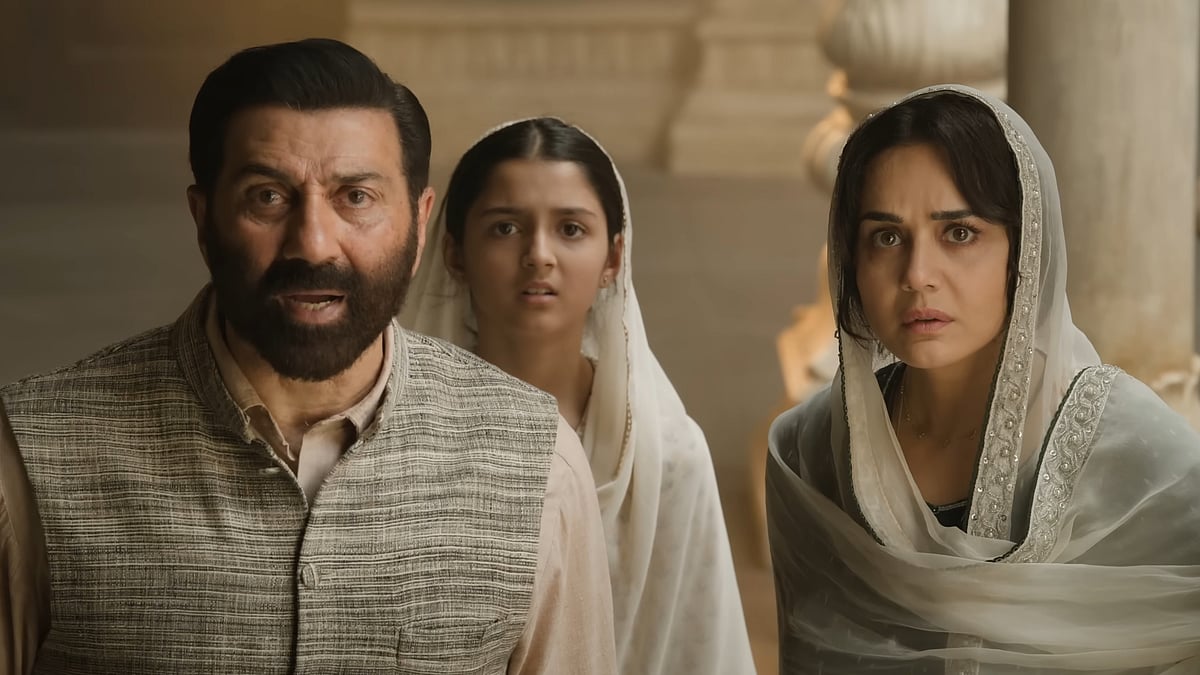
I don’t get to describe a premise like this too often, so let me enjoy writing this first paragraph. A prosperous Muslim family from Meerut — led by patriarch Sikandar Mirza (Sunny Deol) — is forced to flee for Lahore on a blood-soaked Partition night. Just like that, they have nothing. After months, they are allotted a house. But they move in to discover that it will never be their ‘home’; the displacement is permanent. An old Hindu lady (Shabana Azmi), the original owner, still lives upstairs. She waits for her own family to return, refusing to leave. Mirza, his wife (Preity Zinta) and his daughter overcome their biases and start to treat her like their mother; they celebrate her festivals and cook her food. This secularism draws the ire of the community; they’re a people still learning how to discriminate by faith and divide by appearances. The local troublemakers include an extremist goon (Abhimanyu Singh) and gang — they prey on the trauma of Mirza’s son, Javed (Karan Deol), and poison him. Tensions rise, and Mirza is threatened for harbouring the ‘enemy’. As a Deol, he resists.
It’s hard to imagine this mainstream Hindi storyline in 2026. But it does exist. With a big-screen hero (Sunny Deol), a big-screen masala director (Rajkumar Santoshi), and a big-screen producer (Aamir Khan). The choice to adapt Asghar Wajahat’s play Jis Lahore Nai Vekhya, O Jamya E Nai for the screen is a brave one. As with most Partition-era titles, the message is chaste: compassion over religion. And this is no subtle drama about grief and memory, it’s a violently blatant melodrama that almost unfolds in real time. The language is direct and commercial. Some of the lines are so pointed that they’re contemporary: “Don’t mix politics and religion, it destroys everything” or “nothing is more dangerous than the silence of good people”.
Credit: Source link