
We have thousands of human-written stories, discussions, interviews and reviews from today through the past 20+ years. Find them here:

There’s a reason why the Bruch Violin Concerto still tops the classical music charts, 160 years after it was written. In the right hands, it’s a 25-minute highlight reel for the violin, showcasing both its beauty and its power, its capacity for melody and virtuosity, its ability to evoke a range of emotions, from deep melancholy to wild joy.
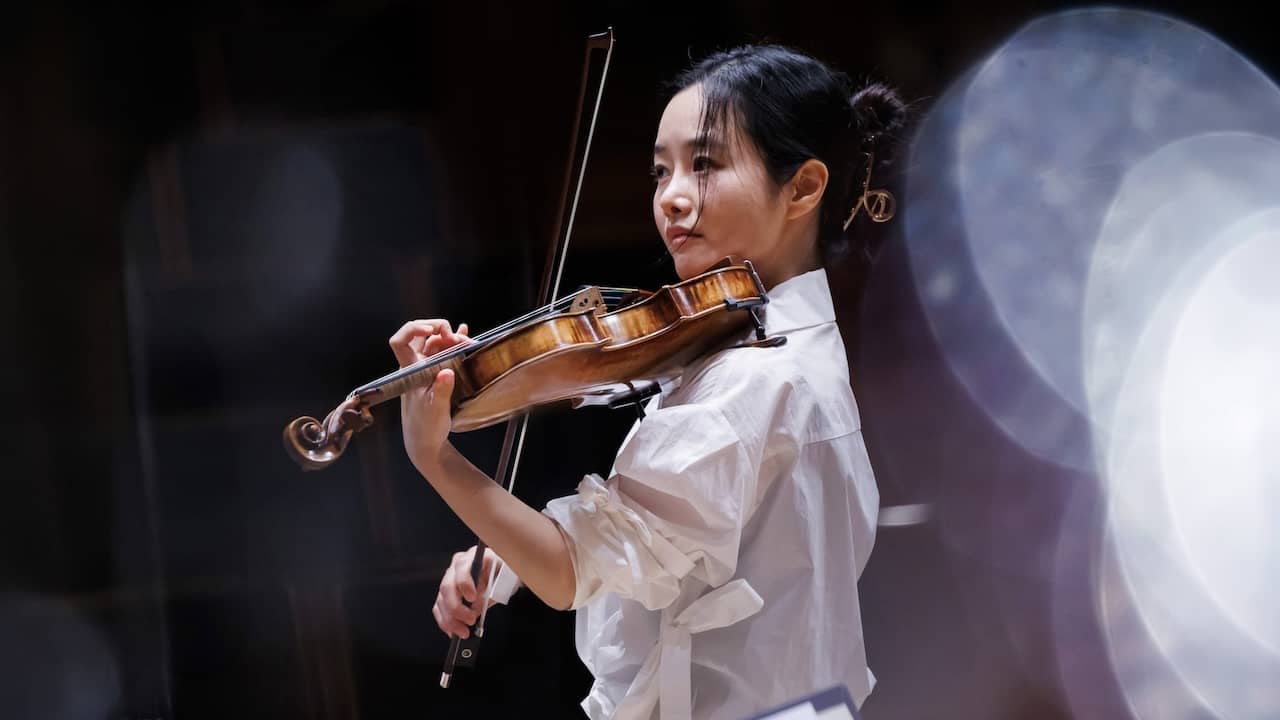
On Tuesday night it was in the right hands, with violinist Bomsori and the Los Angeles Philharmonic, led by Anja Bihlmaier at the Hollywood Bowl.

Violinist Bomsori. Photo by Bartek Barczek.
By now a veteran of the concert stage, Bomsori has played with many of the world’s finest orchestras and continues to widen her circle. She actually recorded the Bruch quite recently, in a 2025 album for Deutsche Grammophon that also included the Korngold Violin Concerto, both performed with Jakub Hruša and the Bamberger Symphoniker.
Tuesday’s concert (called “Dvorak and Bruch”) took place on the first night in September. After a week of 100-degree days in Los Angeles, here finally was some evidence that fall is coming, with temperatures dropping as the sun set a little earlier over the Hollywood Bowl, which was already dark by the time the music began.
Against the cool night, Bruch’s low-and-slow opening was all warmth. Bomsori played with a dark and burnished tone, coaxed from the 1725 “ex-Moller” Guarneri del Gesù violin she has on loan from the Samsung Foundation of Culture and the Stradivari Society of Chicago. (And I’ll note: it’s a feat to get a 300-year-old fiddle to cooperate for an outdoor concert!)
From the start, her playing was brimming with energy, her spot-on double-stops charged with fast vibrato. Bomsori is a notably articulate player, something that was on display in the hammer-clarity of her trills and in the way she enunciated each note with both strong fingers and decisive bowing. The LA Phil matched her for energy and kept pace admirably when she occasionally hit the accelerator.
The second movement’s series of melodies allowed Bomsori to tease some gorgeous tone out of that fine violin, with her vibrato ranging from quite-fast-and-wide to — on occasion — none at all. The non-vibrato made for an especially riveting moment, (m. 77-78) at the transition between the steady motion of her solo melody to a quieter and more still passage in the orchestra. Another beautiful moment came toward the end of the movement (m. 140), as intensity turned to nostalgia, with a softer retelling of a melody from before.
Best of all was the last movement, where Bomsori’s playing showed the most passion, connecting with the orchestra and showing visible enjoyment in the music. She led an exciting accelerando to the end, after which there were several standing ovations – but alas, no encore! (This has been quite common for the Hollywood Bowl, so no negativity toward Bomsori. But I miss hearing those little gems at the end!)
The rest of the evening’s program was both poignant and enjoyable. The concert opened with the U.S. premiere of “beyond the beyond” by Sarah Gibson (1986-2024); and it ended with a Romantic favorite, Antonin Dvorak’s Symphony No. 8.
Local to the Los Angeles area, Gibson was a composer who died from cancer at age 38, less than a year after giving birth to her son. She wrote most of this piece during that short window of time when she was experiencing both the joy of her newborn baby and the pain and fear of her illness. A friend’s description of her difficult situation as being “beyond the beyond” stuck as a title for her last composition. The piece, nearly complete when she passed away in July 2024, was completed by her friend and musical partner Thomas Kotcheff. It was to have been premiered that August at the BBC proms but was delayed due to all these circumstances.

Composer Sarah Gibson (1986-2024).
On Tuesday conductor Bihimaier, who gave the later world premiere of the piece in March 2025 with the BBC Philharmonic, was on hand to conduct this performance of the work. Beforehand she described some of its most innovative moments, including a passage during which winds simply blow through their instruments, evoking the breathing of Gibson’s newborn baby as he slept. (Here also is a beautiful article that her husband Aaron Fullerton wrote about this work.)
The beginning of the piece was busy and chaotic, full of high notes and glissandi. The piece is more atmospheric than melodic, an atmosphere that begins with exuberance and then shifts steadily toward quiet and stillness. Harmonies grow more and more consonant – until reaching a point of tranquility, something the composer described as “humming to my baby, alone in a quiet room.” Toward the end, the music bursts back into the active energy of the beginning.
“Beyond the beyond” was well-received, and the occasion was especially meaningful, knowing that many of Gibson’s family, friends, teachers and mentors were there in the audience for this premiere.
The program closed with Dvorak’s Symphony No. 8, a piece so comforting and inevitable-feeling that it’s easy to overlook the genius in this amazingly detailed orchestral writing and the way it adds up to such clear expression: the pastoral feel of the first movement, the nostalgia and swirling emotions of the second movement, the lilting dance of the third and the triumph of the fourth. What a ride!
The symphony is also a pretty nice showcase for two instruments in particular: flute and cello.
Dvorak 8 actually begins with the spotlight on the celli, on this night led by Principal Cello Robert deMaine. In that opening statement the celli offered the warmth and ebullience needed, despite being a little under-amplified. The celli were noticeably en-pointe in their tricky triplet passagework in the first movement, and during their star appearance in the last movement they were strong, warmed-toned and precise.
Principal Flute Denis Bouriakov also played an important role; his beautiful birdsong was a highlight of the first movement, as was his well-synchronized duet in the second movement with Principal Oboe Ryan Roberts – to mention just a few of many instances throughout the symphony.
And a shout-out to Concertmaster Bing Wang for her strong solo in the second movement.
Overall the LA Phil gave a committed performance to this well-known work, capping a satisfying evening at the Hollywood Bowl.
You might also like:
* * *
Enjoying Violinist.com? Click here to sign up for our free, bi-weekly email newsletter. And if you’ve already signed up, please invite your friends! Thank you.
Replies
Credit: Source link