
Jonah Tulis’ Serling, a new 98-minute documentary about The Twilight Zone creator Rod Serling, is good, but it’s mostly a good shell.
Persuasively showing that Rod Serling was one of the medium’s true prophets, a prolific thinker capable of seeing the world around him and using it as a prism to look both backward and forward, Serling proves less deft in examining Rod Serling as a man. Despite interviews with Serling’s wife and daughters, as well as several collaborators, this remains a portrait of the artist as a very wise fortune cookie instead of a flesh-and-blood storyteller whose work still thrills us in a way that countless contemporaries, however acclaimed, never achieved.
Serling
The Bottom Line
A worthwhile if somewhat shallow dive into a deep man.
Venue: SXSW Film Festival (Documentary Spotlight)
Director: Jonah Tulis
1 hour 38 minutes
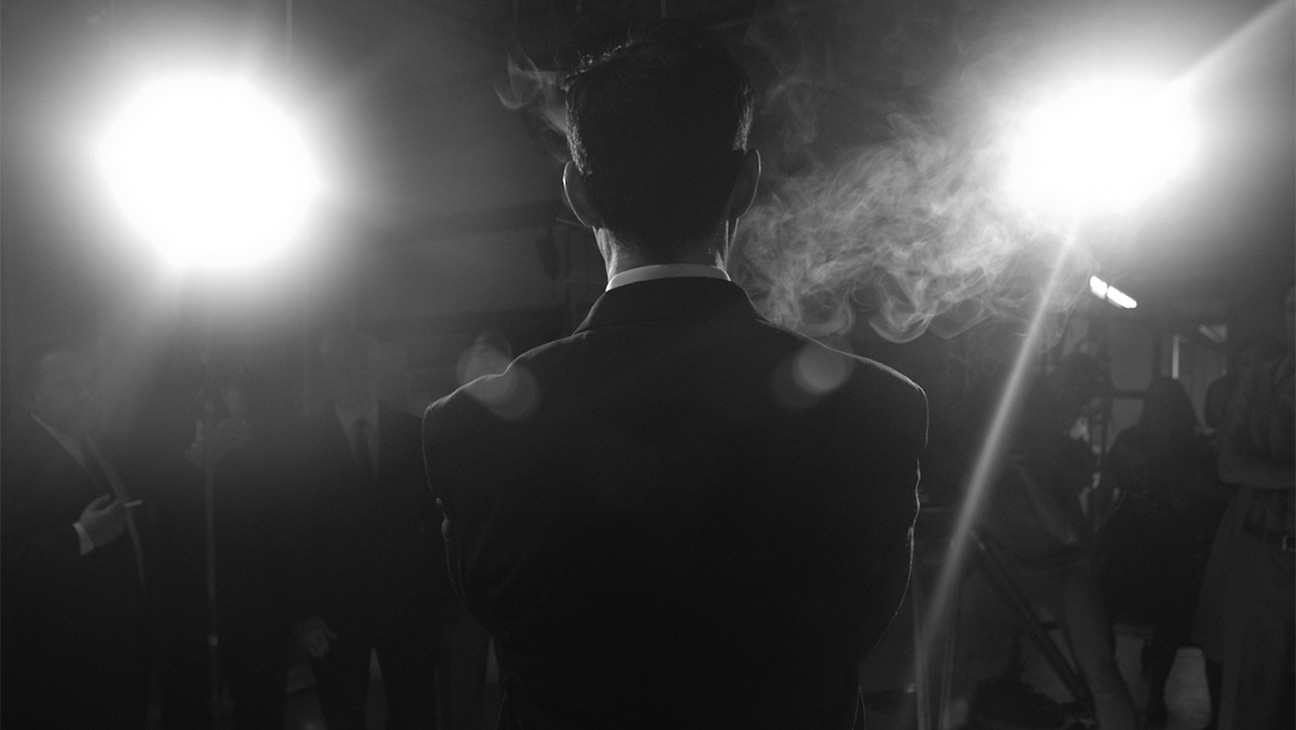
One of Tulis’ central aesthetic conceits is a bunch of re-enactments in which Serling is featured either as a blurred face, a smoking profile or a silhouette, and that’s how he ultimately comes across in the film. He’s a suit and a cigarette and an impeccable hair-do, rarely a person.
Watching Serling made me want to binge The Twilight Zone and Night Gallery, but more than that, it made me crave a four-hour documentary capable of a greater level of humanizing and specificity.
I learned some things from Serling, but the primary thing I learned is that Rod Serling loved a dictaphone.
Serling apparently dictated letters and scripts and general observations on the industry he helped shape, providing what, in Tulis’ hands, evolves into the voluminous narration that guides the documentary.
Tulis had so much of Serling’s voice that he was able to do Serling as a documentary told primarily through the perspective of its subject, eschewing expert outside observers and avoiding talking heads. Instead, Serling’s recordings, as well as a wealth of in-depth television interviews over the years, steer the film, with audio from interviews with his wife Carol and daughters filling in personal gaps. On the professional side, Tulis has interviews with several Twilight Zone writers and producers, but it’s never clear which of those interviews were conducted for this film and which existed from earlier untold provenance.
You can take the “all archival/no talking heads” approach to documentary storytelling if you have the visual footage necessary to hang all of that talking on. Tulis has all those TV interviews, a decent cache of home movies — the Serling family’s house in Pacific Palisades and lake house in Interlaken, N.Y. both look like nice places to have raised a family — and lots and lots of clips, usually disseminated in lengthy montages, from Serling’s various TV shows.
But it isn’t enough, and the documentary’s over-reliance on black-and-white re-enactments is a flaw. It isn’t just that the re-enactments don’t seem to have been made with a cohesive sense of perspective; they’re also shot in a black-and-white digital style that, while pretty, in no way matches the rich tones that the best of 1950s and 1960s TV was able to achieve. The result here is that every transition from period footage to newly shot imagery feels slightly jarring. Since presumably this approach was intended to avoid having cutaways to talking heads, which themselves would have felt jarring, I wonder why nobody attempted to doctor the re-enactments to tone down the hard lighting and crisp edges. Everybody in the re-enactments wears nice suits and smokes, but otherwise nothing is really evoked.
Perhaps actually seeing Carol and the daughters would have helped bring the human side of Serling to the foreground? I came away with no sense of who he was at home, other than “extremely busy,” nor who he was in a writers room or boardroom. The things that shaped his perspective are either discussed in the most generic of terms — his time in World War II was formative, but bland — or ignored entirely. It doesn’t matter if Serling was a practicing Jew in his adult life — the Internet suggests he was not — but so much of his worldview, including his thoughts on civil rights and the initial lure of fighting in WWII in the first place, comes from at least a secular Jewish place. Eliding it entirely erases something that is, at least to me, important.
Whatever its origins, Serling’s dogmatic and argumentative spirit is the thing that the documentary captures best. Tulis shows how Serling’s passion for civil rights and later opposition to the Vietnam War colored so much of what he wrote, and so much of what he believed that television, as a medium, was capable of accomplishing. Tulis isn’t always able to give enough depth on specific Serling scripts and how they fit into his worldview, but there are brief nods to Twilight Zone episodes like “The Monsters Are Due on Maple Street,” “The Invaders” and “Time Enough at Last” as installments that realized his aspirations. And he’s able to trace how the advertiser-driven focus of television homogenized scripts like the teleplay Noon on Doomsday, initially intended as a commentary on the murder of Emmett Till before being moved geographically and topically.
Serling takes on its greatest prescience in breaking down the end of The Twilight Zone, doomed at least in part because CBS executives had ties to Republican politicians who didn’t like the show’s liberal inflections. It does not take an imagination like that of Rod Serling to envision something similar occurring today (it does, apparently, take a great imagination to know what Serling thought about his own movie career, which was lucrative but remains barely a footnote here).
Whatever limitations Serling has as a documentary or as an overall profile of its subject, it underlines Serling’s reputation as one of those visionaries whose thoughts on the medium are eternally relevant, doing its part to negate Serling’s self-effacing quote, “I don’t think, truly, that’s there’s anything I’ve written that’ll last, that’ll stand the test of time.”
Credit: Source link