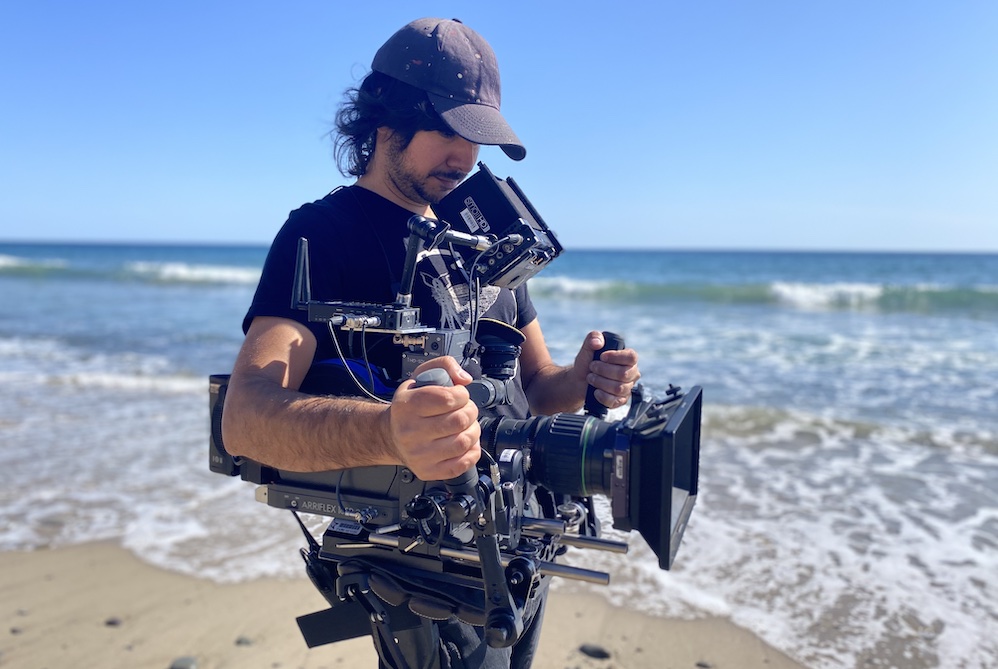
Cinematographer and San Antonio native Antonio Cisneros was captivated by cinema at an early age. He recalls watching Ridley Scott’s 1979 sci-fi horror masterpiece Alien alone on TV as a child, an experience that he said “really screwed me up.”
He also remembers his parents giving him a VHS copy of Fantastic Planet, the surreal 1973 French animated classic about a race of giant blue aliens who kept humans as pets. Films like those sparked Cisneros’ lifelong fascination with visual storytelling.
Today, Cisneros, a 2004 graduate of North East School of the Arts (NESA), is a professional cinematographer who has worked on projects for Disney+, Netflix and ABC.
In 2022, he served as the director of photography for the Disney+ documentary, Mickey: The Story of a Mouse, about the history and social impact of iconic animated character Mickey Mouse. His latest film, Cookie Queens, a documentary about Girl Scout cookie season, is set for release later this summer. Cookie Queens premiered at the Sundance Film Festival earlier this year.
In conversation with the Current, Cisneros, 39, talked about which filmmaker inspired him the most as a kid and why he chose cinematography over directing. He also discussed how the Texas Young Masters Program, which he received a grant from while in high school, swayed him to pursue a career in film.
How did San Antonio shape you as a filmmaker and serve as a launching pad for your career?
At NESA, I had a teacher there who really took an interest in me — George Ozuna. I wouldn’t have taken the path I’ve taken if it wasn’t for him. The thing about San Antonio is that it’s such a fertile place of culture. It was easy to go out and find stories or take pictures at a young age. I miss San Antonio a lot.
What other films do you remember making an impression on you growing up?
I was 12 years old when I was flipping through the channels and saw this epic samurai battle. It was [Akira Kurosawa’s] Ran. The first half of Ran is very slow and intense. When the second half begins, it’s all these fucking chaotic battle scenes — violence I had never seen before. I remember thousands of extras, hundreds of horses, samurai swords, spears, and arrows flying everywhere. It’s one of the most brutal things ever in cinema. I couldn’t take my eyes off it.
Were you hooked on Akira Kurosawa after that?
Yeah, a few days later, I went to the Bazan Library and wrote out his name, Akira Kurosawa, and the librarian was like, “Oh, we have all his movies at the big enchilada main library.” So, I caught the bus to go down there, and they pointed me to the back where all the foreign films were. I grabbed Yojimbo and thought it was fucking cool. I basically watched all his films between the ages of 12 and 17 except for some of his earlier stuff they didn’t have at the library. He was a big influence on me.
Did you initially want to be a director before you turned your attention to cinematography?
There is so much bullshit you have to deal with being a director, and I don’t enjoy that aspect of filmmaking at all. Sometimes, you have to be a masochist to be a director. It’s really hard work. As a director, you need to deal with actors. That’s a whole different thing than just focusing on camera work. I didn’t think I wanted to become a cinematographer until the very end of my experience at New York University. I just enjoy having a camera in my hands.
You have made a lot of documentaries. What about the genre do you like in comparison to a fictional narrative film?
One thing I really love about documentaries is that they can raise a lot of ideas and thoughts and put them in people’s minds. With fiction, it’s hard to focus on the story. With documentaries, you eliminate all that. It’s just the subject, the sound person and the camera. It’s very hands on. With documentaries, I can do 30 different projects, all with different styles, languages and approaches.
I noticed. One year you’re following drug cartels to make Kingdom of Shadows, and then you’re following Girl Scouts to make Cookie Queens. That’s quite a shift.
Having a range of different stories and jumping back and forth between narrative films and documentaries gives you a lot of different skills. You have to make very fast decisions in a short amount of time when you make a documentary. Your storytelling skills have to be very strong. The fun thing about documentaries is that all the stories are usually fascinating.
As a Texas Young Masters alum, how did a program like that enable you to pursue your artistic talents?
It allowed me to experiment and make mistakes at a young age. It gave me access to a dark room throughout high school, which gave me a lot of confidence and ability to learn how to look at images. The program gave me a jumpstart to find my voice.
Sign Up for SA Current newsletters.
Follow us: Apple News | Google News | NewsBreak | Reddit | Instagram | Facebook | Twitter | Or sign up for our RSS Feed
Related Stories

The feature film, which follows the story of a rancher who accidentally shoots a young migrant woman, begins streaming Friday.

The screening of the film, known for its unconventional narrative approach, is part of Texas Public Radio’s Cinema Tuesdays series.

The downtown library will screen the Wes Anderson coming-of-age film for free this Tuesday — and even throw in camp-related activities.
Credit: Source link