
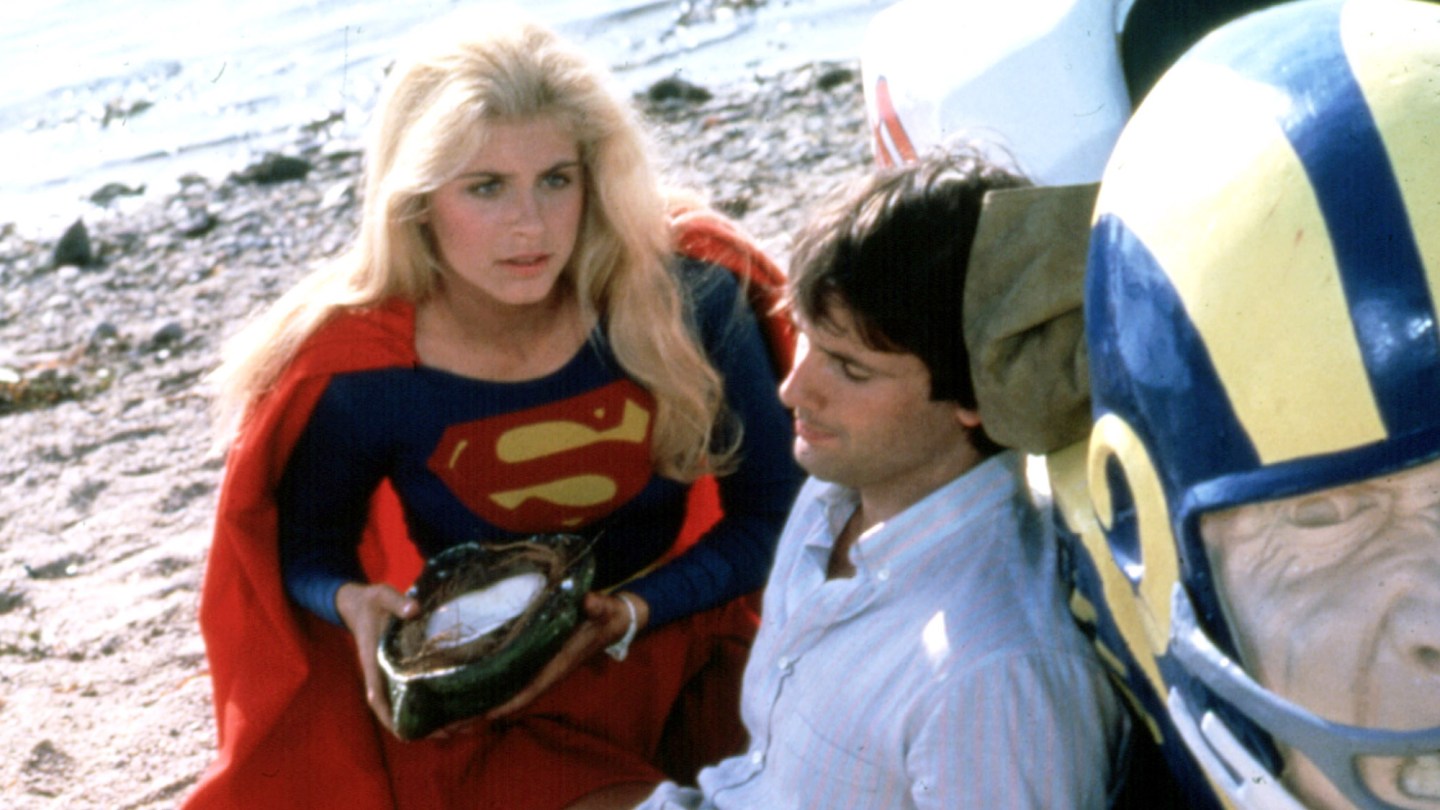
On Nov. 21, 1984, Tristar released its $35 million adaptation of Supergirl in theaters stateside as a spinoff of the Christopher Reeve-led Superman franchise. The film, starring Helen Slater and Faye Dunaway, ultimately grossed $14 million domestically in theaters. The Hollywood Reporter’s original review of the feature is below:
The main trouble with Alexander and Ilya Salkind’s elaborate production of Supergirl is that it doesn’t really fly. Despite its expense and hard-working cast, its extensive, expensive and eye-filling special effects, and an effective but ear-splitting score by Jerry Goldsmith, the film remains surprisingly small, thanks to David Odell’s unimaginative, earthbound screenplay. Even its occasional attempts at campy tongue-in-cheekiness seldom raise more than a titter.
One keeps longing for Supergirl to do something spectacular, like steadying a towering skyscraper or halting a runaway train. Instead, she manages to put out a two-alarm fire and save Hart Bochner from being crushed to death by an array of amusement park bump’em cars. The Salkinds have repeatedly stated that they didn’t want Supergirl to become Superman IV, and the sad fact is that they’ve succeeded all too well.
Perhaps the biggest problem with this movie is that Supergirl (Helen Slater) seems terribly leisurely about her fateful mission. Catapulted to earth to retrieve the life-sustaining Omegahedron that slipped from her fingers back in Argo City (which splintered off from Krypton when that planet was destroyed), she assumes the identity of teenaged Linda Lee and enrolls at Midvale High. It just happens that her supercilious math teacher (Peter Cook) is in love with a carnival fortune-teller (Faye Dunaway), whose modest ambition is to rule the world. When the Omegahedron lands in her picnic lunch, she quickly seizes her opportunity.
Meanwhile, our Supergirl is making high school friends and enemies and falling in love with the muscular Bochner. But so has Dunaway and far too much of Supergirl’s attention is diverted to rescuing her young man from Dunaway’s evil clutches. Since the girl doesn’t even know that Dunaway possesses the precious power source until well on in the story, one wonders why she continues to hang around Midvale High — unless it is to save Bochner from the numerous scrapes that Dunaway keeps devising for him.
It’s a movie in which the baddies not only have all the fun but provide most of it. Helen Slater, as Supergirl, chosen by the Salkinds after an international search, is as wholesome and exciting as a vanilla malt. When she flies through the air with one arm punched out before her (as she does frequently), she seems to be saying, “Gimme an M, gimme an I, gimme a D …” Her romantic interludes recall Sandra Dee in her prime. And young Bochner is understandably queasy in his delivery of the poetic lines he’s been handed for these same interludes.
On the other hand, Dunaway and her tart-talking sidekick, Brenda Vaccaro, seem to be having the time of their lives as mistresses of the shades of darkness (their ramshackle abode is a funhouse Ghost Train ride festooned with skeletons, spiders and tattered netting). Dunaway is amusingly imperious as she tries out her newfound powers; Vaccaro is her more realistic partner, never quite sure how their venture is going to turn out, but expecting the worst. And Peter Cook, who can give a droll twist to the flattest of lines, is urbanely sinister as the professor who’d like to start a coven of his own. Peter O’Toole lends his customary grace and authority to his role as the patriarch of Argo City, although he appears only briefly in the film’s opening and closing reels; while Mia Farrow, given fourth billing, is actually on the screen for less than two minutes as Supergirl’s mom.
With its name-heavy cast as only one example, Supergirl is a film that promises more than it delivers. The catastrophies that our heroine averts are awfully small potatoes — a bulldozer running amok, an amusement park ride speeding out of control, some prankish teenagers scheming to turn the girl’s shower into a steambath. Even the special effects emerge as less than spectacular — especially since Jeannot Szwarc’s plodding direction affords ample time for one to sit there and figure out just how they were accomplished. And the scene obligitoire of these epics, the race through space, comes so early on that it’s all but thrown away.
Despite all these faults, this Tri-Star presentation will probably make it handily through the holidays on the strength of its heavy presell campaign; but none of the kiddies that I spoke to after last Saturday morning’s preview expressed any keen interest in going back for a second helping. — Arthur Knight, originally published on Nov. 20, 1984.
The 1984 theatrical poster for ‘Supergirl.’
Everett Collection
Credit: Source link