
On a live concert stage, sound engineers wage a constant, mostly invisible war against noise. A kick drum bleeds into a vocal mic. A guitar amp pollutes a monitor feed. The singer drops the mic to their chest mid-chorus and half the lyric disappears into the mix. For decades, the tools available to fix those problems have been essentially the same: equalization, compression, volume, judgment. Human hands on a mixer, making trade-offs in real time.
This summer at the Hollywood Bowl, something different is happening. A machine learning system called Source Intelligence — developed by L’Acoustics, the French audio company that supplies the Bowl’s sound infrastructure — is listening to every microphone on stage and doing something that wasn’t possible until recently: isolating a vocalist’s voice from everything else around it, in real time, with a precision that engineers say they’ve never encountered before.
The system achieves as much as 40 decibels of rejection on unwanted stage noise — a thousandfold reduction — which L’Acoustics Chief Executive Laurent Vaissié says is roughly 20 decibels better than any competing technology on the market. The practical effect, according to Fred Vogler, who has been the Bowl’s principal sound designer since 2003, is startling. “Suddenly, you’re not getting the guitar amp or the drums in that mic,” he said. “You’re just getting the vocal.”
Source Intelligence is one piece of a sweeping audio overhaul at the Hollywood Bowl this season — the venue’s most ambitious upgrade in a generation — that also includes a new flagship L Series line array system and a first-of-its-kind immersive surround installation that may be the largest of its kind anywhere in the world.
Close-up shot of new sound system at the Hollywood Bowl
(Courtesy of Hollywood Bowl)
The physics of the upgrade
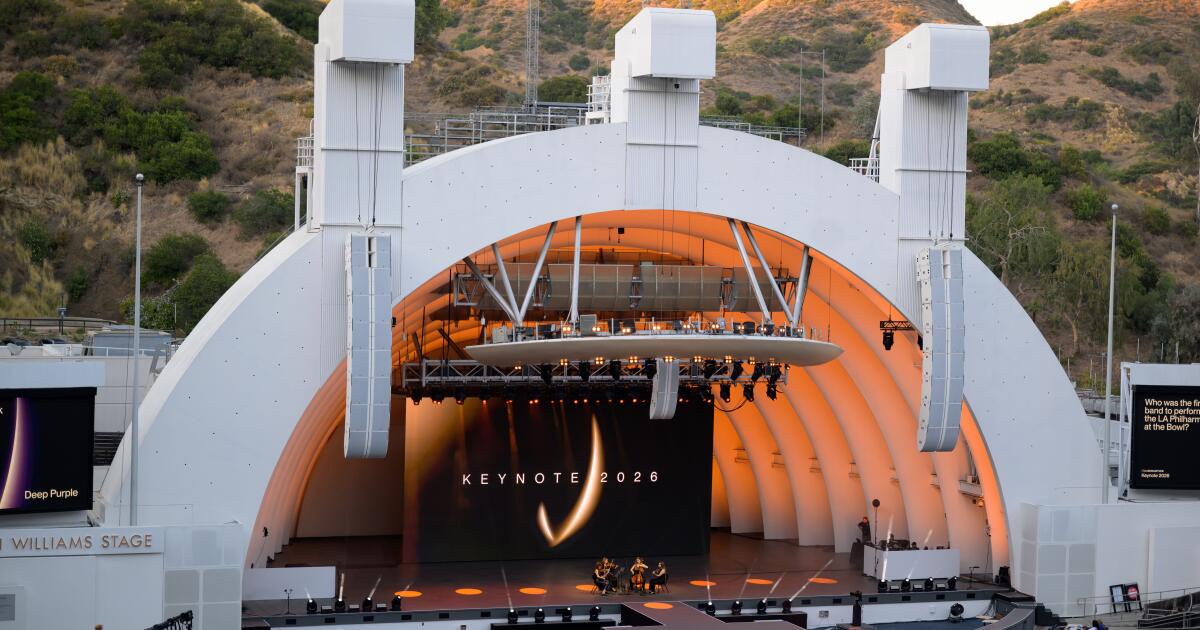
The centerpiece of the overhaul is the L1, L’Acoustics’ new flagship line array system — the first major architectural rethinking of the format since the company invented the modern line source array in 1993. Line arrays work by suspending multiple speaker cabinets in a curved vertical column, allowing sound engineers to precisely shape the direction and throw of audio across a large space. The problem, inherent to the design, has always been the physical gaps between those individual boxes.
“When you attach multiple boxes, you create a physical gap between the speakers,” Vaissié explained. “You lose a little bit of coherence.”
The L1 addresses that by integrating speakers directly into a reshaped cabinet that already carries an angle built into its design, reducing the number of interfaces in the chain. The result is a system that is simultaneously 30% smaller in footprint than its predecessor — visitors to the Bowl this summer will immediately notice the two white arrays hanging above the stage look more compact — yet more powerful than the K Series it replaces.
For the Hollywood Bowl specifically, the stakes were high. The venue’s uppermost seats sit roughly 400 feet from the stage, and the surrounding residential neighborhoods make noise bleed a genuine concern. Historically, engineers managing the Bowl’s system have contended with as much as six to nine decibels of variance between the loudest seats near the stage and the softest at the back — an audible and sometimes frustrating gap.
With the L1, that variance has been reduced to approximately three decibels — a significant engineering achievement that translates directly to audience experience.
“All the way to the top, you feel like you’re really close to the stage,” Vaissié said.
Vogler put it in more visceral terms. “The upgrade from the K Series to the L Series has been dramatic,” he said. “More dramatic than I anticipated.”
Vogler noted that the new system’s low distortion characteristics are particularly striking. “Distortion can fool you into thinking sound is louder,” he said. “When there’s no distortion, you turn it up and it’s just so clear. Pristine.”

“The upgrade from the K Series to the L Series has been dramatic,” Fred Vogler, the Bowl’s sound engineer said . “More dramatic than I anticipated.”
(Courtesy of the Hollywood Bowl)
AI on the mix
If the new speakers represent an evolution of physics and engineering, the AI components of the upgrade represent something newer and potentially more consequential: the application of machine learning to live sound, in real time, at scale.
Source Intelligence, L’Acoustics’ new vocal isolation tool being deployed at the Bowl, uses machine learning algorithms to separate a singer’s voice from the cacophony of a live stage environment — drums bleeding through microphones, guitar amplifiers, the general acoustic chaos of a large concert — and deliver a cleaner, more isolated signal to the mixing board.
The technology traces a somewhat unexpected lineage. It originated, according to Vaissié, as a tool for DJs — a stem-separation algorithm that allowed a DJ to break a stereo track into its component parts (vocals, bass, drums, effects) and spatialize them in three dimensions at a nightclub in real time. Engineers at L’Acoustics recognized the algorithm had a live sound application and redirected it.
For mixing engineers, the practical effect is profound. “Suddenly you’re not getting guitar amp or drums in that mic. You’re just getting the vocal,” said Vogler. “You can then elevate the vocal without elevating everything else.”
What that translates to for audiences is better intelligibility — words that land rather than wash — and a cleaner overall mix, because the engineer is no longer spending mental and technical energy fighting unwanted signal at the source.
Source Intelligence is already deployed on several of the largest touring productions in the world this season. According to L’Acoustics, the system is currently traveling with Harry Styles, the Weeknd and Bruno Mars, whose mixing engineers have reportedly been vocal about the technology’s impact.

War on Drugs perform at the Hollywood Bowl on May 19, 2026 in Los Angeles California.
(Hal Horowitz)
The immersive frontier
The third major component of this season’s upgrade may be its most future-facing. For the first time in the Bowl’s century-long history, the venue has installed a full immersive surround sound system — L’Acoustics’ L-ISA platform — wrapping the entire 17,500-seat amphitheater in distributed speakers capable of enveloping audiences in spatial audio.
Scott Sugden, director of product management at L’Acoustics, described it as potentially the largest immersive sound deployment, by sheer physical geometry, anywhere in the world.
L-ISA operates on two primary modes: a room engine that uses digital reverberation to simulate enclosed architectural space — allowing an outdoor amphitheater to, in effect, feel like a concert hall when the Los Angeles Philharmonic performs — and a surround object mode that allows engineers to spatialize individual sounds across the entire seating area.
“We can make a singer on stage feel like they’re inside something,” Sugden said. “Or we can break the fourth wall — turn that off — and suddenly they’re talking directly to you.”
Vogler is already experimenting with it cautiously. He’s run it on orchestral performances and a pop show earlier in the season, finding it capable of creating what he called “a club atmosphere in this giant acoustic.” His approach has been deliberately understated.
“We don’t want it drawing attention to itself,” he said. “We just want people to feel like, if you turned it off, something was missing.”

Kool & the Gang and the Hollywood Bowl Orchestra with Thomas Wilkins. (Myung J. Chun / Los Angeles Times)
(Myung J. Chun/Los Angeles Times)
A century-old venue, a 21st century bet
The Hollywood Bowl was founded in 1922, and the current physical structure — its seventh iteration — dates to a 2004 renovation that also marked the beginning of its partnership with L’Acoustics. The Bowl became the first venue in the world to install both the K1 system in 2013 and, now, the L1 this season.
“In order to stay a world-class venue, you have to think about what the best experience for everybody is,” Vu said. “The Bowl was founded on good sound. That ethos has carried through to today.”
Every touring artist that comes through the venue — and there are more than 130 shows scheduled this summer — uses the house system. None of them augment it with their own. That is, by any measure, a remarkable vote of confidence in the infrastructure.
What the L Series, Source Intelligence and L-ISA collectively represent is the Bowl’s most ambitious technological leap since amplified sound became standard — a bet that the future of live music isn’t just louder or bigger, but smarter, more precise and more immersive. The audience, for now, just has to show up and listen.
Credit: Source link