Suffering from severe financial inequality and oppressed by the yoke of dictators and oligarchs, the people rise up and storm the seat of government. No, it’s not the latest Democratic Socialist manifesto, but rather the subject of the new historical drama written and directed by Paul Greengrass.
The Uprising concerns the Peasants’ Revolt that occurred in medieval England in 1381, an event that’s probably more familiar to British than American audiences (we can barely bother to learn about our own brief history). In this case, a lack of foreknowledge may be helpful, since there are dramatic plot twists as the story unfolds that demonstrate that, when it comes to historical dramas, ignorance may be an advantage.
The Uprising
The Bottom Line
Skillfully made and acted, but exhausting.
Release date: Friday, September 11
Cast: Andrew Garfield, Jamie Bell, Stephen Dillane, Tom Hollander, Cosmo Jarvis, Thomasin McKenzie, Jonny Lee Miller, Woody Norman, Stanley Townsend, Katherine Waterston, Sky Yang
Director-screenwriter: Paul Greengrass
Rated R,
2 hours 7 minuteds
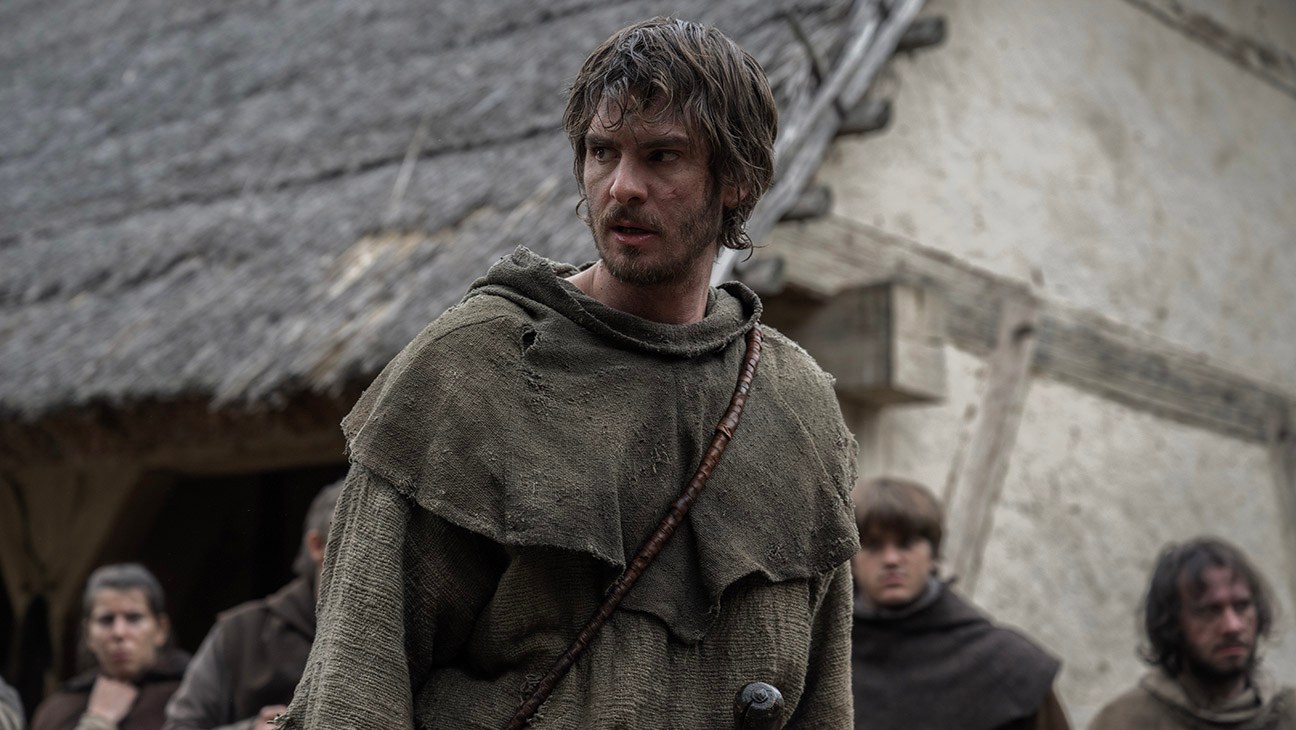
Ruled by a teenage King Richard II (Woody Norman, C’mon C’mon), the peasants are still suffering the effects of the Black Plague and onerous taxation incurred by the monarchy to pay for the country’s never-ending war with France. Among them is a simple farmer (a terrific Andrew Garfield) whose miserable, solitary life is illustrated by his relentless plowing of his fields and the three graves, marked by one large and two small crosses, that occupy his land.
Faced with the dictate of paying yet another tax, the farmer, who refers to himself only as “The Ploughman” — “I am what I do,” he says by way of explanation — erupts in a violent rage and suddenly finds himself at the center of a rebellion whose leaders include the real-life figures of radical cleric John Ball (Jamie Bell) and former soldier Wat Tyler (Cosmo Jarvis). Also figuring prominently in the proceedings is the cleric’s acolyte Alyce (Thomasin McKenzie, Jojo Rabbit), a fictional character representing the many women who took part in the movement. In typical action-movie leading-man fashion, the Ploughman demonstrates remarkable fighting abilities for someone who’s been working the fields instead of at war.
To emphasize the present-day parallels, the film includes early scenes in which the king’s oligarchal counselors — including Treasurer Robert Hales (Tom Hollander), Archbishop Simon Sudbury (Stephen Dillane), Chief Justice Bealknap (Stanley Townsend), and London Mayor William Walworth (Jonny Lee Miller) — take advantage of the power vacuum caused by their overwhelmed teenage king and decide to take the necessary funds not from the rich merchants but rather the common people. From that point on, things get very, very violent. (During his publicity tour, Garfield has stated, “I hope that if any billionaires watch it, they’re scared shitless.” Somehow, I don’t think Elon Musk is quaking in his boots.)
In typical Greengrassian fashion, The Uprising proves intense from first minute to last, the director utilizing his familiar handheld camera and frenetic editing style to an at times exhausting degree. The stylistic approach works well enough during the many and extremely bloody action sequences, but eventually proves so relentless and lacking in modulation that the film becomes a grueling and sometimes tedious experience. The director also tends to overdo the swooping drone shots, either real or CGI-generated, to convey the expansive scope of the uprising.
Still, there’s no doubting the commitment of everyone involved, from the superb cast that seemingly includes every notable British character actor to the technical craftspeople who evoke medieval England with such vividness that you can practically smell the church incense (and much less appealing aromas). Pal Ulvik Rokseth’s gritty cinematography, featuring the sort of muted color palette endemic to historical dramas of this type (there was apparently no sunshine until at least the 18th century), fully immerses you in the action. Production designer Nikolaj Danielsen takes full advantage of the ancient Bavarian locations standing in for England, while costume designers Andras Daniel Toth and Attila Godena-Juhasz clearly worked overtime to create innumerable period outfits.
The performances are first-rate across the board, with Bell and Jarvis outstanding as the lead conspirators. Katherine Waterston shines as King Richard’s mother despite not having much in the way of dialogue, while Sky Yang makes a strong impression as the Scribe who plays a pivotal role in the proceedings. But it’s Norman who steals the movie as the trauma-scarred teenage king who proves surprisingly cunning, the young actor proving mesmerizing every moment he’s onscreen.
Briefly and confusingly marketed with the tagline “The Rise of Robin Hood,” the film merely hints at the possibility that it’s the origin story of the mythical figure whose onscreen death we already suffered earlier this year.
Credit: Source link