Summary
- Collider’s Steve Weintraub talks with Coyote vs. Acme‘s Dave Green and Eric Bauza.
- They discuss how the movie was rescued from the vault and its miraculous release with Ketchup Entertainment.
- They also nod to Who Framed Roger Rabbit and discuss why this true underdog tale resonates today.
Director Dave Green is still in disbelief that Coyote vs. Acme is getting a theatrical release, three years after it was originally set to debut. After Warner Bros. Discovery shelved the finished film, they’d already mourned their loss with a funeral screening, gifts and all, Green and voice actor Eric Bauza tell Collider’s Steve Weintraub. It was a done deal until upstart distributor Ketchup Entertainment rescued the movie from its limbo, allowing this “true underdog story” to take on a whole new life.
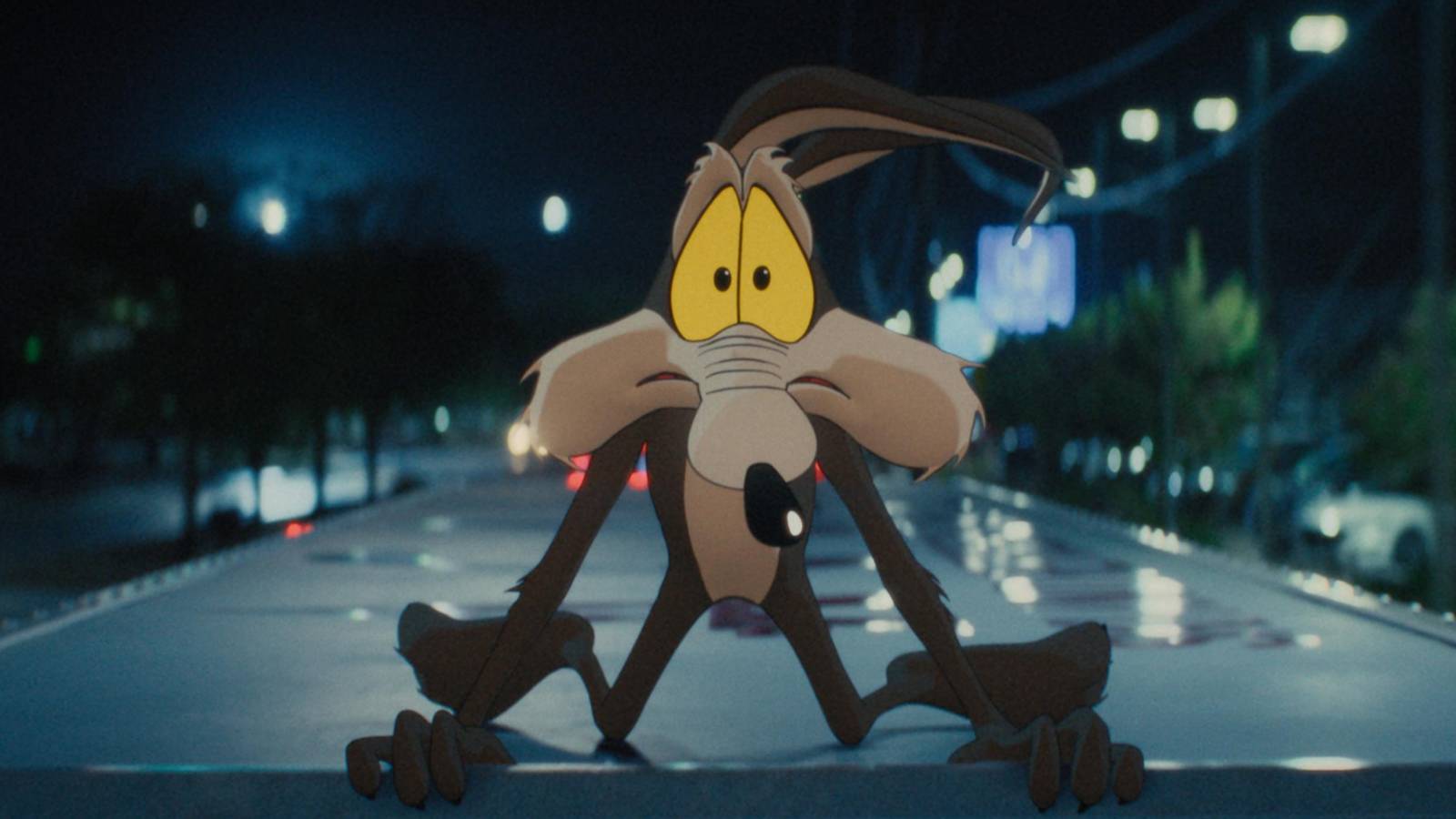
Coyote vs. Acme’s hero’s tale was originally inspired by a satirical New Yorker article, brought to the studio by James Gunn before he was the co-chairman and co-CEO of DC Studios. What began as “very dry, wry legalese” was adapted by screenwriter Samy Burch into a story “about the fight and the plight of the underdog,” Wile E. Coyote, who just can’t seem to achieve his dreams (i.e., “Road Runner stew”). When he discovers attorney Kevin Avery’s (Will Forte) ad on TV, it prompts Wile E. to go after the source of his failed attempts — ACME Corporation. The movie also stars John Cena and Lana Condor, with Bauza providing the voice of many iconic Looney Tunes characters, including Bugs Bunny.
Don’t miss out on the full conversation in the video above, where Green and Bauza reflect on the rollercoaster release of Coyote vs. Acme, and getting to reunite with the team that brought this animation and live-action hybrid to life on screen. They discuss Gunn’s role in the production, stepping from writer to producer, Ketchup Entertainment’s championing of filmmaking, and taking inspiration from the 1988 masterpiece, Who Framed Roger Rabbit.
Dave Green and Eric Bauza Reflect on ‘Coyote vs. Acme’s “Wild Journey” to Theaters
“It’s happening right now, and I still don’t believe it.”
COLLIDER: Dave, this has to have been the most insane last few years, because it was coming out at Warner Bros., but then Warner Bros. dumps it, and then it’s for sale, but now it’s not for sale, and then it’s for sale. What has this been like for you?
DAVE GREEN: It has been a wild journey, I gotta say. But, look, I’m thrilled that we get to talk today. The fact that we get to talk today is a miracle, and I still don’t believe it. It’s happening right now, and I still don’t believe it. It’s incredible. It honestly just speaks to the resilience and the passion of the fan base, and the fact that people really spoke out on our behalf and stood up for the movie and stood up for these legacy characters that have existed for 80 years. It is incredibly moving on a personal level. It overwhelms and blows me away.
What was it like when you got the call that Ketchup Entertainment was going to pick it up and distribute it?
ERIC BAUZA: He knows more about that than I. I usually just rely on what the press puts out there, and I just follow orders, as a performer in the film would. You kind of just are at the beck and call, waiting to hear what the next news is or what the next steps are. And again, to be able to sit with you here among your colleagues and see the other performers here today is something else.
GREEN: It was crazy. I think there was a lot of disbelief at first. I got a phone call 24 hours before you read about it in the press, basically, and I spent that day not believing. And I think I spent the next three months not believing. But it’s really happening, and it feels real right now.
BAUZA: I had an experience with Ketchup Entertainment with The Day the Earth Blew Up. It was done on a much smaller-scale budget, as it was made for Warner Bros. televised animation, but they came out of the woodwork to make sure it was distributed in a very limited run in the animation festival circuit, as well as Video on Demand and streaming. But I remember being at the WGAs presenting, and I made a joke. I was like, “Hey, if you watch this movie, who knows? Maybe Ketchup will get Coyote vs. Acme out of the vault.” And I was like, “Maybe I shouldn’t have said that.” I’ve said so many things in the past couple of years…
GREEN: Speaking of things I shouldn’t say, I heard a rumor from your co-star, Candi Milo, who plays Granny in the movie, and Witch Hazel. Before I heard about the official news, she told me about a Ketchup rumor, and I was like, “I can’t believe it.” She’s like, “I heard they were making the movie.” Sorry, I don’t want to get Candi in trouble.
BAUZA: No one will get Granny in trouble, for sure. Everyone loves Granny.
I truly appreciate what Ketchup Entertainment has done, and I will be forever grateful for them getting the movie into the theaters. One of the things that they’ve done so brilliantly is lean into “the film Acme doesn’t want you to see.” That marketing is fantastic. It’s a play on everything that’s going on. What was your reaction when you first saw that trailer and saw the way that they’re leaning into this?
BAUZA: It’s a little daring, but it’s part of the brand, too. Acme and Looney Tunes, especially in the history of animation, the Golden Age of animation — we’re talking about the ‘30s, ‘40s, ‘50s — they’ve always broken the fourth wall and turned the eye inward and made fun of themselves. How many times have we seen Daffy being thrown off the Warner Bros. lot for doing something stupid? It just kind of feels in theme with the whole movie itself. And like you said, life imitating art. It’s got its own built-in marketing.
GREEN: Exactly. Warner Bros. has always turned a mirror back onto itself.
BAUZA: They’re very self-deprecating. Obviously, we would have heard something by now if we were really in trouble. But thank goodness, here we are.
How Involved Was James Gunn on ‘Coyote vs. Acme’?
Gunn originally found inspiration for the movie from a “very dry, wry” New Yorker article.

James Gunn was involved in coming up with the story. I think his name gets a lot of people interested. What was James’s involvement in this, and was he involved at all once he saw a cut?
GREEN: Absolutely. Showing him the director’s cut of the movie was one of the highlights of the entire process. He was so supportive and so encouraging. He said so many nice things. It was really one of the biggest highlights of the entire show.
I’m pretty sure that James found the original New Yorker article that the movie was based on. I don’t know if you’ve read it, but it’s this hilarious satirical piece about if Wile E. were to sue Acme, would he have a good case? And it is five pages of very dry, wry legalese from Wile E.’s lawyer, Kevin Avery, talking about the numerous times that Wile E. has been burnt to a crisp or pushed off a cliff or smashed by a boulder, and Acme products have backfired in his face. That was really kind of the birthplace of the entire project, not just from a character point of view, but also from a tonal point of view.
Eric, you’ve done so many voices throughout your career. What’s the toughest voice on your vocal cords, or are they all tough?
BAUZA: They’re all oddly weird and tough in their own way. I think Bugs is tough because everyone knows that voice so well. Every individual has such a clear memory of how that’s supposed to sound, including myself as a kid who watched it on Saturday morning cartoons.
Vocally strenuous? Marvin the Martian is weird because I feel like I have an Adam’s pineapple after all the years of Martian speaking. Because you have to use these weird vocal cords, like the muscles. I have calves on my neck because of that voice.
And then there’s Daffy, who I always leave to last. If I’m recording scripts, there’s like three or four characters. Because he’s always at 11 for some odd reason. [In Daffy’s voice] “I’m just built that way! I don’t know.”
GREEN: Lot of screaming.
BAUZA: He has no ears. I don’t know. He likes to speak loud.
‘Who Framed Roger Rabbit’ Was a “Tonal North Star” for ‘Coyote vs. Acme’
“It’s a masterpiece.”

When watching this, you cannot help but think about Who Framed Roger Rabbit, and I would imagine that’s like the North Star when making a film like this. Can you talk about that impact on both of you? Did you ask the cast and crew before filming began to watch it again, just so you understand what perfection is to go after this?
GREEN: [Laughs] I would say it was absolutely a tonal North Star because that was the first hybrid animated movie for me. It’s a masterpiece, but it really showed that you could do darkness at the same time that you could do absolute stupidity. It was also wearing this genre cloak. It was a film noir. And I think the fact that the recipe of the movie was intercutting absolute stupidity with this absolute darkness, both in theme and tone and in subject matter, is what makes it special. That was my experience with that, for me. Yes, always a tonal North star.
BAUZA: [In Bugs’s voice] “And jumpin’ in without a parachute, kinda dangerous, ain’t it, Doc?” [In Mickey Mouse’s voice] “Yeah! You could get killed.” I mean, I have that cell in my living room. I have an animation cell of Bugs and Mickey. That’s like the holy grail for me. I’m sure my son will miss the first year of college or university because I bought it from his college fund, but I have almost over 10 animation cells from that movie in my house somewhere. I have the triple when Jessica goes from being Jessica Rabbit to, like, horrific, like that scary face that she makes.
I have to pause. How early on were you collecting these cells?
BAUZA: Oh my God, early-early. Even before I should have been. I should stop. In fact, I’m gonna leave.
GREEN: You gave me a Coyote/Roadrunner Clampett.
BAUZA: Yeah. In the movie The Mask, if you look at Stanley Ipkiss’s apartment, there’s the model sheet for Marvin the Martian and Bugs Bunny, and they also had one in that vein for Coyote and Roadrunner, and I gifted it to him after what was supposed to be the funeral screening of our film. I thought, “Oh, I might never, ever see Dave again. I might as well give it to him now.” I hope you’re not expecting more cells because I don’t know if I have any to give.
GREEN: I’ll just take some of the Roger Rabbit ones.
BAUZA: Okay. The Roger Rabbit one. For sure.
One of the things about this film is one of the main stars is silent, and you do such a great job with it. What is it like when you’re preparing for scenes, knowing that he is not going to speak and everything has to be conveyed with his face or with occasional signs?
GREEN: He’s one of the best comedians of all time, even though he never speaks a word. He came from Chaplin and Buster Keaton and these silent film actors. Those were sources for Chuck Jones and inspiration.
Our process was really like storyboarding the movie with story artists who challenged me on what Wile E. would think and want in every single scene. They would say, “Well, I don’t know if Wile E. goes out this door. What if he goes out that other door? What if he stands up here and he has dynamite now?” We just kind of bat ideas around until we were all laughing.
Then, on set, we had this legendary puppeteer named Dave Barclay, who was one of Jabba the Hutt’s puppeteers, and he was an incredible Henson legend. He showed the actors what Wile E. would be doing from take to take, and that was kind of how we had Wile E.’s presence on set.
‘Coyote vs. Acme’ Is a “True Underdog Story”
“A story like this only comes around once in a generation.”
Ultimately, this is a classic underdog story about a cartoon character fighting back against a massive corporation or conglomerate. Why do you think that specific theme resonates so deeply with modern audiences today?
BAUZA: [In Daffy’s voice] “Wait, this isn’t a movie, is it? I thought this was a documentary, to be honest.” I thought this was happening outside our windows right now. I mean, it just is what it is. The entertainment industry is always this pendulum that swings back and forth and will forever swing back and forth. How rough the ride is depends on who’s funding what or if companies break down and build themselves back up. It’ll always be that way.
But I feel like a story like this only comes around once in a generation. And I feel like the timing of it couldn’t have been more perfect with what’s happening out there, and how it was treated, and how it’s now going to be seen by lots of people, and seen where it should be — not on a shelf, but on a big screen. It’s pretty important.
GREEN: And it is a true underdog story. It’s about this character who wakes up every single day expecting to eat Roadrunner stew. That is his dream, and that is his passion, and yet at the same time, every single day, this gigantic corporation is working hard to squash his dreams. So, it’s really about the fight and the plight of the underdog, and this story is about how an underdog really never does lose his passion.
Coyote vs. Acme will officially hit theaters on August 28.

- Release Date
-
August 28, 2026
- Runtime
-
101 Minutes
- Director
-
Dave Green
Credit: Source link