
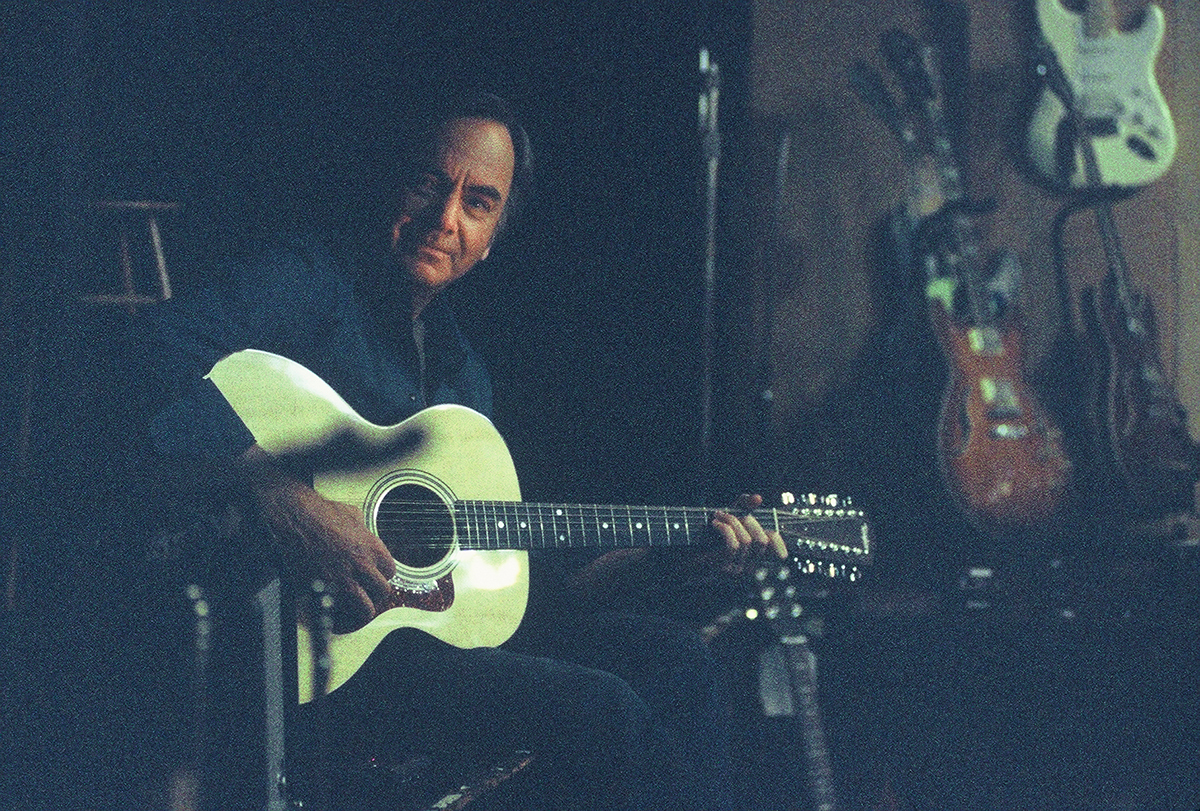
Neil Diamond, Photo: Martyn Atkins.
There are musicians who burn brightly and then burn out, and others whose light illuminates, not glaringly but satisfyingly, over time. Rarer are the artists who have successfully done both, having had their moments at the top, but were able, through adaptability or sheer craft, to then embark on a lower-profile yet rich later career. I’m talking about artists like Paul McCartney, Neil Young, Robert Plant and even the Black Crowes.
I would add to that short list Neil Diamond, someone who’s had his day in the sun most notably as a 1960s AM radio hitmaker who in the 70s went in a much slicker (or “schlockier”) direction.
But until his 2018 retirement, he never really went away. And as should be expected from an artist named to the Songwriters Hall of Fame and awarded two of the highest honors a songwriter can receive – the Johnny Mercer Award and the Sammy Cahn Lifetime Achievement Award – Diamond continued to write quality songs long after the spotlight largely subsided.
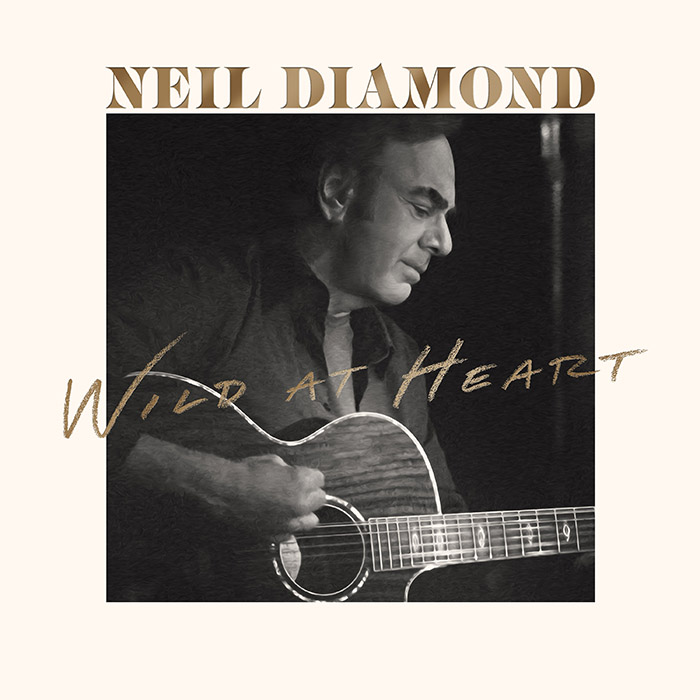
Such was the case with the nine “new” songs, and one reworked one, on new release Wild at Heart, the third and supposedly final album to come from Diamond’s 2006-’07 collaboration with famed producer Rick Rubin.
Diamond and Rubin approached these 10 songs with the kind of minimalism that in particular defined Rubin’s work with late-career Johnny Cash, notably on Cash’s cover of Nine Inch Nails’ “Hurt.”
The horns and strings that flesh out the sound on Diamond’s old hits like “Cracklin’ Rosie,” “Sweet Caroline,” “Solitary Man” and many others long engrained in the American psyche are absent here. Instead, it’s all acoustic guitars (Mike Campbell, Smokey Hormel, Matt Sweeney and Diamond himself), plus piano and an alternate keyboard here and there (by Benmont Tench) that, given the minimalism, put across surprising musical variety over 10 songs.
The fairly stark approach puts the focus squarely on the songs themselves, and on the man singing them. There are no grand gestures like “I Am, I Said,” or dramatic rave-ups like “Brother Love’s Travelling Salvation Show,” here. There also isn’t any glam among these songs. In each of them, Diamond addresses his subject matter – usually love – in a forthright and literate manner worthy of his abilities.
The songs, all between two-and-a-half and four minutes long, don’t need elaborate musical backing to work. Diamond was in his 60s when he sang these in a voice somewhat weary at times but direct.
“You’re My Favorite Song” is typical of what Neil Diamond gives us here. It’s a jaunty, modest little love song stating, “On the dance floor of my life, you’re my favorite song.” On “Talking It to Death,” Diamond begs a lover for a little less conversation: “Let’s just put the words away and play it/ From the heart that’s how we’ll say it/ Talking it to death won’t get it done.”
And it’s easy to imagine “The Secret You,” with its sparse (even for this album) keyboard backing, being sung onstage as part of some unrealized musical. It may have worked even in the actual Neil Diamond musical “A Beautiful Noise.” And the version of “Forgotten” here is an even more stripped-down version of that song on Diamond’s previous album with Rubin, Home Before Dark.
On the shuffle “You’re Getting to Me,” Diamond pledges that “You and me are here for the long haul.” He certainly has been, and on Wild at Heart, he proves his songwriting chops are still intact.
About The Author

Sam Richards is an East Bay journalist, a 27-year veteran of the East Bay Times and its predecessors. He now writes for the Rossmoor News, which serves an 11,000-population community in Walnut Creek, Calif. He’s been a contributor to the Piedmont Exedra in Piedmont, Calif., and has reported for Berkeley-based Bay City News Service/Local News Matters, and for newspapers in Missoula and Bozeman, Mont. and Tracy, Calif. Richards also has six Trains magazine bylines over the past 40 years.
Credit: Source link